By John Engel
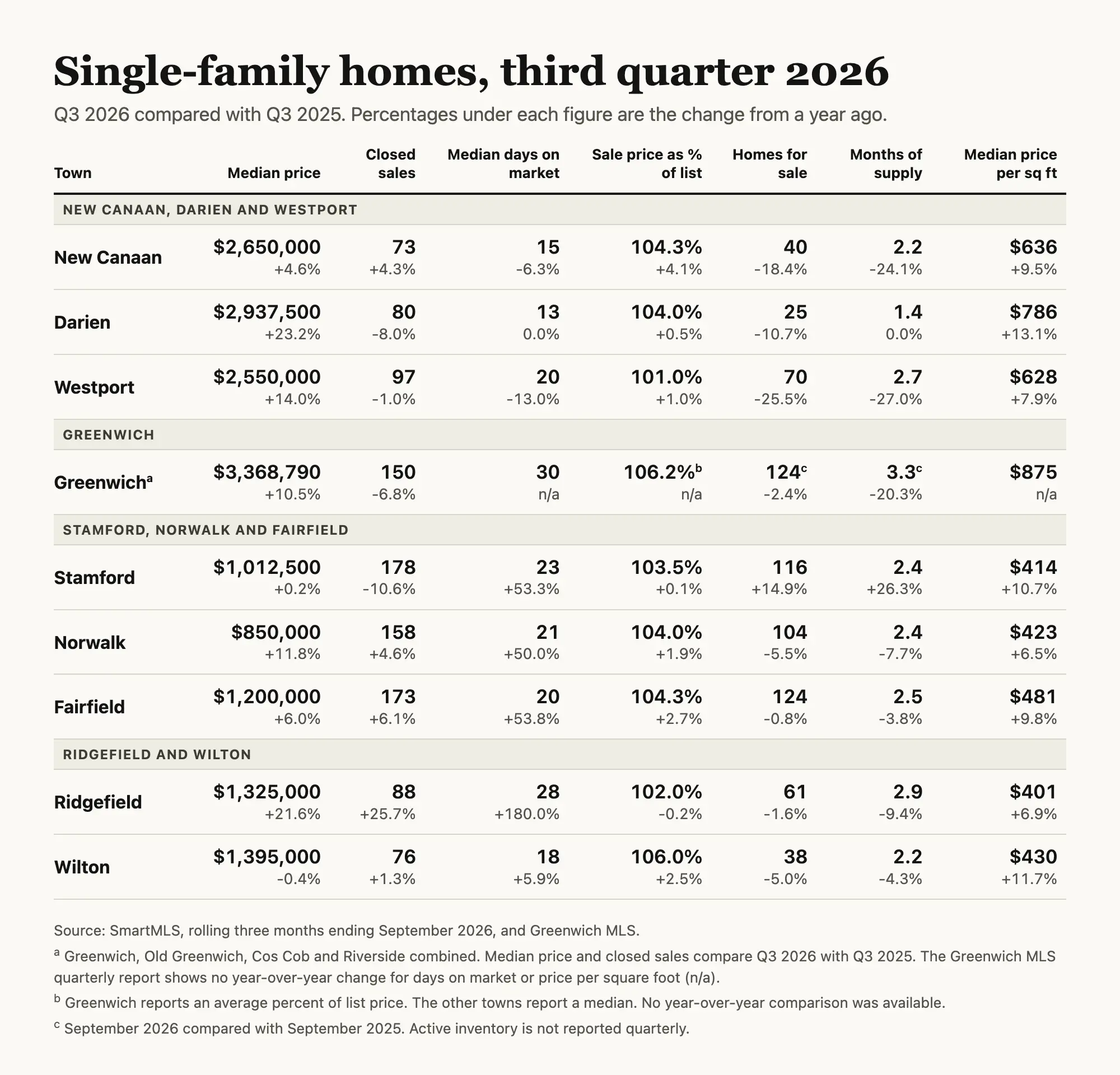
Across the nine markets, 1,073 houses sold from July through September, against 1,074 a year earlier.
In four markets, median days on market rose by 50% or more: Fairfield went from 13 days to 20, Norwalk from 14 to 21, Stamford from 15 to 23, and Ridgefield from 10 to 28. All four still closed above list price.
WHY? I think buyers became more selective. A house that is priced right and shows well still draws several buyers within days. A house priced above what buyers will pay, or one that needs work, sits for weeks. Both kinds sell in the same town in the same month, so both land in the same statistics. With carrying costs high, buyers are less willing to compromise, so they pass on the second kind and bid on the first. Days on market rose because more of the houses that sold had been sitting. Prices stayed above list because the right houses still sell that way.
Three towns converged. In the second quarter, Darien houses sold in a median nine days, New Canaan’s took 26, and Westport’s took 28. This quarter, the three are at 13, 15, and 20.
New Canaan had 40 houses for sale at the end of September, down 18.4%, yet sold 73 houses, up 4.3%, at a median 104.3% of list price. The median price rose 4.6% to $2,650,000, while the average fell 2.1%.
WHY? New Canaan appears to have worked through some of the pricing problem visible in the spring. With fewer houses to choose from and prices closer to what buyers would accept, competition returned. The median held up while the average fell, which suggests the mix of sales shifted away from the top of the market.
Darien’s median price rose 23.2% to $2,937,500, and its average rose 23.4%. Median price per square foot rose 13.1%. Darien had 25 houses for sale and 1.4 months of supply, unchanged from last year.
WHY? The median and the average rose by almost the same amount, so a handful of expensive closings does not explain the jump. Some of the increase probably comes from larger, pricier houses selling, since price per square foot rose about ten points less than the median. The rest appears to be buyers paying more per square foot. Darien was short of houses before the quarter began and stayed short, so sales fell 8% with very little to buy.
Westport had 70 houses for sale, almost three times Darien’s 25, and houses closed at a median 101.0% of list price against 104.3% in New Canaan. The median price still rose 14.0%.
WHY? Westport buyers had more houses to choose from than buyers in Darien or New Canaan, so they did not have to bid as aggressively, and prices still rose strongly.
Greenwich houses took longer to sell this quarter and still sold above list price. Median days on market was 30, up from 12 in the second quarter, and houses closed at an average of 106.2% of list price. The median price rose 10.5% to $3,368,790. Sales were 150, down from 161 a year ago, and new listings fell 39.3% from the second quarter.
WHY? Greenwich shows the same split as the broader market: Houses took considerably longer to sell, but the ones that sold still attracted aggressive bids.
Stamford sold 178 houses, down 10.6% from last year, while houses for sale rose 14.9% to 116. The median price was $1,012,500, up 0.2%.
WHY? Stamford accumulated inventory and lost sales. Months of supply, which is how long it would take to sell every house now listed at the current pace of sales, rose 26.3% to 2.4. Buyers did not absorb the additional houses, and the median price barely moved. Fairfield and Norwalk went the other way. Both sold more houses, up 6.1% and 4.6%, while inventory was flat in Fairfield and down 5.5% in Norwalk, and their medians rose 6.0% to $1,200,000 and 11.8% to $850,000. Stamford moved most clearly toward balance between buyers and sellers.
Ridgefield sold 88 houses, up 25.7% from last year. The median price rose 21.6% to $1,325,000, while median price per square foot rose 6.9% to $401. Median days on market nearly tripled, from 10 to 28, and houses closed at a median 102.0% of list price.
WHY? I think the mix of houses sold changed in Ridgefield this quarter. The median price rose about three times as much as the price per square foot, which points to larger or pricier houses making up more of the sales. Ridgefield’s market also broadened: 25.7% more houses sold, including houses that took considerably longer to find a buyer.
Wilton sold 76 houses. The median price was $1,395,000, down 0.4%, yet median price per square foot rose 11.7% to $430. Houses closed at a median 106.0% of list price, the highest of the eight towns outside Greenwich.
WHY? Wilton’s flat median disguises what buyers were paying. Price per square foot rose 11.7% even though the median sale price fell 0.4%, which suggests that smaller houses made up more of the sales this quarter while buyers paid substantially more for the space they bought.
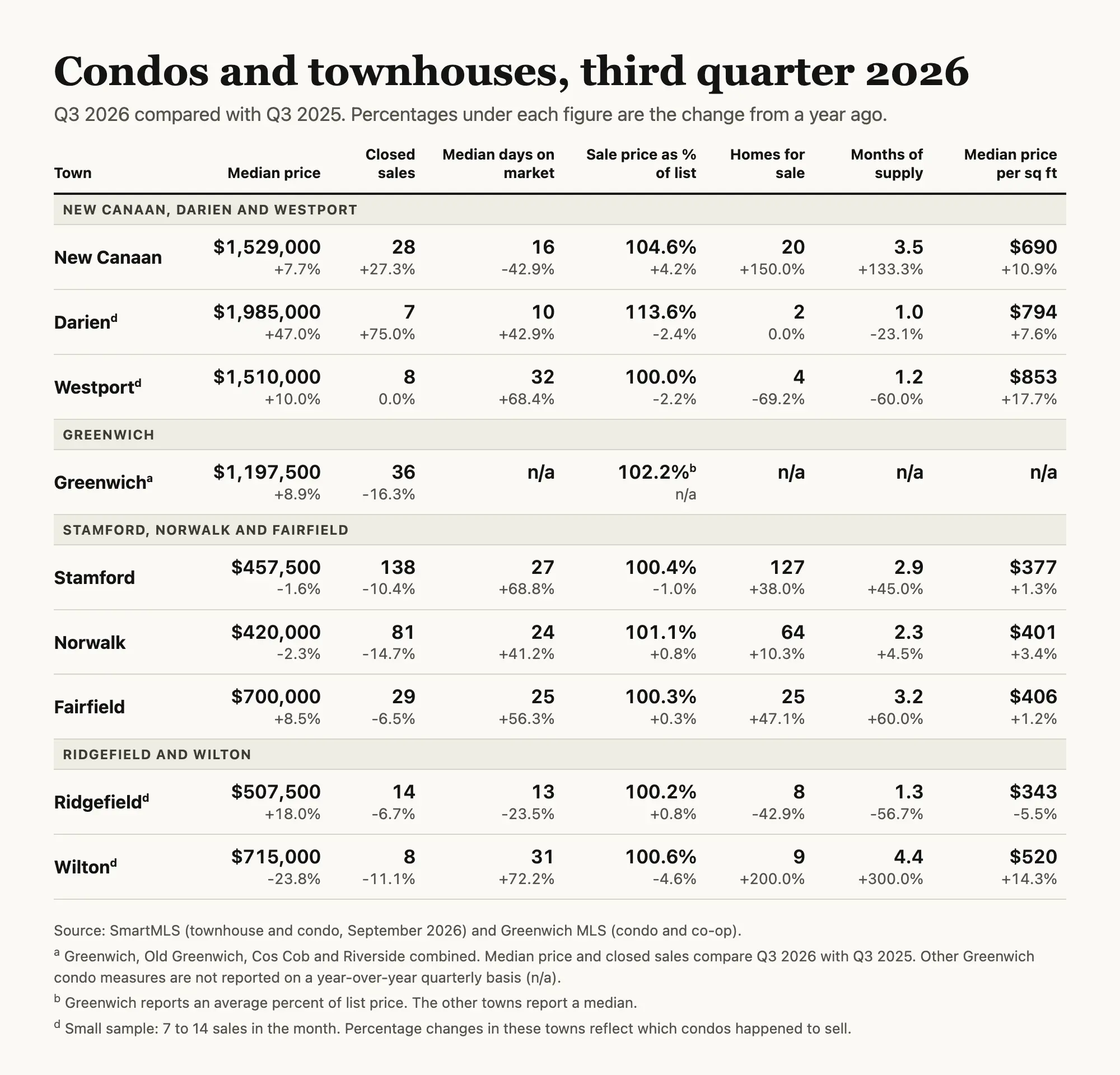
Stamford, Norwalk, and Fairfield made up 248 of the 313 condo sales in the eight SmartMLS towns. Sales fell in all three, with Stamford down 10.4% to 138. Condos for sale rose in all three, with Stamford up 38.0% to 127 and Fairfield up 47.1% to 25. Median prices held.
New Canaan went the other way. It sold 28 condos, up 27.3%, even though the number for sale rose from 8 to 20. Days on market fell from 28 to 16, and condos closed at a median 104.6% of list price.
WHY? New Canaan absorbed the additional supply. Unlike Stamford, Norwalk, and Fairfield, more inventory in New Canaan was met by more buying rather than fewer sales and longer marketing times.
Darien, Westport, Wilton, and Ridgefield each sold only 7 to 14 condos, too few to read. Swings like Darien’s 47.0% rise on 7 sales come from which condos happened to sell. In Greenwich, 36 condos sold, down from 43 a year ago.
Looking ahead, rates are the clearest piece of the outlook. According to Freddie Mac, the 30-year fixed-rate mortgage averaged 7.28% as of October 1, up from 7.03% the week before and 6.34% a year ago.
The fourth quarter will begin to show the effect. Contracts signed in the coming weeks will close in November and December at these rates. Buyers who passed on mediocre or overpriced houses this quarter have even less reason to compromise now. I expect the penalty for getting the house or the price wrong to increase, with longer marketing times and more pressure to cut prices. If supply remains tight, the houses priced right can still draw multiple offers and sell above asking.
Spring depends on whether sellers come out. If inventory stays as thin as the 1.4 months in Darien and 2.2 months in New Canaan this quarter, spring could bring the same two-track market: fewer buyers able or willing to pay these rates, but too few houses to give the remaining buyers much leverage.
I can’t say how the election, the wars, energy prices or interest rates will resolve, and neither can anyone else. What the third quarter does tell us is that buyers became more selective and stayed in the market. The market took longer to decide.
John Engel is a broker on The Engel Team at Douglas Elliman in Connecticut, and he plants bulbs with an auger on a cordless drill. Bow drills date to the Neolithic period and were common in Egypt, but it took till 1943 when a Kansas farmer dug one hole per minute and charged 10 cents apiece. Daffodil bulbs cost 60 cents apiece and there’s a thousand of them to plant. A thousand holes at a minute apiece is almost 17 hours. I’ll be done by Saturday.