By John Engel
Consider the Hermès Birkin bag, one of the world’s most expensive and coveted handbags. It takes five years to train an artisan, and another 18 to 24 hours to make the bag. Each bag is constructed by a single craftsman. A standard Birkin 30 sells for $22,300, while Jane Birkin’s original bag sold at Sotheby’s in July 2025 for $10.1 million, setting a world record for a handbag.
You can buy a handmade, full-grain leather handbag with solid brass hardware from BagmakerStudio on Etsy for $399.
So what exactly are you paying for? The craftsmanship? The time invested? The Hermès name? Or the scarcity that makes owning one such a prize?
It’s a question we’ve been asking since the Industrial Revolution.
In 1851, London’s Great Exhibition celebrated the wonders of industrial manufacturing. John Ruskin worried about what mechanization was doing to craftsmanship and the people who practiced it. William Morris carried those ideas forward, helping inspire the Arts and Crafts movement. In 1888, the Arts and Crafts Exhibition Society championed handmade work and required exhibitors to identify its makers.
In 1899, economist Thorstein Veblen offered a cynical explanation in The Theory of the Leisure Class. He argued that machine-made goods were often superior, yet handmade goods commanded higher prices because they signaled wealth and social status. He called it “conspicuous consumption.”
The little imperfections in a handmade object demonstrated that somebody had spent considerable time making it. The expense itself became a mark of distinction. The imperfections had to be just right, however. Too much irregularity suggested incompetence; too little suggested a machine.
Apparently, even in 1899, appreciating expensive imperfections required training.
A century later, researchers found another explanation. In a 2015 study published in the Journal of Marketing, Christoph Fuchs, Martin Schreier, and Stijn van Osselaer discovered that consumers associate handmade products with the love and care of their makers.
In one experiment, consumers were willing to pay 17% more for soap described as handmade. The preference was particularly strong when people were buying gifts for loved ones. The effect persisted even when the buyer didn’t know the person who made the object.
I once owned a 1958 Porsche 356 and was fascinated by the documentary Made by Hand, showing craftsmen building these cars in Stuttgart around 1960. The original 356 bodies had been hammered into shape in Austria in 1948, using wooden forms to guide the complex curves. By the time my Porsche was built, those curves were stamped into steel, while much of the fitting and assembly remained handmade.
Rolls-Royce has taken a different path. According to the company, its average selling price rose from less than $300,000 to more than $500,000 over a decade, driven by increasingly elaborate personalization. Customers commission bespoke interiors and finishes created by skilled craftsmen alongside sophisticated automated manufacturing.
Meanwhile, even identifying a handmade product has become complicated. Etsy, founded in 2005 as a marketplace for handmade and vintage goods, introduced classifications in 2024, distinguishing items made by, designed by, handpicked by, or sourced by sellers.
Artificial intelligence presents a further challenge. A University of Chicago Booth working paper found that buyers in four experimental auctions paid less for art when they were told AI had been involved in its creation. Yet a study published in Frontiers in Psychology in January 2025 found that participants preferred AI-generated artwork when they didn’t know which works were made by humans.
Apparently, knowing who made something can change how much we value it.
Hinckley Yachts, the Maine boatbuilder, combines modern composite construction with traditional woodworking. One proposal described in an Instagram video from @ smallbizrider would have veteran craftsmen wear Meta smart glasses to record their work. AI could turn those recordings into a searchable archive, allowing apprentices to follow demonstrations of particular tasks, such as fitting a teak rail.
The idea is to preserve the skills of craftsmen whose knowledge has traditionally passed from one generation to the next through years of apprenticeship.
Over 175 years, handmade craftsmanship has represented protest, status, emotional connection and, increasingly, proof of human origin.
American homebuilding remains remarkably dependent on skilled labor. According to the National Association of Home Builders, modular and panelized construction accounted for just 3% of new single-family home completions in 2024, down from 7% in 1998. The vast majority were built using conventional construction methods, relying on carpenters, masons, electricians, plumbers, and other skilled tradespeople.
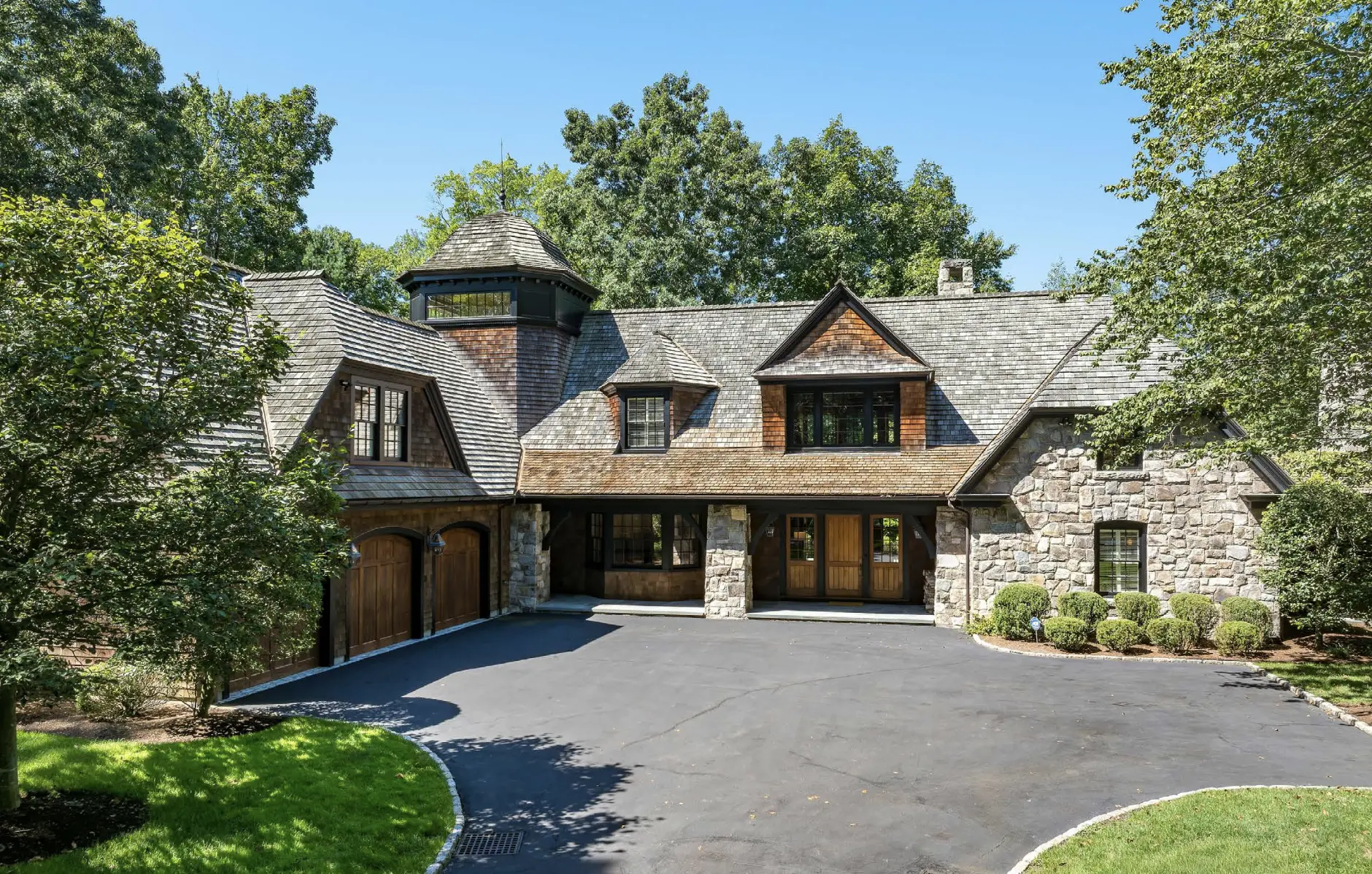
Yet we rarely describe an ordinary new house as handmade. We reserve that description for particular details: hand-cut stone, plaster moldings, restored windows, custom millwork, wide-plank floors, and cedar roofs.
My mother always remarks, “This is such a beautiful street,” when we drive down White Oak Shade Road. I’m convinced it’s the old handmade barns. They lend character to and elevate the entire neighborhood.
And consider New Canaan’s stone walls. We all remember the controversy at Merritt Village on Park Street in 2019, when the developer defended concrete retaining walls designed to resemble the traditional stone walls lining our colonial-era streets. Our most expensive houses often feature magnificent handmade stone walls, usually a little straighter, a little taller, and better maintained than their counterparts in the woods.
Consider the cedar roof. The variations in the shingles are part of its charm. They develop character as they weather, but installing them costs $600 to $1,430 per roofing square. A local roofing contractor estimates another $500 to $1,000 for maintenance treatments every two to three years.
Veblen would recognize the appeal immediately.
Quarter-sawn oak floors are cut to reveal a distinctive grain, at the expense of more waste at the sawmill. In 20 years, nobody has asked me for quarter-sawn oak floors. A seller can spend a fortune on craftsmanship that most buyers never recognize.
Scott Hobbs, of Hobbs, Inc., is restoring a midcentury modern house, and one non-negotiable requirement is preserving the original wood. Why? Though a replacement might be equally handmade, the house is said to lose something of its identity without the original material. Car collectors who covet “matching numbers” understand this instinctively. It’s rarer in houses, where almost nothing is numbered or signed. This is, I suppose, the exception.
True divided-light windows have individual panes of glass separated by muntins. They’re more expensive to make, and their appeal is largely aesthetic, recalling the antique windows we grew up with. Unlike quarter-sawn oak floors, divided-light windows are a requirement for many homebuyers today, and builders have responded. Many buyers eschew simulated divided lights, insisting on the real thing.
As a Realtor, I’ve seen handmade details span the entire range of value. Murals hardly ever add to the sale price, while stone walls nearly always do. Handmade tiles and hand-painted wallpaper are personal choices, and their value depends on whether the next owner shares the seller’s taste. To borrow from Veblen, sometimes the consumption is too conspicuous.
Lighting fixtures offer another opportunity for creative expression. Unlike tiles and wallpaper, they can be swapped out. A great handmade fixture is appreciated by buyers and often excluded by sellers, since a good one is expensive and difficult to replace. It’s ironic when we spend millions building new houses, then search for rewired antique chandeliers or new fixtures designed to look handmade.
For sellers, craftsmanship can be an asset, an expensive indulgence, or something the next owner intends to remove. The more personal the choice, the less certain the return.
We began by asking what handmade is worth. After 175 years of improving machines, we’re still willing to pay a premium for the work of human hands. The interesting question is how much, and for whose hands.
John Engel is a broker on The Engel Team at Douglas Elliman. As the weather turns to Fall, he remembers YMCA Indian Princess camping weekends with his three girls. Handmade leather wallets, drip candles, friendship bracelets, tie-dyed T-shirts, birdhouses, and painted pottery. The memory of the hand-making: priceless, to him.