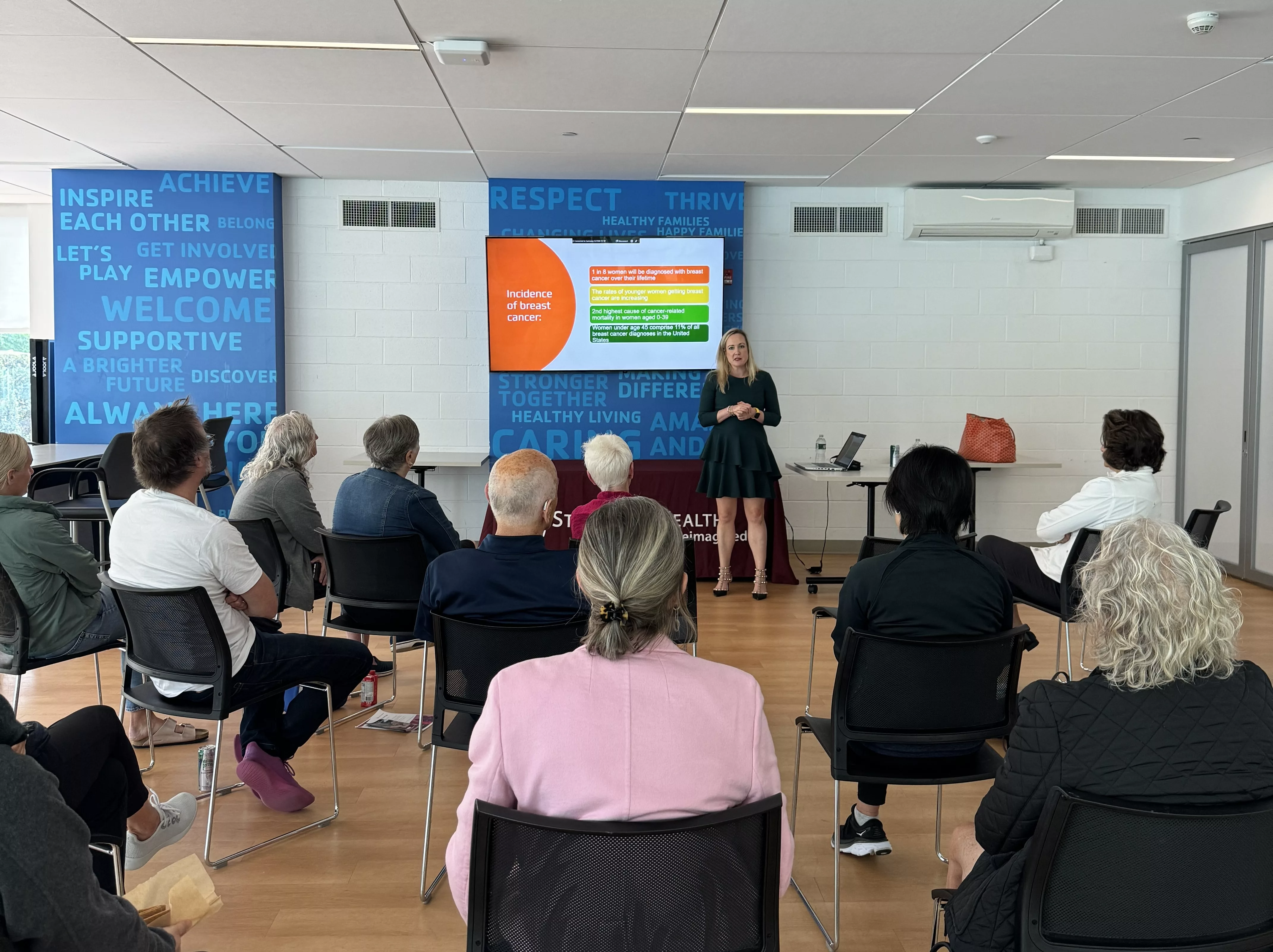
In recognition of Breast Cancer Awareness Month, the New Canaan YMCA hosted a lecture in partnership with Stamford Health, featuring Dr. Sarah Cate, the Chief of Breast Surgery at Stamford Hospital. The event aimed to provide vital information on breast cancer, addressing prevention, risk factors, and treatment options. It was an effort not only to educate but also to support individuals navigating the complexities of breast cancer, either directly or through loved ones. Mary Coleman, a familiar face at the YMCA and former Membership Director, introduced Dr. Cate and shared her personal story of resilience, having undergone breast cancer treatment earlier this year at Stamford Hospital under Dr. Cate’s care. Coleman spoke candidly about the experience, noting the compassionate environment and the exceptional care she received, which helped ease the burden of her diagnosis.
Dr. Cate began her lecture with sobering statistics: one in eight women will be diagnosed with breast cancer over the course of their lives. The incidence of breast cancer among younger women is also rising, with the disease now standing as the second leading cause of cancer-related deaths among women under the age of 39. Approximately 11% of all breast cancer cases in the United States occur in women younger than 45, underscoring the urgency of increasing awareness and early detection efforts. Dr. Cate emphasized that while the overall survival rate for breast cancer has improved significantly over the past few decades, early diagnosis remains crucial, especially for younger women who may not consider themselves at risk.
The presentation delved into the biology of breast cancer, explaining that it originates from the cells of the breast tissue and can manifest in various forms, including hormone receptor-positive, HER2-positive, and triple-negative breast cancer, each with distinct biological behaviors and treatment responses. Dr. Cate pointed out that understanding these subtypes is essential for guiding treatment decisions and that personalized medicine is now at the forefront of breast cancer care.
Dr. Cate detailed numerous risk factors associated with breast cancer, such as family history, genetic predispositions (e.g., BRCA1 and BRCA2 mutations), lifestyle factors, and hormonal influences. She emphasized that while some risk factors, like age and genetics, are beyond an individual’s control, there are modifiable factors—such as diet, physical activity, and alcohol consumption—that can significantly impact one’s risk. Women with a family history of breast cancer or known genetic mutations may benefit from genetic counseling and more aggressive screening strategies.
One of the central points Dr. Cate highlighted was the importance of regular mammograms. She advocated for annual screenings starting at age 40 for women of average risk. For those considered high-risk, earlier and more frequent screenings may be necessary. Stamford Health’s high-risk program provides comprehensive screening and monitoring for individuals identified as having an increased likelihood of developing breast cancer, incorporating advanced imaging techniques and personalized risk-reduction strategies. Dr. Cate also discussed the role of newer screening technologies, such as 3D mammography, which can improve the detection of cancers in dense breast tissue.
The lecture provided an overview of the various treatment modalities available for breast cancer, which typically involve a combination of surgery, chemotherapy, radiation therapy, and endocrine (hormonal) therapy. Dr. Cate underscored the importance of a multidisciplinary approach in breast cancer treatment, where specialists from different fields collaborate to develop a tailored plan that addresses the unique characteristics of each patient’s disease.
Stamford Health offers a range of innovative treatment programs, including:
Cold Capping: A technique used to reduce hair loss during chemotherapy by cooling the scalp, thus minimizing the amount of chemotherapy that reaches the hair follicles.
Clinical Trials: Stamford Health collaborates with renowned institutions like Dana Farber to provide access to clinical trials, offering patients cutting-edge therapies that may not be widely available.
Integrative Medicine: To complement traditional cancer treatments, integrative medicine services such as acupuncture, yoga, and massage therapy are offered, aiming to alleviate side effects and improve patients’ quality of life.
Psycho-Oncology Services: This specialized form of therapy addresses the psychological and emotional aspects of cancer diagnosis and treatment, offering support for patients and their families.
The Young and Strong Program: Focused on younger breast cancer patients, this program aims to meet the unique needs of premenopausal women, addressing concerns such as fertility preservation, body image, and long-term survivorship.
The event at the New Canaan YMCA highlighted the longstanding partnership between the YMCA and Stamford Health, which has spanned over a decade. This collaboration has brought numerous health and wellness services to the community, including on-site wellness coordination, physician referrals, blood pressure screenings, expert health lectures, and physical therapy services. Both organizations share a commitment to enhancing the health and wellbeing of residents in the region.
For further information about breast cancer care at Stamford Hospital, visit www.stamfordhealth.org.