By Rev. Msgr. Robert Kinnally
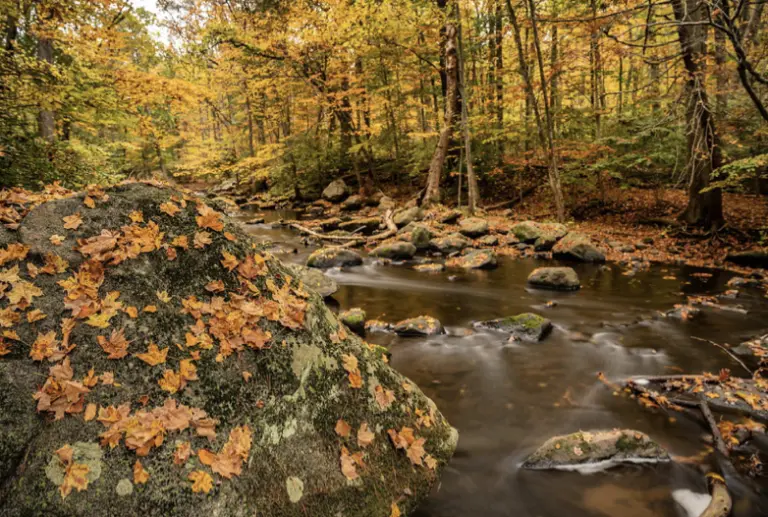
As we move into another New England autumn, I think of poet Gary Soto’s “October,” a vividly descriptive work that paints the scenes of a season of change and anticipates winter reflected in the dark eyes of a crouched coyote. Here’s the poem in its entirety:
OCTOBER
A cold day, though only October,
and the grass has greyed
like the frost that hardened it
This morning.
And this morning
After the wind left
With its pile of clouds
The broken fence steamed, sunlight spread
Like seed from one field
To another, out of a bare sycamore
Sparrows lifted above the ridge.
In the ditch an owl shuffled into a nest
Of old leaves and cotton
A black tassel of lizard flapping
From its beak. Mice
And ants gathered under the flat ground
And slipped downward like water,
A coyote squatted behind granite,
His ears tilting
Toward a rustle, eyes dark
With the winter to come.
Change is a bit easier when there is a smooth transition. Every September I say that summers are getting shorter. The truth is that summers are the same length; the sense of brevity comes from the desire to hold onto the slower pace, the extended daylight, the restful afternoons at the water’s edge, and the rejuvenation that comes from time away from the fray. September rushes in and everything starts up and we say things like, “Before you know it December will be here.” Autumn carries us gently toward whatever winter will be. As leaves change, a brilliant red-orange burst reminds us that even in leafy death there is a glorious reality. And so it goes with God who in our journey to the winters of life (illness, aging, struggle, darkness) gives us additional light each day and with that the promise of an even brighter and robust spring.
In Gary Soto’s poem, God’s creatures prepare to hunker down and settle into a time of fewer resources and a pervasive coldness, when leaves and the soon-to-be frozen earth will serve as a temporary home. In our life with God, autumn offers an opportunity to rejoice in the gift of a refreshing summer and of a good harvest of grace and blessings that can be life-giving in the dead of winter. As leaves fall and the angle of the sun shifts to provide a stronger glow, we are reminded that even in the greying of the green, the Son still shines brightly on creation. As growth subsides in nature, the God of Creation never stops creating, and perhaps this autumn is a time for each of us to work with God who desires to continue fashioning us into who we are meant to be. Maybe this autumn as the trees let go of their dead leaves, we will “die to self that we may truly live.” (see Luke 9:23, Romans 12:2, Galatians 2:20). Maybe this autumn we will soften our own hearts so that we can warm the frost that stifles relationships. Maybe this fall we will rise to the occasion offered to us by God to use the rich harvest of gifts and talents we possess to ease others out of their winters of discontent.
The other evening, I was privileged to witness an exquisite show of color at sunset. The performers appeared in layers of rose and orange with a curious bright green cushion as the foundation. The rows of colors slowly moved about and eventually disappeared one at a time leaving the town in a dark-blue and black blanket that signaled the official sunset time. It was a God-show for sure because none of us could paint it as brilliantly, and none of us could offer something like the light of the moon as a reflection of the sun and the assurance that the light only fades – it’s doesn’t go away. In Gary’s poem, winter is an ominous promise through the “dark eyes” of the coyote and light disappears in those dark eyes. However, in our life with God and one another, we must always remind ourselves that God doesn’t go away, and that even in the shorter days ahead, God longs to stay with us giving us light and warmth through His love.
In describing the Incarnation – God breaking into the world as the “Word made Flesh” – the Gospel of John situates that truth in terms of light and darkness:
In the beginning was the Word, and the Word was with God, and the Word was God. He was in the beginning with God. All things came to be through him, and without him nothing came to be. What came to be through him was life, and this life was the light of the human race; the light shines in the darkness, and the darkness has not overcome it. (John 1:1-5)
God who created the day and the night has given us a daily balance of light and dark. He has also fashioned for us a remedy for personal darkness: a life in God, a life in His Son. As we revel in the sights, sounds, and smells of Fall in New England, may our journey to winter be gentle, our days be filled with all the pumpkin spice that makes us happy, and our souls be enriched by moments of peace, joy, and love that come to us from friends who brighten each day. I pray that in our autumn we will relish the opportunity to act gently, spice up the dullness, and offer peace to one another.
Rev. Msgr. Robert Kinnally is the pastor of Saint Aloysius Catholic Church in New Canaan and the Vicar General of the Diocese of Bridgeport. In addition to his theological credentials, he has a master’s degree in English and American literature with a concentration in 20th century American poetry.