By Peter Barhydt
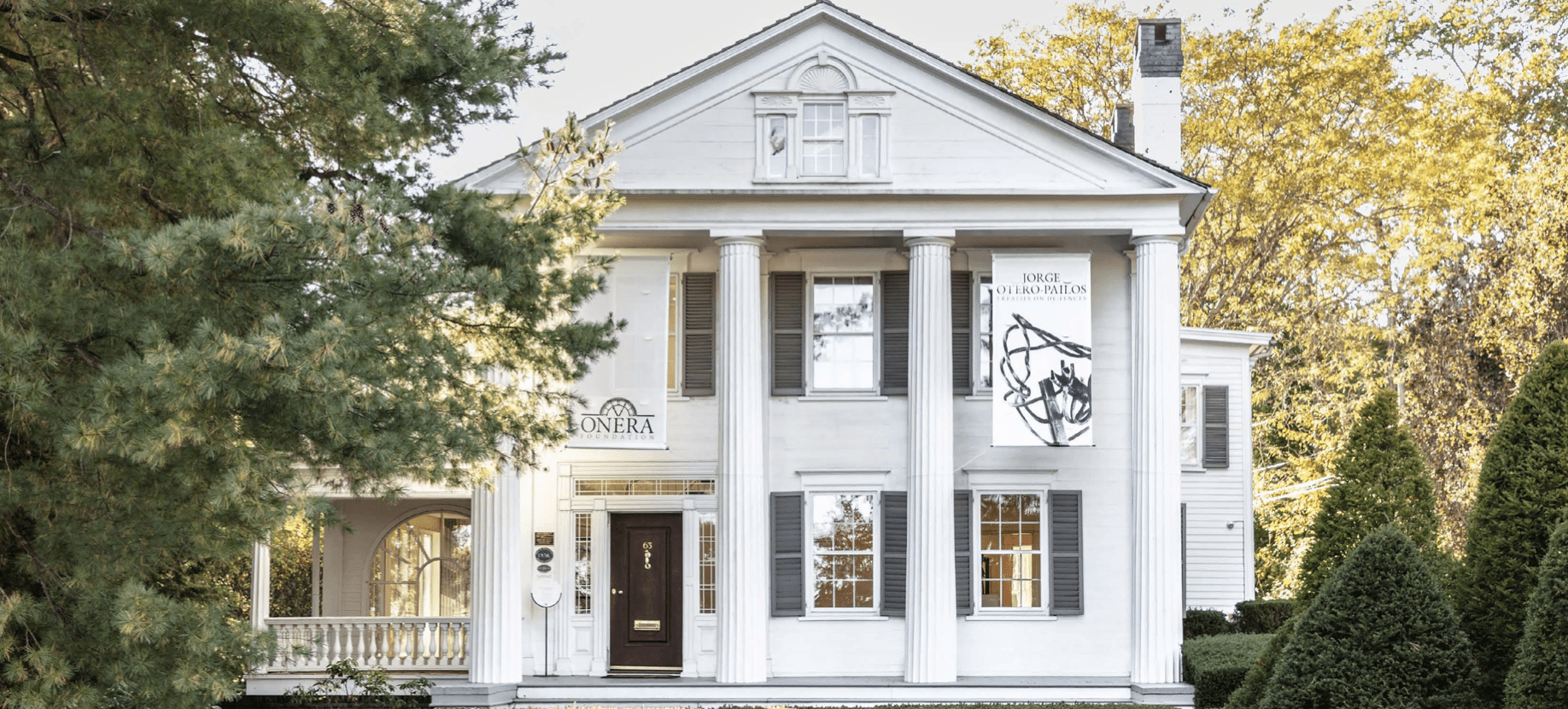
Walk up the garden path at 63 Park Street and you enter a new public room for New Canaan: a 19th-century home, restored with care, now dedicated to telling big stories about architecture, art, and diplomacy—stories that begin in American embassies and end at a neighborhood doorway that’s open, free, and intentionally welcoming.
“I’m the executive director of the foundation,” Laurence Lafforgue says by way of greeting. “I’ve been working with David Peterson, the founder of the Onera Foundation, for over a year.” Peterson, she explains, “founded the [foundation] in 2018 following a lifelong interest in supporting historic preservation… a preservationist, but also [a] philanthropist and a former finance person.” He wanted to “help educate and advocate for historic preservation in a way that was meaningful, approachable, and scalable.”
The effort is multi-pronged. One arm advances preservation practice through the Onera Prize. an annual $25,000 award that supports Columbia University’s Graduate School of Architecture, Planning, and Preservation’s students graduating from the M.S. Historic Preservation program to test new preservation theories and technologies in practice. Another arm extends to publishing. “He… turned his thesis into a large format book, very much image driven,” Lafforgue says. The topic—Embassies of the Cold War—opened archives to the general public: “this award-winning book brings together for the first time images that had never been seen before by the [general] public. They were sort of buried in university archives.”
But the third arm may be the most visible in New Canaan: a physical home where exhibitions and public programs make preservation more tangible to everyone. “[David] bought [63 Park Street] in 2018, [and] took about two to three years to go through restoration… This is our first exhibition here in this space.”
A House With Many Lives—And a
New One Now
From the street, the house reads as classical and calm. Inside, it carries the imprint of those who saved it. “We owe it to Richard Bergman and his wife, Sandra Bergman,” Lafforgue says. “They were the owner[s] of the house for 45 years… 1973 to 2018.” When Bergman—a local architect—took it on, “it was four apartments with four different kitchens.” He and Sandra “did all the hard work… restoring the place structurally, stabilizing it.”
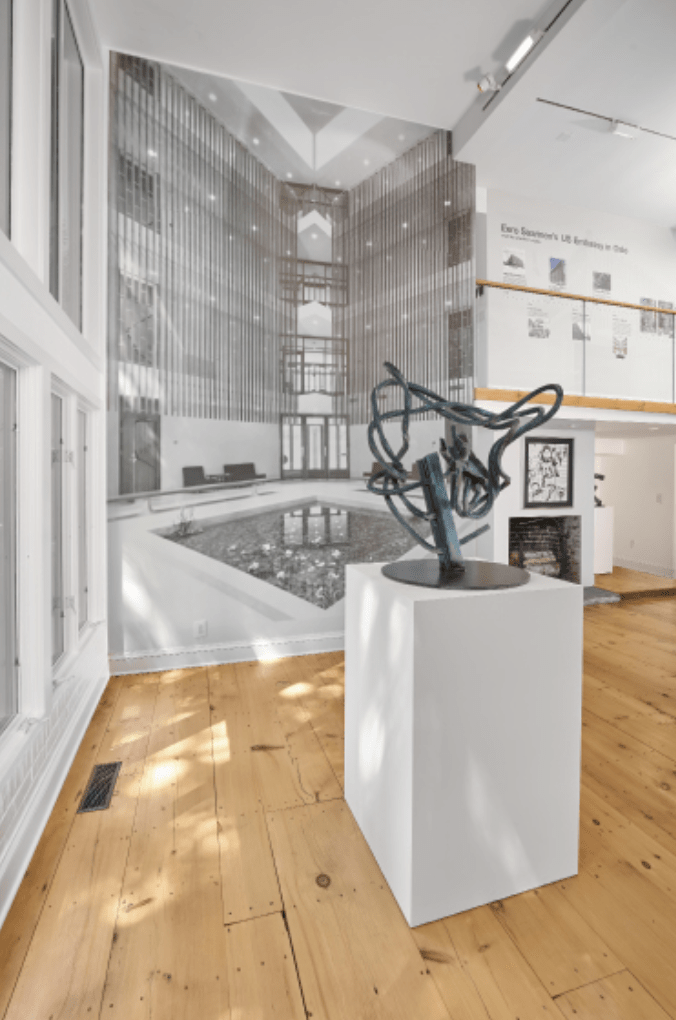
Peterson’s restoration made the home usable as a public venue. “What David did is uncover the floor, which is a historic 19th-century [pine]… and also, he opened up the… flow here by changing where the staircase lands… so you can really see from first floor down all the way to the garden, [and] make your way through.”
The garden—Bergman’s own modernist design—remains an essential chapter. “It’s pretty much as it is,” Lafforgue notes. “In fact, we have three sculptures from Richard that we just restored in the garden.”
For visitors, the on-ramp is simple: “This is a space that is going to be open Tuesday to Saturday, 12 to 5 pm—free,” she says. “We hope to bring [schoolchildren]. We hope to bring anyone… We want it to be as inviting as possible.”
An Embassy Fence Becomes Sculpture—and a Conversation
The foundation’s inaugural exhibition presents work by Jorge Otero-Pailos —“an artist and a preservation architect who also directs the preservation program at [Columbia] University,” Lafforgue says—whose long engagement with the U.S. Embassy in Oslo led him to a preservation riddle. After 9/11, a heavy, galvanized-steel security fence went up around the embassy; when the building was later restored to its mid-century character, “the fence… had to be taken down. And no one wanted it… So [he] thought, okay, what can we do about this material evidence of an important… moment as part of the story of the embassy?”
“He thought about [turning] it into art,” she says, “because art as its own ecosystem… allows you to tell a story to a public. It gets picked up through an ecosystem of museums and institutions.” Those ideas became 51 sculptures forged from the embassy fence itself: “They’ve been exhibited first in London at the Winfield House and in The Regent’s Park… then… here on Park Avenue… [and] the State Department at the National Museum of American Diplomacy.”
Six sculptures are on view in New Canaan, joined by prints, watercolor studies, and an artist’s book that folds into a triangle—“the shape of the embassy in Oslo”—with a mirrored base “where [you] could see yourself reflected in it, because the embassy is the embassy of the [people].”
Just as revealing is the process video: “It was all happening pretty much on site,” Lafforgue says. “The backhoe did the job… [Jorge] worked with very skilled Norwegian workers… He always says that 80% of the job was done on site while the fence was being taken down,” with the remainder composed and refined in the studio.
The prints borrow their titles from the treaties negotiated while the fence still stood—an effort to “parallel [the] work of a diplomat… [who] traces lines of text” with the “work of the architect[s] [who] trace lines of fencing or buildings,” Lafforgue explains. The point is perspective: “Jorge… always says how interesting [the treaties] are… They’re about more than war and peace… [including] space exploration… scientific cooperation and student exchange.”
One piece nearby is titled “Documentary Form,” after a treaty on best practices for sharing data. Another, “Holders of Local and Traditional Knowledge,” draws from an Arctic agreement. “You can imagine the amount of work that must have gone on diplomatically,” she says. At the National Museum of American Diplomacy showing—timed with NATO’s 70th anniversary—visiting diplomats recognized signatures on the prints: “Some of them saw their name… ‘I worked on this treaty.’”
Cold War Culture, New Canaan Connections
The exhibition extends beyond sculpture to a compact history lesson on America’s Cold War embassy program, which sought to counter Soviet cultural claims through architecture, art, music, and design. Lafforgue shows magazines, catalogs, and a map that make the point: “Time Magazine was reporting on it… [MoMA] curated [a] show on embassies… with the State Department.”
New Canaan’s link is direct. “There is… a connection immediately between the U.S. Embassy program and the Harvard Five,” she says, pointing to a pair of images: the Glass House interior by Philip Johnson and the Havana embassy interior by Harrison & Abramovitz. “Clearly the ideas that were percolating here made their way through…”
The theme continues: “You are looking at an incredible experiment happening in this town,” Lafforgue says—John Johansen and Marcel Breuer are among those who designed embassies abroad and who also lived and worked in New Canaan either during or earlier in their career. The buildings themselves keep finding second lives—landmarked, adapted into cultural centers, and newly interpreted for public use. “They’re fulfilling their mission even after they’re no longer in use,” she notes.
The House as a Teaching Tool
Upstairs and down, the building functions as its own case study. “We have a binder that looks at the entirety of the restoration that David did.” Photographs show the floors “buried,” the baseboards set higher than they should be “because those floors were buried at least [two layers deep].” In the kitchen—still fitted with mid-century appliances—students “felt like they were in a 1950s advertisement…” They were especially taken with a vintage Thermador microwave: “It still works, by the way.”
The restorations are documented in a binder with photographs of artifacts recovered during restoration—pottery, shells, even animal bones— evidence of the lower room’s life as an early cooking hearth. Reuse is visible everywhere: bricks once underfoot now line the back stair; salvaged planks from upstairs serve as treads on the new staircase. “[It’s] in the spirit of preservation… not throwing things away… [but] deciding on which period you want to highlight, and then finding ways to reuse what you’ve taken out so that it’s there.”
A wall timeline traces the house’s occupants: community school; rental; physician’s office; the arrival of Max Perkins (whose literary legacy helps explain the home’s listing on the National Register of Historic Places); and, finally, the long Bergman chapter that stabilized the structure and created the garden. “What I love about this house is that it has both a very classical architecture… [and] a modernist inspired garden… It shows you that great architecture is great architecture…” Lafforgue says.
Public Programs—and a Public Invitation
The foundation’s first season aligns with New Canaan’s October4design. “Now we hope to be a community resource first and foremost. That’s a very important goal,” she says. “We want to make sure that everybody knows it’s here and it’s available for everyone”. “Next year we are showing the work of artist Terrence Gower,” Lafforgue says. The attraction is obvious to her: “Artists… have a sense of wonder… It’s not surprising that many have gravitated towards those buildings because they are masterpieces.”
Why It Matters
The Onera Foundation believes that historic and significant American architecture is a vital part of the nation’s culture, worth protecting in the same way we do for other national treasures. Lafforgue is careful to define preservation. “Preservation is not necessarily about celebrating, but it’s about recognizing [significance] and saying, if it goes away, we have no more material evidence of that history,” she says. The Cold War embassy program, she argues, is a perfect example: buildings conceived to be open, light, and operate almost as public cultural centers became vulnerable when technology made proximity dangerous. Some were decommissioned. Some were adapted. Many still speak powerfully—especially when their stories are told with objects, images, music, and film that let people recognize themselves in the narrative.
“We hope people enjoy it and see the value,” Lafforgue says simply. For now, the doors are open, the floorboards are glowing again, and the garden—modernist and serene—leads you back to Elm Street with anew map in mind: from Oslo to Park Street, from treaties to prints, from a fence to a forum where anyone can walk in.
The Onera Foundation is open Tuesday through Saturday, from 12:00 PM to 5:00 PM. Visitors can schedule their visit and reserve a free timed-entry ticket through the Foundation’s website. https://www.onerafoundation.org/visit