By Sentinel Staff
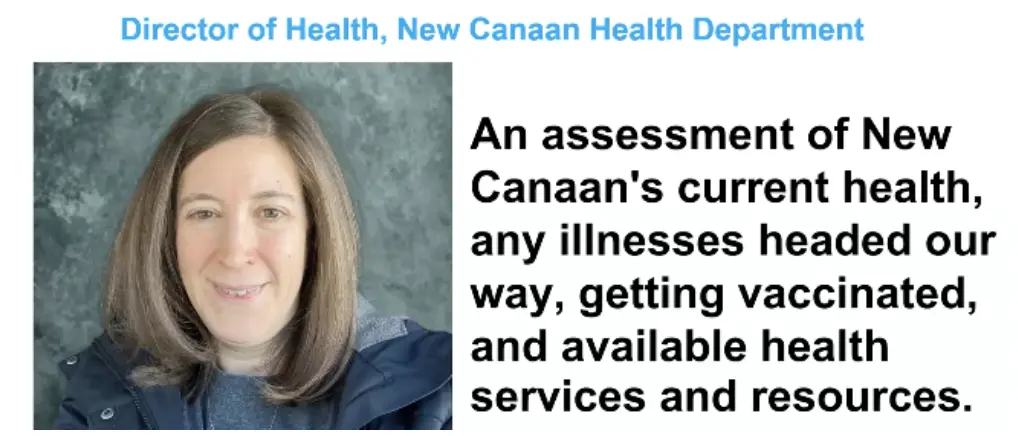
New Canaan’s new director of health, Amy Lehaney, used a Nov. 7 talk to the New Canaan Men’s Club to sketch the town’s overall health profile and explain how a small staff monitors everything from septic systems and wells to restaurant kitchens, disease outbreaks and mental health trends.
Lehaney, who joined New Canaan in June after serving as health director in Monroe and working in Bridgeport, Stamford and Fairfield, told members she is “super excited to come and be in New Canaan” and has “really enjoyed” her first five months. Trained in environmental science at St. Bonaventure University with a master’s in public health from Southern Connecticut State University, she described herself as a “working director of health” who still conducts inspections in the field.
She outlined a lean department headquartered at Vine Cottage on Main Street: herself as director, medical director Dr. Jaime Ruszkowski, administrative assistant and Phase 1 sanitarian Debra Katz, sanitarians and health program planners Shannon Vallerie and Kelsi McCarthy, and part-time public health nurse Ellen Samai. The team, she said, aims to function “behind the scenes” so that most of its work is invisible unless something goes wrong.
Much of the department’s effort falls under environmental health, which Lehaney called “the backbone of a small local health department.” In 2024, staff handled 92 septic permits, 142 septic plan reviews and 429 building-permit reviews tied to on-site sewage systems. For the many New Canaan homes on septic, the department conducts soil testing, percolation tests and inspections, and must sign off on building projects to ensure existing systems can handle additional bedrooms or finished space.
The department also regulates private wells and public drinking-water wells that serve multiple users, such as schools and camps. When a new well is sited, staff check that it can be protected within a 75-foot radius from nearby septic systems. Lehaney urged homeowners on wells to test their water at least every year or two, reminding the audience, “You are the water company when you own your well.”
Food and personal-care establishments form another large part of the workload. The Health Department licenses 104 food service establishments in town, from full-service kitchens to pharmacies that sell limited groceries, and inspects them between once and four times a year depending on risk level and population served. Each visit, she said, is “a snapshot in time,” and trends over multiple inspections give a truer picture of how an establishment operates. Inspectors focus on food temperatures, hand-washing, sourcing and storage, and spend extra time on cooling and reheating procedures, where serious errors are most likely. The department also oversees 43 licensed salons and 22 public pools, and responds to complaints about rental housing conditions, rodents, garbage, mosquitoes and hoarding, often in partnership with other town departments.
Community health programs are the public-facing side of the department’s work. Staff lead monthly Question, Persuade, Refer (QPR) suicide-prevention trainings at Lapham Center and the library, with McCarthy joining Vallerie as a certified instructor. The department runs health-education programs at Lapham and other venues on topics such as health literacy and understanding medical studies, and has expanded its presence on Facebook and Instagram to deliver timely guidance.
Lehaney highlighted a newer service: tick identification. Residents can bring ticks to Vine Cottage, where staff use a microscope to determine whether they are dog ticks, deer ticks or Asian longhorned ticks. Only deer ticks are sent to the Connecticut Agricultural Experiment Station for lab testing, which helps avoid overwhelming the state lab with samples that do not carry Lyme disease.
The department also offers basic clinical services. The public health nurse conducts screenings at Lapham and Vine Cottage for blood pressure, blood sugar, pulse oximetry and A1C, with the goal of early detection and referral to primary-care providers. Through the federal Vaccines for Children program, the town provides free vaccines for anyone under 18 so students can meet school requirements. Adult COVID-19 vaccination clinics that operated during the pandemic have ended because the town cannot bill insurers.
Disease surveillance occupies much of the department’s background work. Lehaney showed members a national wastewater surveillance map now tracking measles, one of several tools that grew out of COVID-19, and pointed to the state’s weekly respiratory disease report, which helps local health departments monitor COVID-19, influenza and RSV trends and hospital strain. Staff also use a secure state database to follow up on reportable conditions, especially foodborne illnesses such as salmonella, E. coli, campylobacter and norovirus.
When a resident is diagnosed with a foodborne illness, health officials interview them about what they ate and where they shopped in the days before becoming sick. Combined with lab comparisons of bacterial strains, those interviews help investigators link scattered cases to a single product, such as the recent listeria outbreak tied to frozen pasta. Locally, the department also investigates outbreaks linked to catered events or parties, interviewing guests and staff, reviewing menus and food handling, and sometimes collecting food samples.
Emergency preparedness and communication remain central responsibilities. The Health Department maintains plans for bioterrorism scenarios such as anthrax or smallpox, pandemic influenza and weather-related disasters. Lehaney said the department works closely with New Canaan’s emergency management officials and conducts drills to test call-down procedures and plans for large-scale vaccination or medication clinics. Residents are encouraged to sign up for New Canaan Alerts and to follow Health Department messages on town channels and social media.
Looking ahead, Lehaney said public health faces three notable challenges: erosion of trust, the return of preventable diseases and declining federal funding. Vaccine hesitancy, spurred by shifting guidance and misinformation, has spread beyond COVID-19 to long-standing interventions such as fluoridated drinking water. As an example, she cited Calgary, Canada, where officials removed fluoride from the water supply in 2011 and later saw a sharp rise in dental problems among children before voting to restore it this year. She also said measles cases have risen to more than 1,600 across 42 jurisdictions and that 2024 whooping cough cases were six times higher than in 2023, including two infant deaths in Louisiana.
During a question-and-answer session, Lehaney said New Canaan posts restaurant inspection reports in the town’s Documents on Demand system and urged residents to look at patterns over time rather than judging a single visit. She confirmed that Aquarion public water supplies are regulated and tested by the state, while private well owners should continue to rely on certified laboratories and use the Health Department for guidance.
She also outlined Connecticut’s current school vaccination rules. The religious exemption ended in 2021, with only medical exemptions now allowed for new students, and recent kindergarten and seventh-grade data show New Canaan schools above 95 percent coverage for the measles, mumps and rubella vaccine. Lehaney described close collaboration with Human Services, New Canaan CARES, the New Canaan Community Foundation and the New Canaan Behavioral Health Alliance on hoarding cases, short-term counseling and training in mental-health first aid.
Responding to questions about drought and lawn chemicals, she emphasized that wells in town vary greatly in depth and draw from different aquifers, making routine well testing important, particularly when irrigation is heavy or nearby properties use fertilizer. Asked about seasonal illness, Lehaney told members that respiratory disease activity was only beginning to rise but reiterated standard advice: the Health Department continues to recommend annual flu shots for all eligible residents, available through primary-care offices and local pharmacies.