 By John Engel
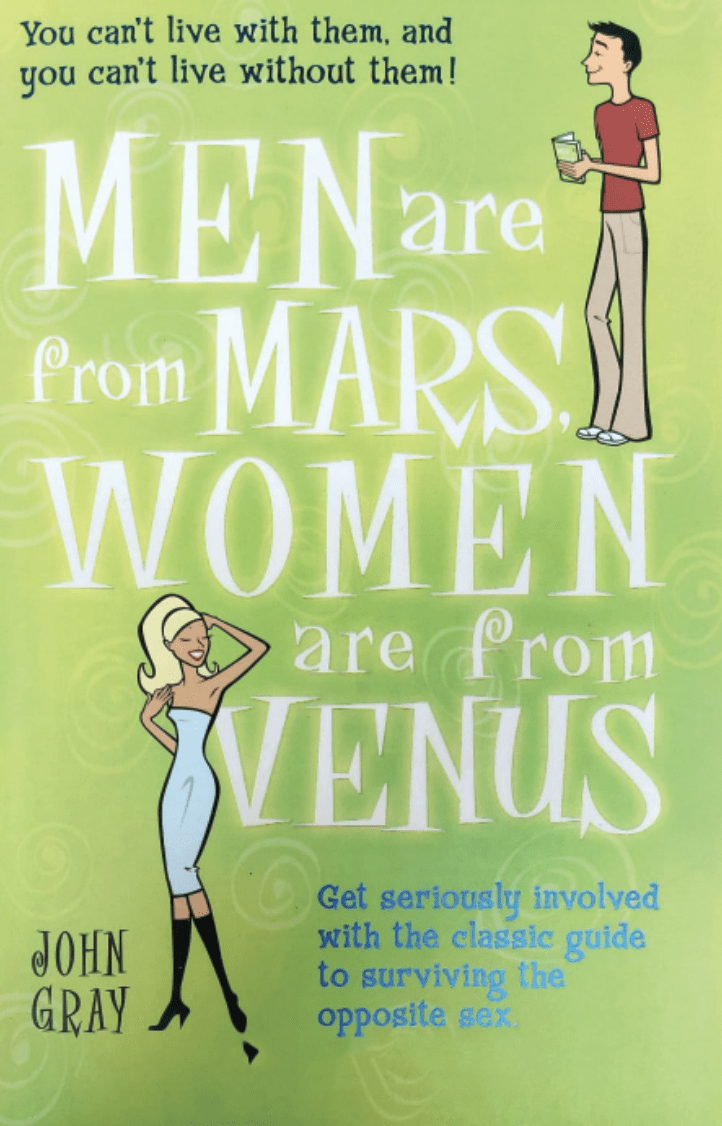
This three-part series explores how human psychology, stress responses, and decision-making styles shape the way people buy and sell homes. Each week examines a different dimension of the same idea: Real estate reveals people more clearly than almost any other process. We begin with the framework — how a cultural artifact like Men Are from Mars, Women Are from Venus unexpectedly offers a vocabulary for what unfolds every day in kitchens, hallways, and inspection reports.
I didn’t pick up Men Are from Mars, Women Are from Venus by Dr. John Gray on my own. A friend in town recommended it because he said it helped him make sense of himself and his marriage, and that was enough to get my attention. Whether you love it, hate it, or haven’t thought about it since the Clinton administration, it’s impossible to ignore its place in the culture: In the 1990s, the book sold 15 million copies, outselling every nonfiction hardcover except the Bible.
My wife and I began with a healthy dose of skepticism, but as we listened on a long car ride to North Carolina, we found ourselves occasionally pausing the audiobook and exclaiming, “A-ha, see there,” when something rang true — not universally, not predictively, but close enough to experiences we’d already had that it sparked a short conversation. The value wasn’t in taking every claim at face value but in the way the framework, however dated or exaggerated, gave us language for patterns we sometimes notice without naming.
This is a real estate column. We weren’t listening to understand real estate, but there’s a lot of real estate in the book. So, I’m diving in on that aspect.
Caves, Closings, and Contrasting Reactions
One of Gray’s most famous images comes early in the book: “When a man is stressed, he retreats into his cave; when a woman is stressed, she seeks to talk.” The cave, he says, is the place men go to gather themselves, solve problems internally, or simply shut out the world for a bit. Women, in his telling, move in the opposite direction — toward connection, conversation, and reassurance. It’s a crude sketch, but he uses it to explain why two people under the same pressure can look like they’re having two completely different experiences.
Here’s where the science gets interesting. What Gray describes metaphorically — different stress responses, different comfort thresholds — is exactly what behavioral economists call Prospect Theory. People fear losses more than they value gains, and you see it in real estate constantly. Inspections trigger loss aversion. Early-season listings trigger loss aversion. Even staging budgets trigger loss aversion. One partner sees a $30,000 staging plan as an investment with a likely return. The other sees the exact same $30,000 as a potential loss. Economists call it loss aversion. Gray calls it different emotional wiring. Out in the field, it looks like hesitation, second-guessing, or walking away from a house they love.
Fear, Financing, and Fallout
Loss aversion isn’t just a theory; it’s one of the most replicated findings in behavioral science. Nobel winners Daniel Kahneman and Amos Tversky quantified it in 1979: On average, people react to losses with about twice the emotional intensity of equivalent gains. And the real estate industry sees this play out in very measurable ways.
NAR reports that roughly 20–25% of accepted offers fall apart before closing, most commonly during inspections — the precise moment when buyers shift from imagining what they stand to gain to imagining what they might lose. Zillow’s 2023 Consumer Housing Trends Report data shows that buyers who describe themselves as “risk averse” are nearly 40% more likely to withdraw after identifying potential defects, even if the repairs are minor. You can practically watch the emotional wiring switch over: Hope gets replaced by threat-scanning, possibility by caution.
Gray gave us the metaphor; Prospect Theory gives us the mechanics. Real estate provides the perfect laboratory in which to observe it. What I see in the post-COVID supply-constrained market are bidding wars, pressure on buyer and seller to decide more quickly, with imperfect information, and to release contingencies. This leads to even higher failure rates than 25% as buyers bail out or sellers jump to an improved offer.
Safety, Stretching, and Split Reactions
Across large national financial studies, women consistently report lower risk tolerance than men, even when controlling for income, education, and net worth. Vanguard’s 2022 Investor Behavior Report showed that women were 40% less likely to trade impulsively during volatility and were significantly less likely to take on leveraged positions. In real estate, this shows up immediately: Women tend to prefer financial safety, lower debt loads, and homes that feel stable and predictable. Men are more likely to stretch for opportunity or upside. These patterns show up consistently in the data.
Week One Summary
This week’s column introduced the basic framework: stress responses, loss-aversion, and risk tolerance aren’t abstract concepts. They show up directly in how people react to inspections, staging, bidding wars, and debt. The same facts land differently on different internal wiring.
Next week, column two will stay with the same theme but move closer to the ground, following couples and sellers through real situations where these patterns shape what actually happens to a listing or an offer.
John Engel is a Realtor with The Engel Team at Douglas Elliman. This month John snagged a rope around his boat propeller, impacting his ability to steer and maneuver in Norwalk Harbor, and limped over to the gas dock where he stripped down, went overboard, cut the line with a knife, and freed the prop. In our family, there are Mars jobs and Venus jobs, and freeing the prop is a Mars job.