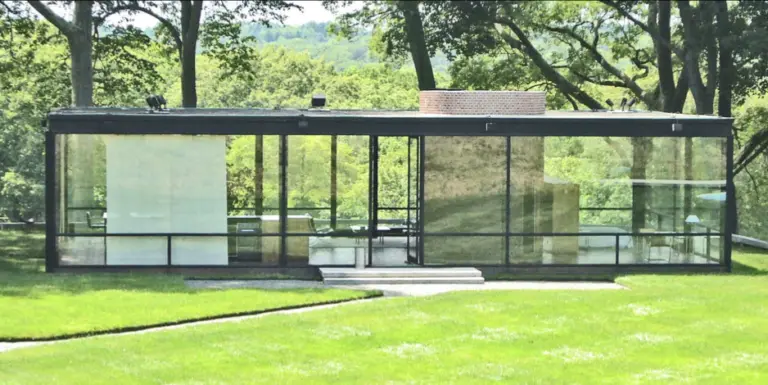
By John Engel
There is a saying — Behind every great man is a great woman — that feels especially apt in New Canaan this week, with the passing of Pamela Gores.
To understand why, you have to understand not just her husband, Landis Gores, but the moment in which New Canaan found itself in the late 1940s — and why it became the unlikely epicenter of modern residential architecture in America.
Unlike his Harvard classmates, Gores was not doctrinaire. As Bill Earls writes in The Harvard Five in New Canaan, Gores and his close friend and fellow Ohioan, Philip Johnson, were mavericks, the “bad boys” of the group. Gores himself recalled that the two shared “a certain feeling of community, a common outlook.” That spirit, more than theory, defined the early years.
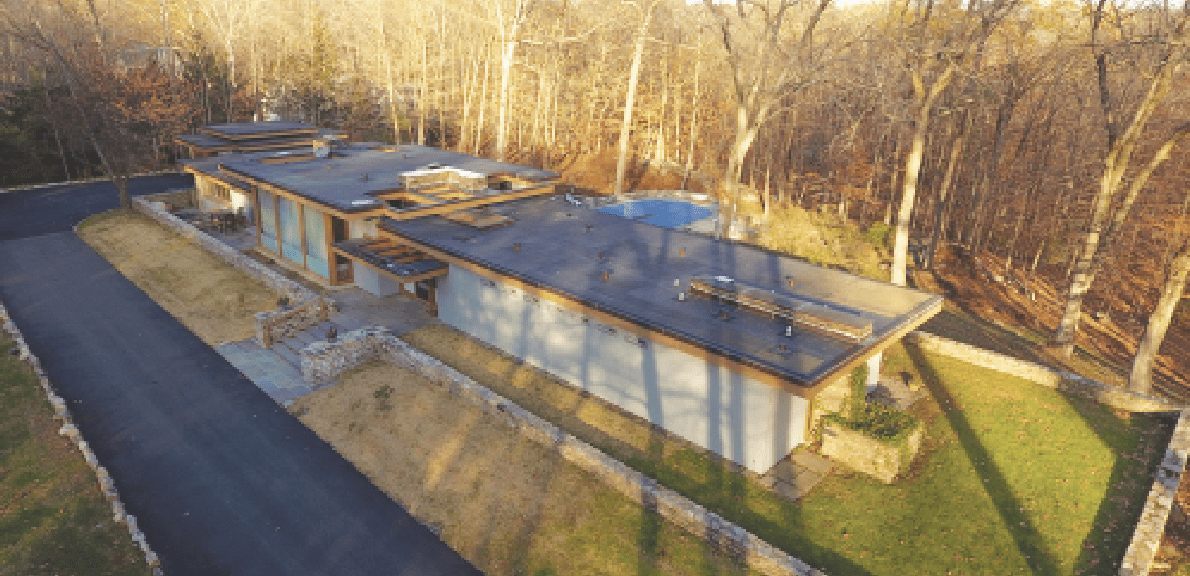
It is no wonder Johnson asked Gores to collaborate on the Hodgson House, a project so early that Johnson was not yet licensed to practice architecture in Connecticut. That house captures a moment when ideas moved faster than credentials., and experimentation mattered more than polish.
Those experiments found a receptive home in New Canaan.
In 1949, seven houses — the Glass House, the Gores House, Noyes I, Breuer I, Kniffen, Mills, and Rantoul — were opened to the public during the inaugural Modern House Tour. More than 3,000 people attended. The New York Times and the New Canaan Advertiser reviewed the work favorably. What followed became a movement. Within four years, more than fifty modern houses were built here.
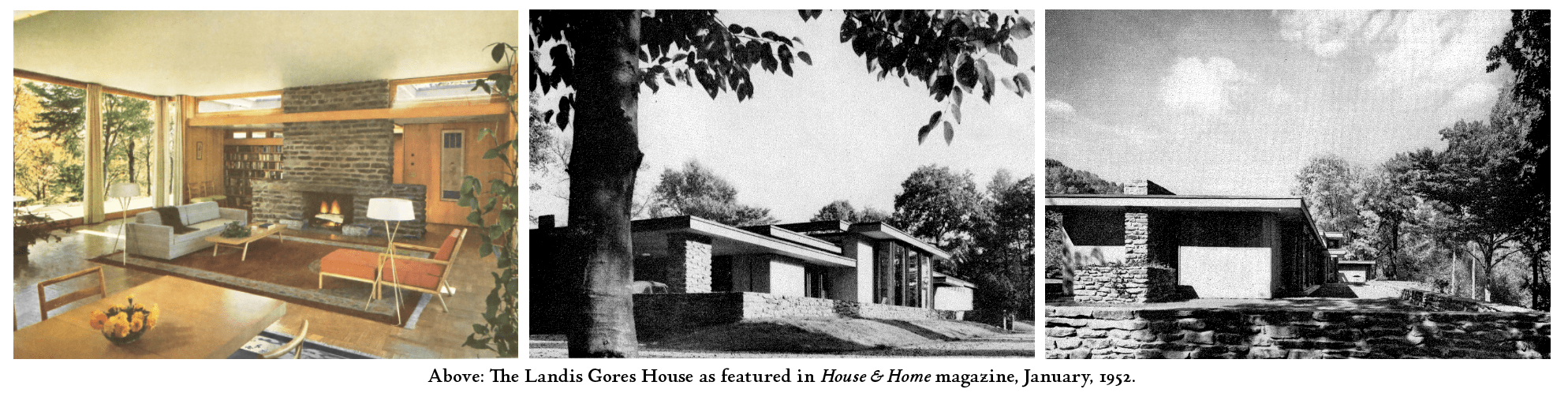
At the center of that moment stood the Landis Gores House.
Completed in 1948 and often described as Gores’s masterpiece, the house succeeds through restraint rather than spectacle. Where others pursued manifestos, Gores pursued livability. House & Home magazine noted the structure’s “almost aristocratic scale,” pointing to the tall living room, the entrance lobby, and the stone ramparts facing the valley. Yet the same article observed something rarer: “an almost aristocratic grace about the way of life which the house implies.”
Gores was, as the magazine put it, “a creative young conservative among his avant-garde contemporaries” — a figure common in literature and philosophy, but “an isolated phenomenon” in architecture.
Pamela Gores was part of that life from the beginning. In the same House & Home article, she recalled that her direct input into the house was modest but telling: a steel frame in the ceiling of the main section so a helicopter could one day land on the roof — a long-held dream not yet realized — and a blue bathtub in the primary bedroom. The anecdote captures something essential: imagination tempered by practicality; vision grounded in daily life.
After Landis Gores’s death in 1991, Pamela remained closely connected to his work. She supported preservation efforts, welcomed documentation, and stayed engaged in the cultural and civic life of New Canaan for decades. These buildings survived through continuity.That continuity is visible all around town.
The Gores Pavilion, designed in 1960 for the Irwin family and later given to the town, represents one of the rare moments when modern architecture in New Canaan became explicitly civic. Modest in scale and deeply connected to its landscape, it is modernism without bravado, architecture as generosity.
Less conspicuous, but equally important, is Gores’s work on Wahackme Road, where he designed an addition to a Techbuilt house. There, he worked within a system-built framework, demonstrating how modern ideas could adapt to everyday housing, not just ideal conditions.
I pass those buildings often. Many residents do. That is part of their success.
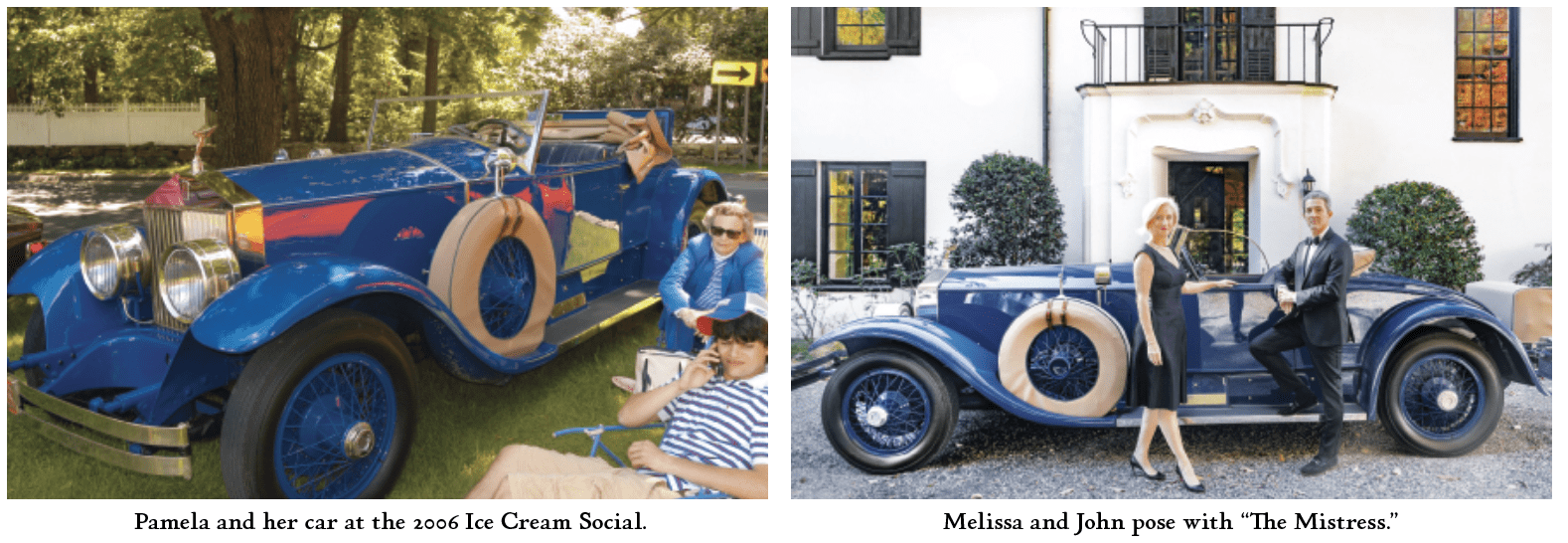
I first met Pamela Gores at the Ice Cream Social. She was gracious, direct, and unmistakably herself. On another occasion, she handed me the keys to “The Mistress” — her name for Landis’s 1929 Rolls-Royce convertible — and trusted me to drive it for a video. It was an act of openness.
I also knew Pam’s daughter, Liz, from our time serving together on the Town Council, just another expression of a long family commitment to this town.
For seventy-seven years, the Gores family helped shape New Canaan — through architecture, civic service, and a belief that ideas matter when they are lived with, shared, and protected.
Pamela Gores leaves behind more than buildings. She leaves behind a community that understands what it has, and why it matters.
John Engel is a broker with The Engel Team at Douglas Elliman in New Canaan. He writes weekly about real estate, architecture, and the moments that quietly bind a town together. He lives in a valley and measures winter storms not in inches but in which cars can make it up Ponus Ridge without help. This week, after 7.2 inches of snow, one car slid half off the road, and he used his 1976 Land Cruiser winch to pull it back onto the road. Two weeks ago, he wrote about his boat propeller, and then about splitting wood. There’s real satisfaction in getting outside, and we’ll be revisiting this theme throughout 2026. Happy New Year.