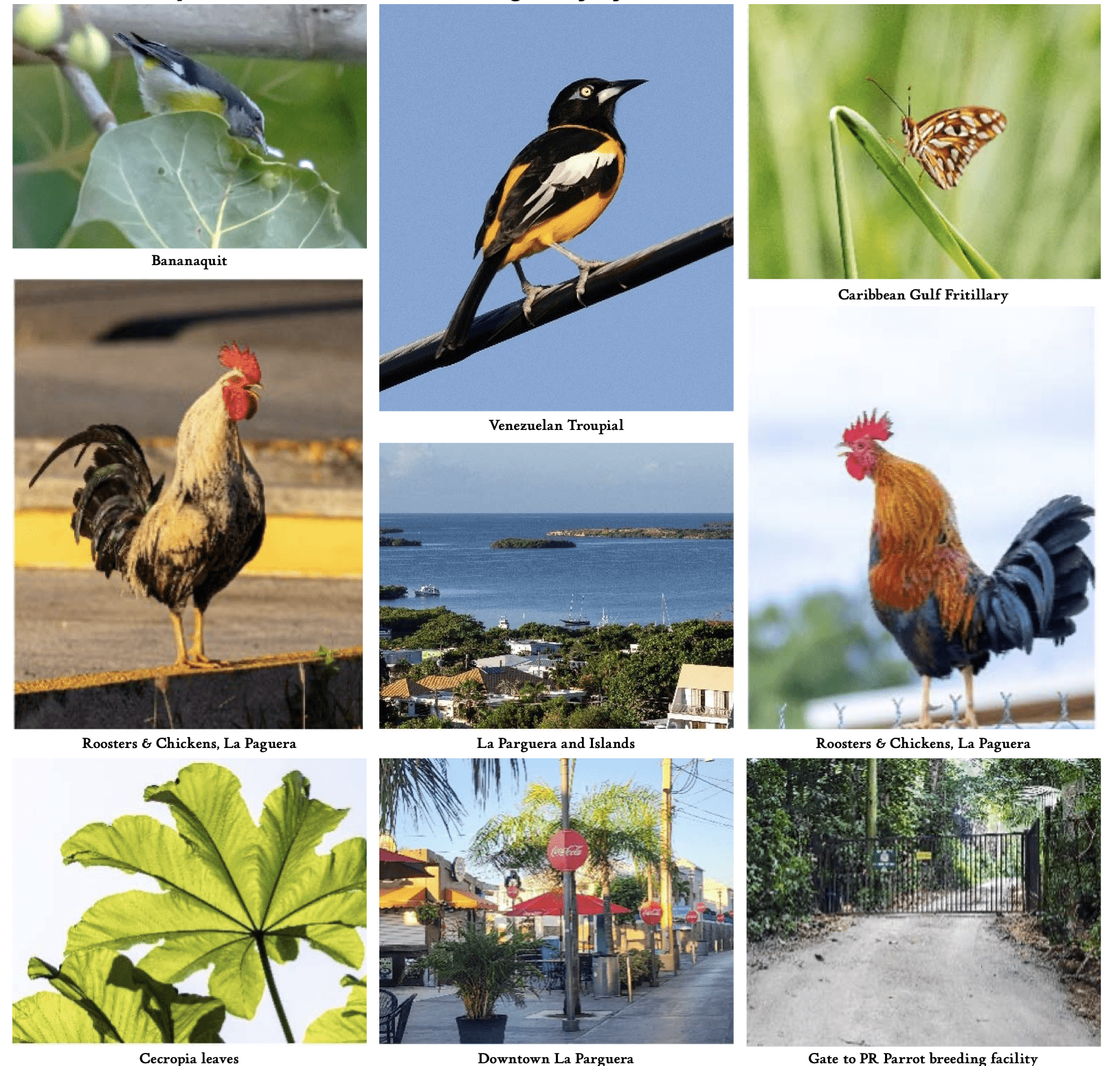
By Frank Gallo
Write this down. Never drive up route 388 into the mountains of Puerto Rico (PR). It doesn’t matter if GPS says it’s the shortest route, or that there’s a rare Puerto Rican Euphonia at the end of the road. Take Route 518. It’s windy, but at least it has white lines outlining it and no potholes!
I’ve been on steep and narrow roads before, but Route 388 (and I use the term “route” loosely) may be the steepest, most windy, and least well- maintained road of the lot. There was one curve so tight that I had to back up to swing wide enough to make it and then go up an incline so steep that anyone who has ever driven a lawnmower up a hill and thought it would flip over understands the feeling I had in the pit of my stomach. Going up, I mostly saw blue sky. Going down the other side, I had visions of buses I’d seen at the bottom of ravines in Peru. I had gotten more than halfway, so there was no turning back. Where would I do it, anyway?
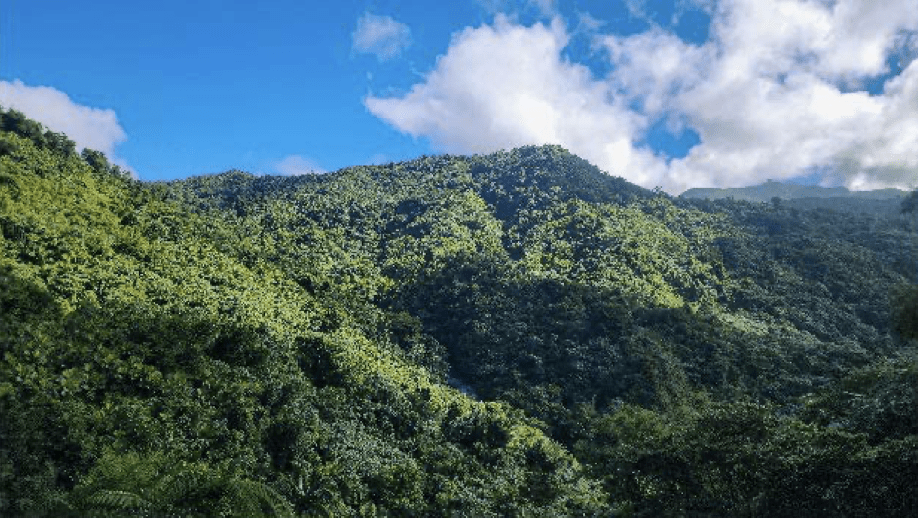
There were a few houses along this desolate pothole-encrusted excuse for a goat path, and occasionally a vehicle would come the other way. There was no shoulder. In fact, much of the road edge was missing, no guard rails, just crumbled asphalt. Fortunately, the locals know what horns are for and beep on corners and I quickly embraced their tradition. I did a lot of beeping. Can you imagine if it snowed here? After more than an hour of driving switchbacks, hairpin turns, and apparent onramps to heaven, I made it to Route 518, where I rediscovered breathing, and spent a minute or two peeling my fingers off the steering wheel.
I turned off Route 518, a lovely unpitted main road to the entrance to the US National Forest where I hoped to see the Euphonias, crossed a bridge, passed through a small town and into the park which, as it turns out, is no longer being maintained because of federal budget cuts. Oh, lucky me. Aside from the tall grass growing along the median and edges, the road was still in pretty good shape, so I went to my first GPS pin for the Euphonias.
Did I mention that GPS doesn’t work well in the mountains of Puerto Rico? GPS got me to my first stop where all was quiet except for a few Bananaquits feeding in the cecropias. When I hit continue, the GPS lost signal. Not to worry, I set the pins before I left the lowlands with this possibility in mind. So, I went from pin to pin. At each stop, I saw a variety of birds, a Cape May Warbler from our Eastern boreal forests, Pearly- eyed Thrashers (think mockingbirds) but alas, there were no Euphonias. As it was my last day, I wouldn’t have another chance to see them. Something to be saved for the next scouting trip.
I thought I was being slick pinning the Euphonia sites into Google maps. I even pinned the airport in San Juan. What I forgot to do was pin the route. When I lost signal, the route to the airport vanished. I knew that I had to get to highway 10, and luckily, I can read a map. So, I enlarged the GPS map, looked for the shortest route to Highway 10 and went for it. Trusty Route 518 as it turned out went “straight” downhill to Route 10, in a windy-mountain-road sort of way.
At one point, just before I reached the highway, I got a GPS signal, and the airport route appeared. I stopped and re-plotted my course and it’s a good thing I did. Otherwise, I would never have found the on-ramp. To get onto the highway, I had to veer onto Route 123, take a very sharp left onto what looked like a steep narrow driveway past some houses, then crest another steep hill right onto the highway. I’ve never driven up a hill through a neighborhood and directly onto a highway before. I’ll find an alternate route next time. This is why we spend so much time researching and scouting a tour…
Why was I doing all this? This was the last day of a weeklong scouting trip to Puerto Rico to plan a future birding tour for Sunrise Birding, LLC in 2027. Puerto Rico is home to 17 endemic bird species, a host of butterflies and other creatures found nowhere else on earth, and several bird species that have ranges restricted to the Caribbean. This was my first visit to the island, and apart from wanting to see the endemics, my job was to explore and get the lay of the land, accommodation, food, culture, people, and to meet local guides. Aside from route 388, I highly recommend it.
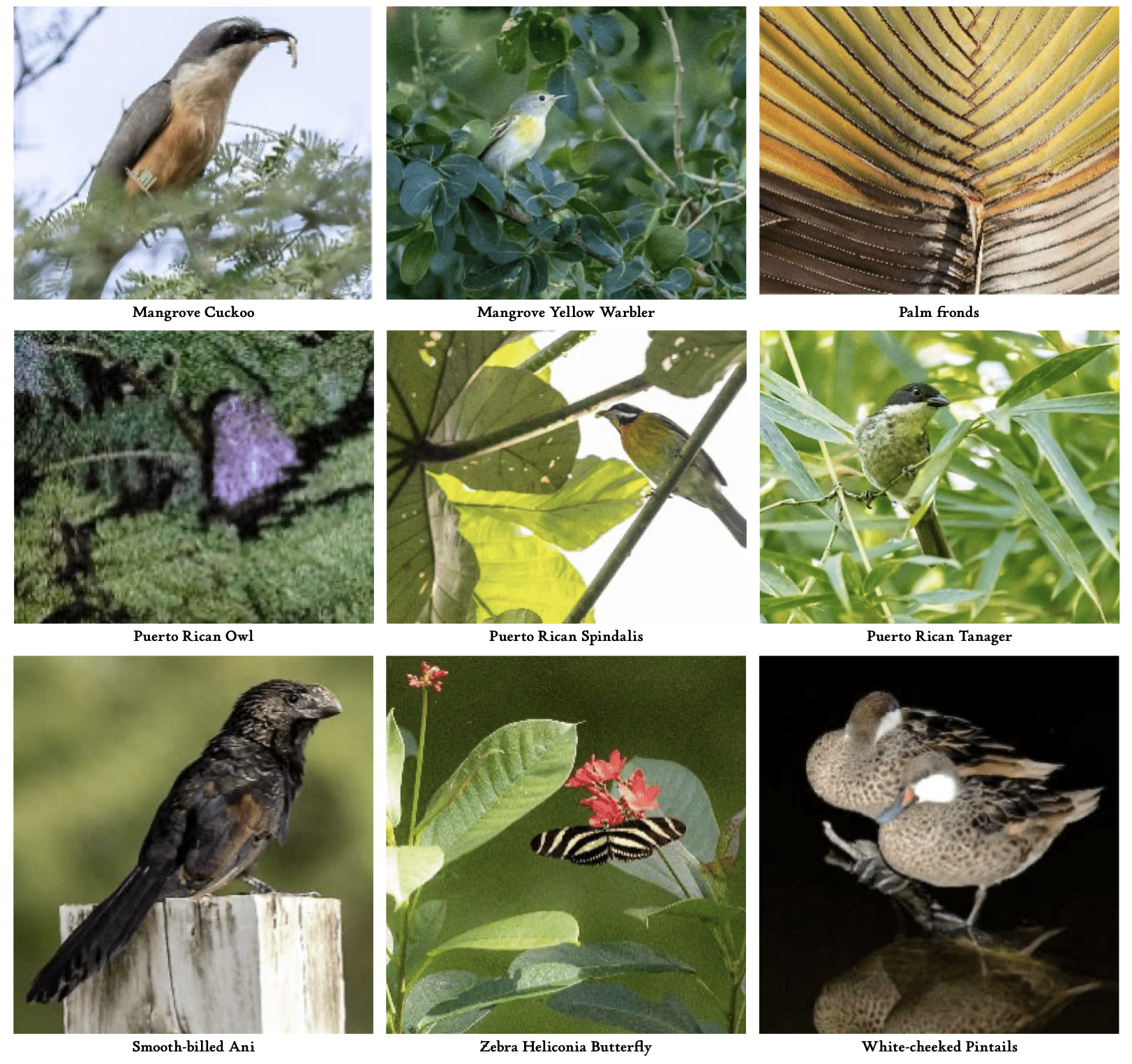
My week-long journey began in the lovely El Yunque National Forest on the east end of the island. The forest there was devastated by hurricane Maria in 2017 but is slowly returning to normal. Young growth has replaced old, and although the mature forest will take years to recover, the birds are still there, though populations are reduced. I loved my daily walks up the valley from Casa Cubuy Ecolodge, where I was hosted by a wonderful energetic 96-year-old expat American and her son. My walks garnered 12 of the 17 endemics. I had fantastic views of the neon green Puerto Rican Tody (perhaps the cutest bird on earth), PR Tanager, PR Spindalis (a tanager), flashy Green Mangos, and many others. I also visited a few coastal sites to see Adelaide’s and Mangrove Yellow Warblers, along with a slew of winter warblers that breed in the U.S.
At the famous Noelia’s restaurant just down the valley I ate a dinner of delicious grouper with tostones that came with a side of PR Owl singing in the trees beside the veranda. The food and the owner were delightful. Give her mofongo a try. Order upon arrival or you’ll wait and check that she’s open. Hours are at her discretion.
On the third day, I timed my departure to arrive in Rio Abajo State Forest at 2:30 p.m. where I walked a mile along a rough hilly road to the gates of the Puerto Rican Parrot breeding facility. Through captive breeding, PR Parrots have recovered from near extinction in the 1970s, to 250+ birds in the wild. Although still critically endangered, there is hope. With some luck, I’d see wild ones coming to roost near the facility.
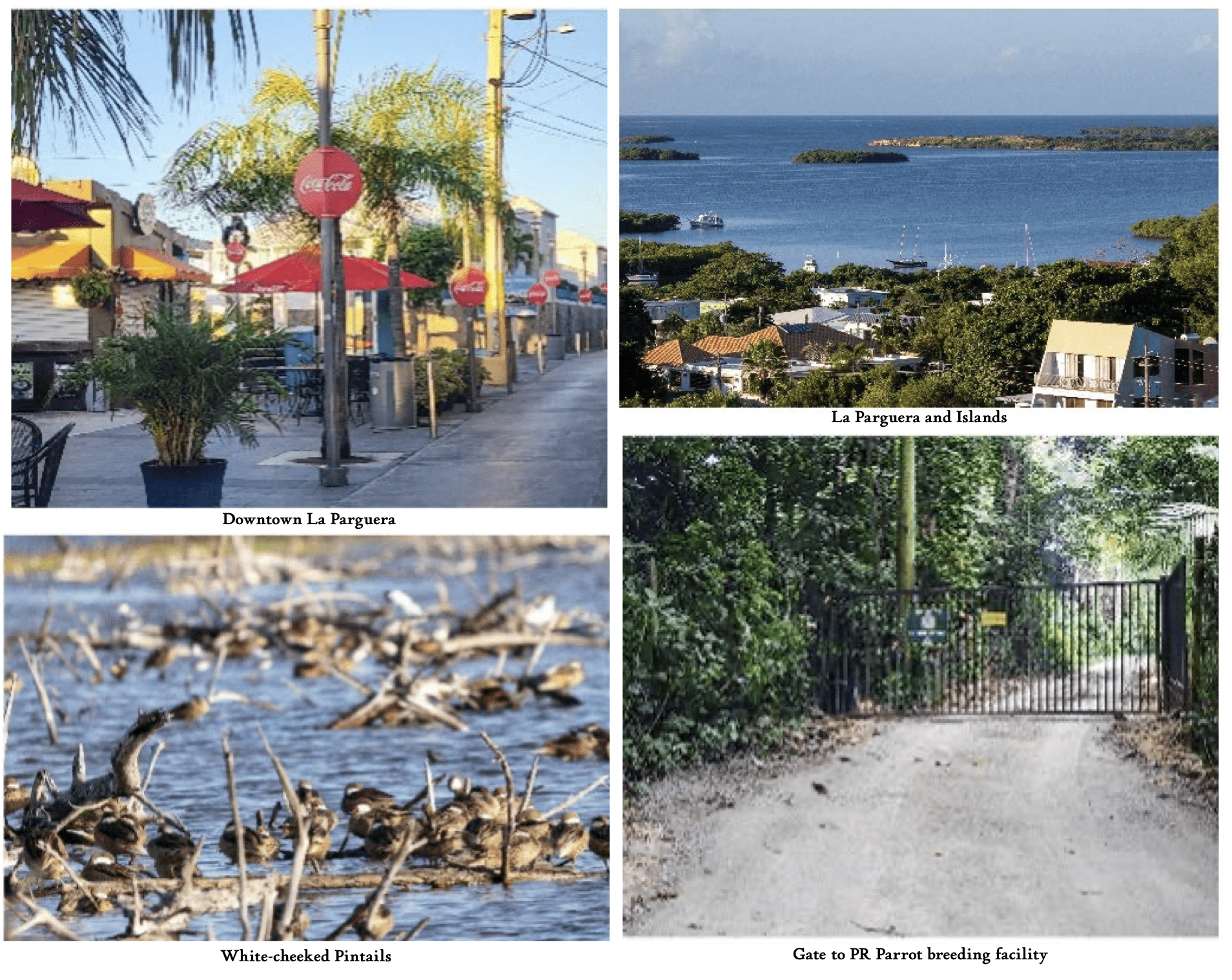
Of course, as soon as I arrived onsite, it started to rain. I’m used to getting wet in the tropics, so I stood under a wide-leafed tree before spotting a tractor with a covered cab parked nearby. I climbed into the cab, stored my camera gear and waited. At 3:50 p.m. I heard parrots. It was still raining, so I left my gear and ran up the hill to the gate. I was greeted there by a raucous group of 16-20 emerald PR parrots with rusty foreheads flying in and out of some palms! I walked back to my car with a smile on my face and a two-hour drive to my hotel in the coastal tourist town of La Parguera.
On the way, I detoured to a site for the endangered PR Nightjar, only rediscovered in 1961, that was six minutes from my hotel. As I drove slowly down the dirt entrance road, I heard several singing on the hillside. I parked and within minutes one flew over the road then sang close to me. I shined my light and found it perched 30 feet away! Amazing.
Over the next several days, I walked La Parguera’s neighborhoods seeking the glittering gold PR Mango hummingbird. I explored nearby lagoons filled with White-cheeked Pintails and wintering shorebirds, and local rice farms for rare Grasshopper Sparrows, and Smooth-billed Anis. I also took several trips into the mountains in search of other endemics, including the elusive Elfin-woods Warbler.
On a lovely quiet morning at dawn, I parked at the state boat ramp to watch flocks of rare, Yellow-shouldered Blackbirds leaving their offshore island roosts to head inland to feed. Local roosters, chickens, and a Venezuelan Troupial (oriole) watched with me.
Hikes on mountain trails revealed more endemics, including PR Vireo and Lesser Antillean Pewee, but no Elfin-woods Warblers. I did meet some nice young Chicago birders who I later showed the Nightjars to; they gave me a new hacking site for PR Parrots that I’ll visit next time. Half the fun of birding is meeting kindred souls often in the middle of nowhere.
On my last morning before my flight home, I again drove and walked La Parguera neighborhoods at dawn looking for PR Mango which kept eluding me. Two flashed across the road chasing one another, but I couldn’t relocate nor count them. A stop at a hotel where several had been seen provided me with a nice breakfast but no Mango (except for the ones I ate). As I was leaving town blissfully unaware of my future fun on Route 388, I glimpsed a bird fly into a flower-filled hedge. I stopped and checked the hedge. Nothing. I checked the neighbor’s flowers. Nothing. The hedge again. Nothing. As I reached for the car door handle, a bird shot out from a nearby tree and hovered 10 feet away. It was the PR Mango! I had just enough time to lift my binoculars and confirm identification before it zipped away. It would be my last endemic for the trip. I went 15 for 17 PR endemics, saw several new Caribbean endemics, and ended with 25 new species for the trip. I’m looking forward to a return visit next fall.
Visiting a new area to scout a potential tour is a wonderful way to meet people, experience different cultures, try new foods, and see incredible scenery. I had fun, and most importantly, contributed a bit to the local economy. It’s what ecotourism should be all about.