By John Engel
Dear Abby’s advice column is more than 70 years old and still read by 110 million people in 1,400 newspapers. This week, I’m using that format to answer the most common Google questions about moving to Connecticut.
Dear John E:
I’m paying $7,000 a month in rent in Manhattan. Everyone says Connecticut is “cheaper,” but then I hear about high taxes and expensive towns. Is Connecticut actually less expensive than New York, or is that suburban myth?
– Overpaying Renter
Dear Overpaying Renter:
Income Tax. If you live in Connecticut and work in New York City, you still pay New York State income tax. What you eliminate by leaving the city is the New York City local income tax of up to 3.876%. For most NYC commuters, that city tax is the real income tax difference.
Housing. $7,000 a month is $84,000 a year in rent. Zero equity. In Fairfield County, that same payment can often support ownership of a $1.3M to $1.7M home, building your equity instead of your landlord’s.
Property taxes on a $1.5M home:
New Canaan: about $17,000–$18,000
Darien: about $16,000–$17,000
Westport: about $19,000–$20,000
Wilton: about $25,000
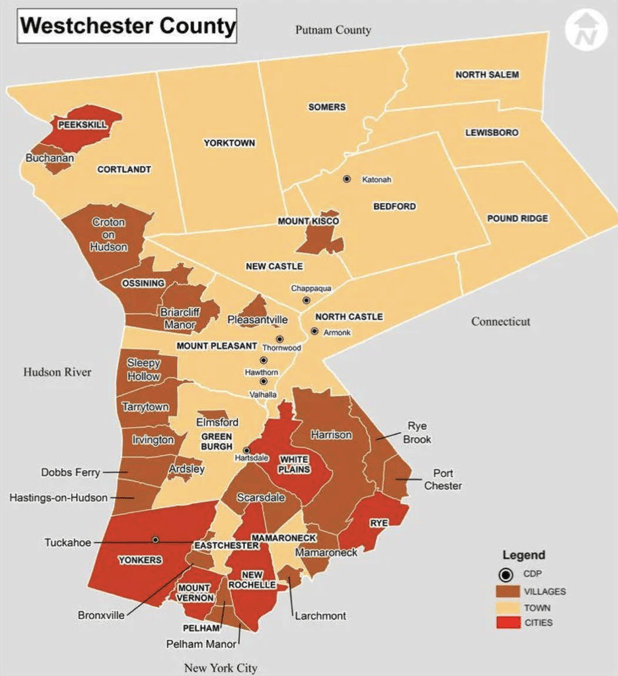
Westchester County: $28,000 to $40,000+ is common on comparably-priced homes.
Nassau County: $25,000 to $38,000+ is common.
Bottom Line: Compared to Westchester or Nassau, Fairfield County property taxes are often $5,000 to $20,000 per year lower on a comparable $1.5M home — on top of the elimination of New York City’s 3.876% city income tax.
Dear John E:
I’m moving to Connecticut but still need to commute to Manhattan. Which towns actually make sense, and which ones look good on paper but are brutal in real life?
–Tired Commuter
Dear Tired Commuter:
Greenwich: ~45-50 minutes. Four stations. Express every 20-30 minutes. Parking: 2,700 spaces.
Stamford: ~45-55 minutes. Main express hub, every 10-20 minutes. Parking: 2,000 spaces.
Darien: ~55-65 minutes. Two stations. Few expresses. Parking: 1,630 spaces.
Norwalk: ~60-70 minutes. Three stations. Few expresses. Parking: 1,000 spaces.
New Canaan: Two stations. Add 10–20 minutes for the branch line transfer in Stamford. Typical door-to-door 70–85+ minutes. Parking: 1,300 spaces. You always get a seat in the morning!
Wilton / Redding / Ridgefield: Danbury Branch or drive-to-train. Often 75–95+ minutes.
Weston / Easton / rural towns: No stations. You are driving to the Westport or South Norwalk train.
Bottom line: If you’re in Manhattan three to five days a week, Greenwich, Stamford, Darien, and Norwalk are the true commuter towns. Go inland or onto a branch line, and you’re trading price and space for 20–40 extra minutes each way.
Thinking of driving? Be on I-95 or the Merritt Parkway before 7 a.m., or you’ll wish you were on the train. In Fairfield County, rail share is 10% to 15%. In New Canaan, it’s roughly double that, and it’s higher still in Greenwich and Stamford. Census data shows:
Train (Metro-North): 30% to 40% of working residents
Drive (car as primary commute): 45% to 55%
Work from home / hybrid primary: 15% to 25%
Dear John E:
If I’m choosing between top towns, how do Fairfield County’s best public schools really compare to the best schools in Westchester, Long Island, and New York City?
– Comparing at the Top
Dear Comparing at the Top:
At the very top of the public-school market, all four regions produce elite schools. The difference is not whether great schools exist. It’s how many fall into the national top tier and how predictable access is by town.
Using the 2025–2026 U.S. News national rankings of roughly 18,000 public high schools:
Fairfield County has six to seven traditional public high schools that rank within roughly the top 500 nationally (top ~3%). That group includes New Canaan, Staples (Westport), Darien, Greenwich, Wilton, Ridgefield, and Weston, depending on the year and methodology. In addition, Fairfield County has magnet schools that rank even higher, but those are not town-based. Eight of Connecticut’s Top 10 public high schools are in Fairfield County, but nationally most fall in the top 300–600 range, not the top 100 nationally.
Westchester County also produces five to seven traditional public high schools that rank in the top 500 nationally. This group typically includes Scarsdale, Bronxville, Rye, Edgemont, Byram Hills, and Chappaqua. In raw count, Westchester is roughly comparable to Fairfield County at the top end.
Fairfield County operates primarily on a one-town, one-district model across 23 towns, making school quality highly predictable by address. Westchester County has 48 separate school districts serving overlapping towns and villages, which means even in top communities, school access is less consistent and requires district-by-district verification.
Long Island produces more top-ranked schools in absolute terms than either Fairfield or Westchester. In the 2025–2026 U.S. News rankings, 11 of New York State’s Top 50 public high schools are on Long Island. Districts like Jericho, Manhasset, Garden City, Great Neck, Cold Spring Harbor, and Syosset routinely place schools in the top 200–400 nationally. The tradeoff is geography: Those schools are spread across two counties and over 120 districts, making access by town less predictable.
New York City has the strongest individual public high schools in the region. Stuyvesant, Bronx Science, Queens High School for the Sciences, Staten Island Tech, Townsend Harris, and Brooklyn Tech all rank in the top 100 nationally, with several in the top 50. That puts NYC clearly ahead at the very top. The difference is access: These schools are exam-based or lottery-based. Buying a home does not guarantee entry the way it does in suburban districts.
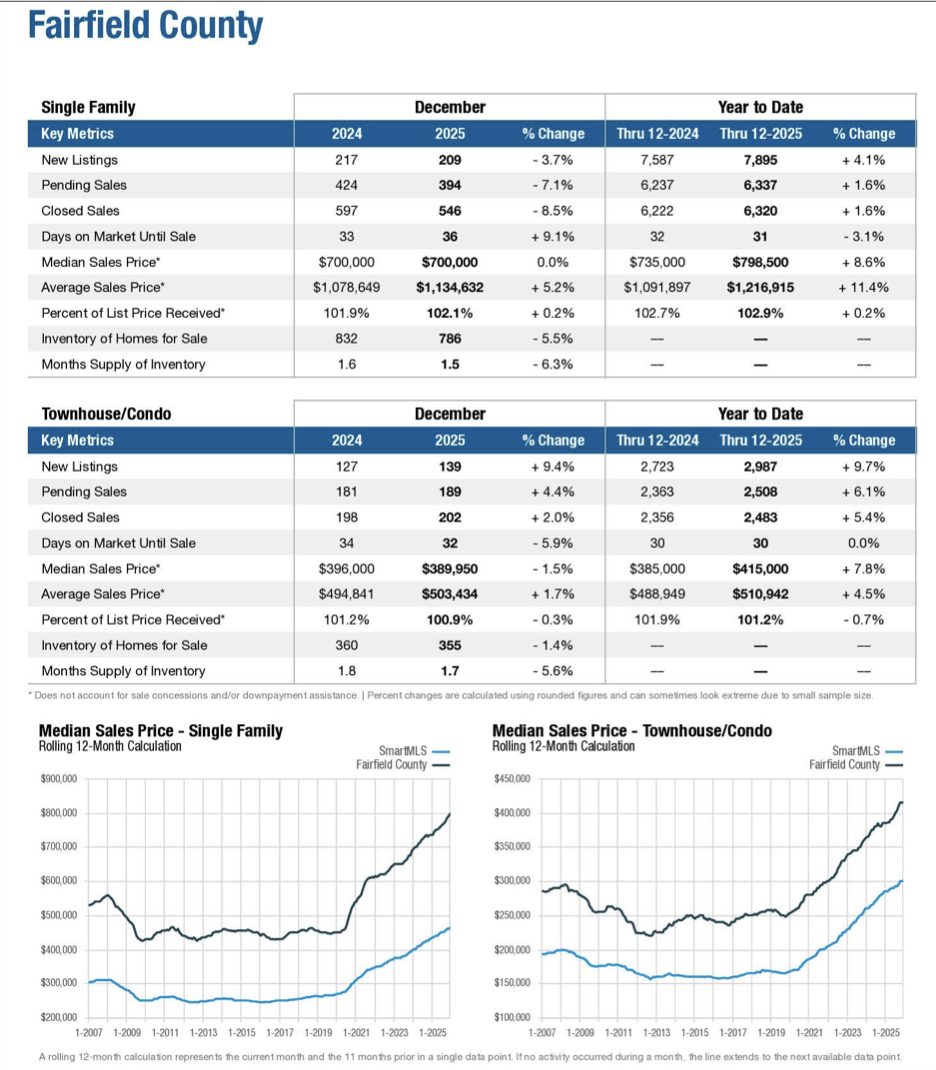
Bottom Line: At the top end, Fairfield County is not uniquely dominant on raw national school rankings. Westchester is comparable. Long Island produces more elite schools in total. New York City produces the very top schools.
Fairfield County’s real advantage is structural: More towns default into very strong public schools without testing or lotteries. For buyers choosing a town, not chasing a single exam school, Fairfield County offers more predictable access to top-tier suburban public schools by address.
John Engel is a broker on The Engel Team at Douglas Elliman, and he’s thinking about the recent snowstorm as a metaphor for the real estate market. After five years of below-average snowfall in New England, we started to think no snow was normal. Boston went 1,427 days without a six-inch storm. Similarly, after 10 years of plentiful listings in Fairfield County, we thought 250 listings and 250 sales per year was normal. COVID has been to real estate what El Niño is to global weather: a big storm, a reset on normal, and a reminder that both snow and real estate now experience inflation.