By Frank Gallo
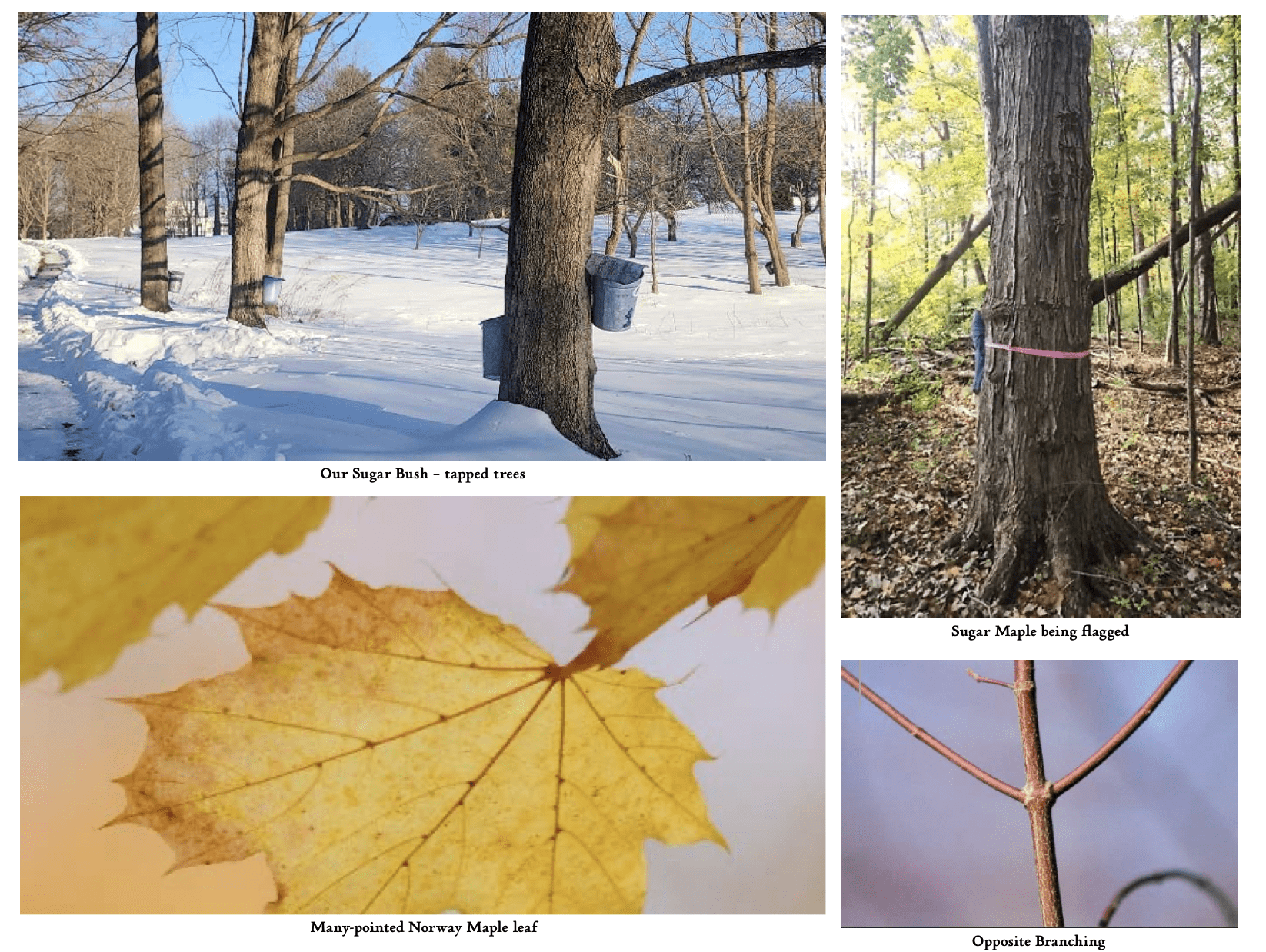
In October, in preparation for maple syruping season in late winter, Aidan Murphey (our Director of Environmental Education) and I marked many of the sugar maple trees on the New Canaan Nature Center’s (NCNC) property with pink flagging tape while they still had their leaves. Sugar maples are easiest to identify when their leaves are still present. Although they can be identified using buds and bark later in the season, it can be tricky.
NCNC has 2-3 species of native maples on the property: red, sugar, and boxelder (maybe gone). There are also several non-native species, including Norway (invasive), sycamore, and ornamental riverbank, and Japanese maples that were planted or seeded in from neighbors’ yards. Sugar, red, and Norway maples are the most common and can all be used to make maple syrup.
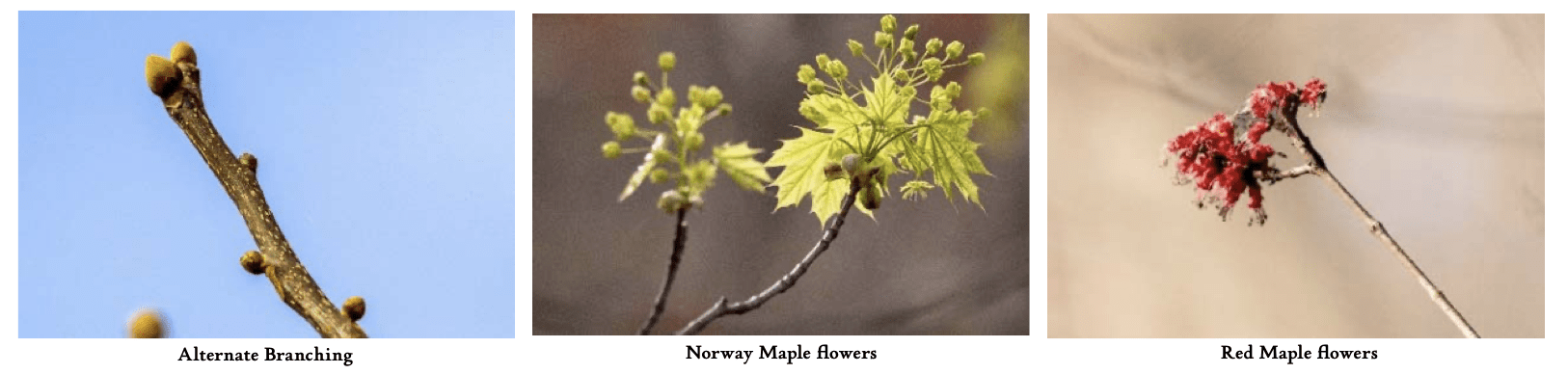
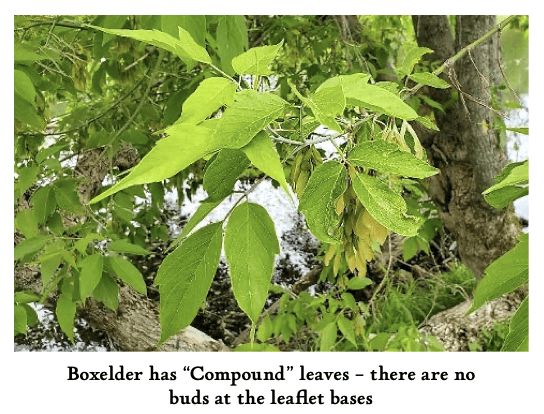
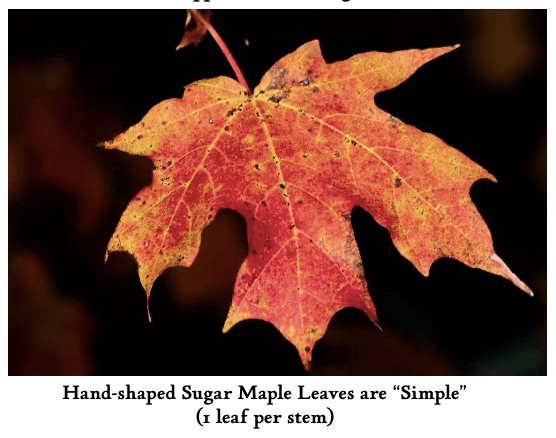
Unlike most trees that branch alternately, maples, ash, dogwood, and horse chestnuts have opposite branches. The mnemonic to remember is, MAD Horse. Care must be taken to determine whether a tree is opposite branched, as branches break off and it can sometimes be difficult to tell. In our area, maples have simple leaves (1 leaf per stem), except for Boxelder which has compound leaves (more than one leaflet per stem). To tell the difference, look at the base of the leaf. There will be a small bud at the base of a simple leaf’s stem, but not at the base of a leaflet’s stem. Maple leaves have a unique hand-like shape – picture the Canadian flag which shows a sugar maple leaf. Other maples have similar leaf shapes that vary in size and number of pointed lobes. Some, such as red maple, have small leaves with 3–5-pointed lobes, while others, such as Norway maple, have larger leaves with many points.
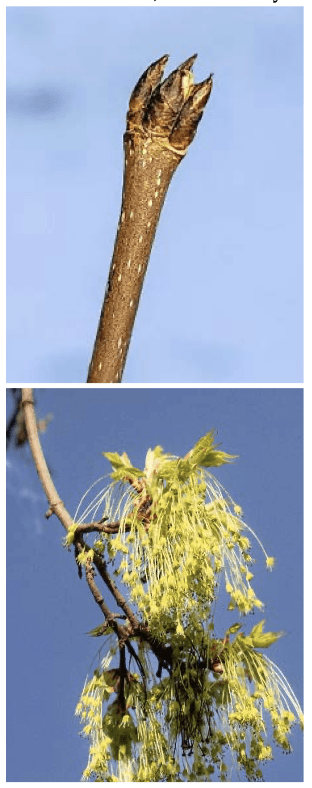
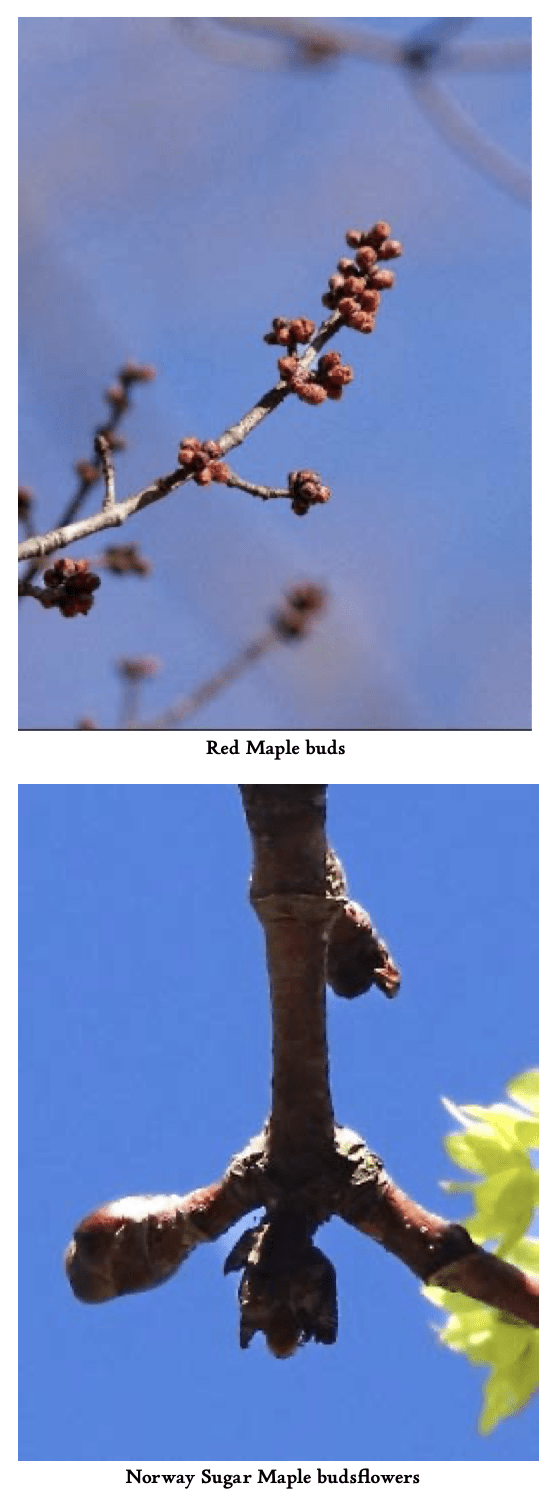
The buds and flowers of maples also differ. Red maples have clusters of tiny red buds and tiny red flowers, whereas sugar maples have one brown central bud with two lateral buds and produce small dangling yellow-green flowers. Norway maples show reddish-brown turban-shaped buds and have erect conspicuous yellow-green flowers. Norway maples also have white sap. Maple and other tree flowers are important food sources for hummingbirds in the spring.
In fall, red maples usually turn a bright red that can deepen to purple. Sugar maples tend toward the dark burnt umber-orange or yellow side of the spectrum, and non-native Norway maples which stay conspicuously green well into the fall (out of synch) usually turn shades of orange or yellow. Colors and timing are soil and moisture dependent and tied to the relative health of a tree and may vary widely from tree to tree and year to year.
Sugar maples are the species most often used for syrup making in the Northeast and Canada where a majority of the worlds maple syrup production occurs. Quebec produces 90% of Canada’s maple syrup and 83.8 % (2024) of the world’s production. The U.S. is the 2nd largest producer at 7.5%, with Vermont accounting for roughly 40% of syrup production in the U.S. followed by NY with 17%. The Netherlands come in third at 2.5%, with the rest of Europe combined producing another 5%. Although the U.S. is the second highest maple syrup producer, we still import syrup to satisfy our collective sweet tooths.
Maple syrup production is increasing worldwide and is now produced in Australia, New Zealand, and Asia, especially Japan, Korea, and China. China and New Zealand are expanding syrup production.
Sap is mostly water with a tiny bit of sugar. The process of making syrup requires removing most of the water. Sugar maples generally have the highest concentration of sugar (sucrose) per gallon, at (2-3%), so are preferred for making syrup. It takes 40 to 60 gallons of sugar maple sap to make a gallon of syrup, which accounts for its high retail price of $40-$80/gal. For red and Norway maples, the ratio is often closer to 60-80 to one. In parts of the western U.S, where sugar maples do not grow well, boxelder is used, as it has a similar sugar content (2.2-2.8%/gal) and produces more sap per tree.
Sap from trees such as Black and English Walnuts and birches can also be used but require substantially more sap. Birch sap has a ratio of nearly 100 gallons to 1, so both types of syrup command premium prices.
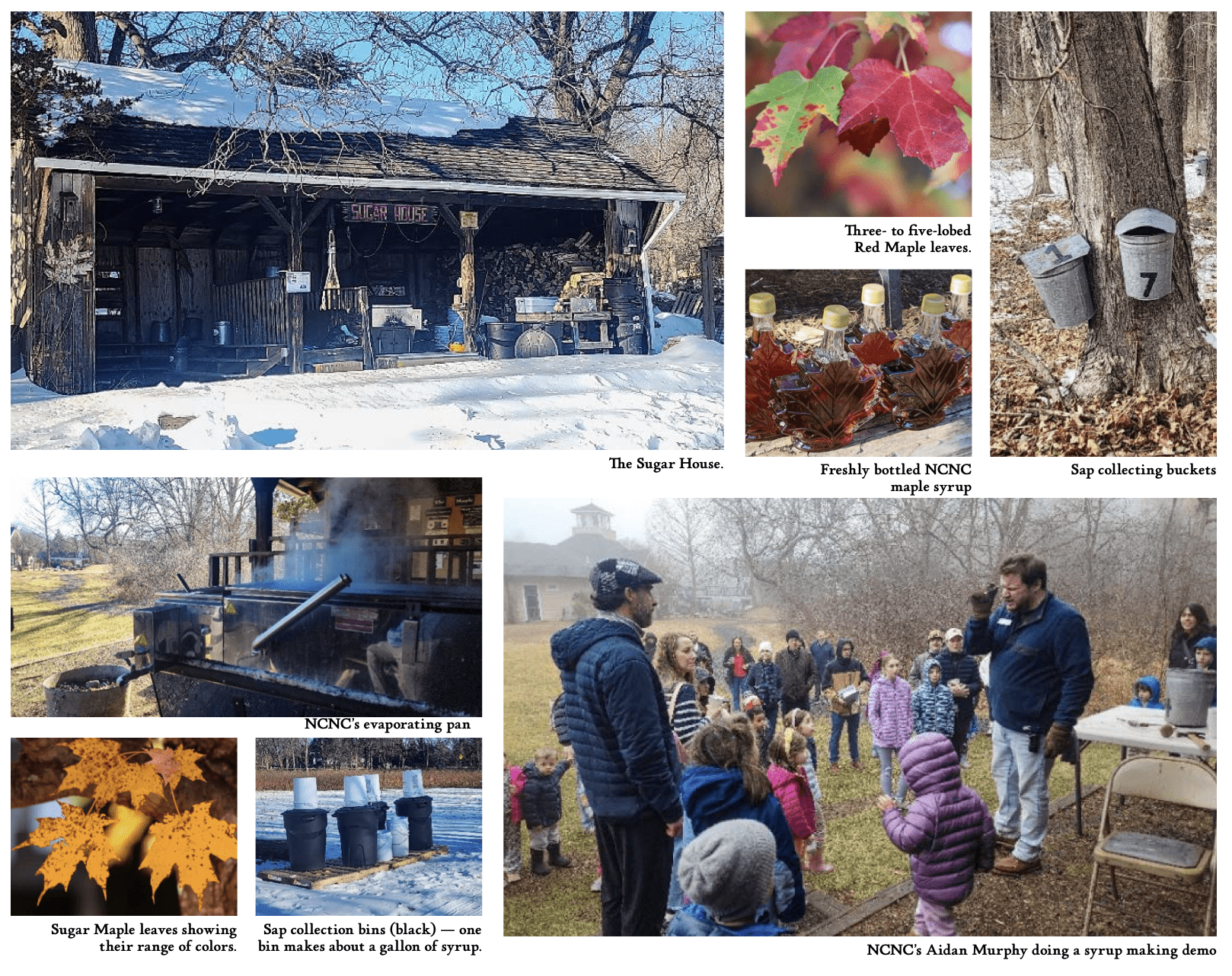
Every January, NCNC hosts our Adopt-a-Tree event where families and individuals can adopt one or more of our sugar maple trees to tend during sugaring season (usually late January to mid-March). At our public season-kickoff held in mid-January, participants choose their tree(s), get kitted out with a numbered bucket and tap, and join staff to tap their tree(s).
Trees that are 10-20” inches in diameter and at least 40’ft tall (usually 20-30 years old) receive one tap and bucket. They are tapped using a 7/16th bit to drill a 3-inch-deep hole into the trunk. Trees more than 20 inches in diameter can support two buckets. When possible, taps (also called spiles or spigots) are placed on the sunny south side, which can improve sap collection. Taps are moved each year as the tree scabs over old holes inhibiting sap flow near them. A hook is secured over the base of the tap, before it is hammered into the hole. The bucket is hung from the hook, and a lid is placed on the bucket to prevent debris and insects from getting into the sap.
Although its precise origin is lost to time, maple syrup making originated with the native Americans and was taught to European settlers. During colonial times, maple syrup was an important commodity because sugar (from sugarcane) was quite expensive.
While buckets and collection tanks drawn by horses were once used in commercial production, most modern commercial operations utilize a more efficient system whereby trees are connected via a closed network of 3/16th inch tubing. Gravity creates a vacuum within the tubing that increases sap flow and feeds sap directly to a centralized collection tank, often in the sugar house itself.
During the short syrup season, commercial syrup processing runs 10-12 hours a day. To save time and fuel, reverse osmosis is now used to extract 90% of the water from the sap before boiling, significantly reducing the time and energy needed for syrup production, making it more environmentally friendly.
Sap runs when temperatures are above freezing. Ideal sugaring weather is when temperatures stay above freezing during the day but go below freezing at night preventing the tree from metabolizing the sap to open its buds. The longer the cycle of warm days and cold nights, the longer the sugaring season. Once the days and nights stay above freezing for three or four consecutive days, the trees begin to utilize the sugar, turning the sap milky with metabolites and rendering it unsuitable for making syrup.
During the sugaring season, Adopt-a-Tree participants visit their trees a few times per week, collect the sap, and transfer it to 55-gal sap receptacles either at the sugar shed or at a collection site near our apple orchard. The sap from these containers is fed into the hopper that adds it to our evaporating pan.
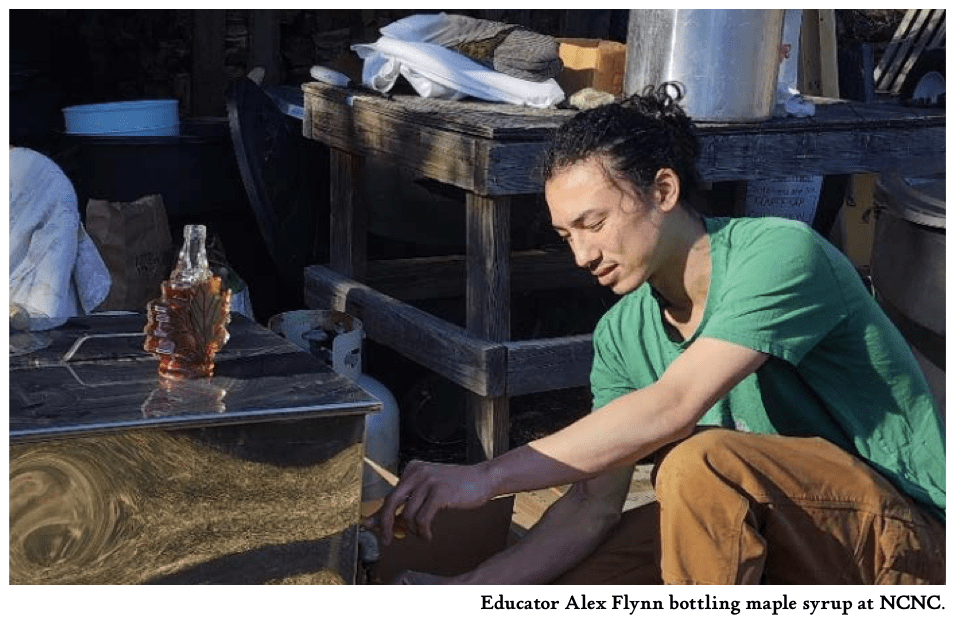
The evaporating pan, which is heated by wood, sits atop a flat woodstove-like base made of stainless steel that has three chambers: one large chamber in the rear and two smaller chambers in the front. The chambers baffled design and large surface area facilitate rapid evaporation. Fresh clear sap is added to the rear chamber where it is reduced until it becomes a golden yellow. It’s then shunted to the second chamber where it’s rendered down further before it’s moved to the front chamber where it is boiled down until it’s nearly syrup. It is finished in a pot on an outdoor stove where the heat can be precisely controlled and measured. At sea level the syrup is finished when the temp reaches 219°F (temp decreases with elevation.) Going beyond this point makes maple sugar. The finished syrup is filtered and then bottled.
Syrup yields vary annually, depending on the number of trees tapped and the length of the season, but lately we have produced 10-15 gallons of syrup annually (80-120 pints) from 75-85 trees. In exchange for tending their tree (s), Adopt-a-Tree participants receive a pint of syrup from the season’s bounty.
During syruping season many area schools, all seven of our preschool classes, and our Little Explorers, visit NCNC for a hands-on experience making maple syrup. They tap a tree, then visit our Sugar House to watch the sap boil and feel the steam rising from the evaporator, before sampling delicious syrup. It’s quite a popular program.
At the end of the season in mid-March, NCNC hosts Syrup Saturday for the public, where everyone enjoys a pancake breakfast with real maple syrup. This year’s celebration is March 14th, from 8:30-11 a.m. There will be tree tapping and syrup making demonstrations, maple-related crafts, and a marshmallow roast around the fire. To register, go to . It is a wonderful event, and we hope you can join us. Next year marks our 60th anniversary of maple syrup making at NCNC.
Frank Gallo is the Senior Naturalist at the New Canaan Nature Center, where he leads environmental education programs, wildlife research, and citizen science initiatives that connect the community to the natural world. A seasoned birder, field biologist, and educator, Frank brings decades of experience in conservation and environmental outreach across Connecticut.