By Peter Barhydt
In the middle of the 20th century, a handful of young architects arrived in New Canaan with little experience, a new set of ideas and a willingness to experiment. The houses they built would quietly change the way Americans thought about living space.
One of them was Eliot Noyes.
After a recent screening of a documentary about his father, Modernism, Inc., The Eliot Noyes Design Story, Fred Noyes reflected on the unlikely path that brought Eliot Noyes from Harvard classrooms to archaeological digs, and eventually to a career that reshaped both architecture and corporate design.
“My father was in architectural school,” Noyes recalled, “sort of with a bee in its bonnet that there was a lot of stuff going on that people really needed help with, and the architectural school was really addressing stuff that was more like an 18th century.”
At the time, architecture schools still focused heavily on classical traditions — columns, symmetry and historical models that had dominated design education for decades. But the world beyond the classroom was already changing.
Eliot Noyes had originally studied classics and had thought about becoming a painter. But eventually he reconsidered.
“He kind of liked painting and miscellaneous other things,” Fred Noyes said, “and thought he might be a painter, but then realized that there are other people at it — Picasso, Miró, that crew — who were better at it than he was.”
A pivotal opportunity soon appeared. While still a student, Noyes was invited to join an archaeological expedition to Persepolis in Iran, documenting ruins through drawings and watercolors.
“They tapped him on the shoulder and said, ‘would you like to go to Persepolis?’” Noyes said. “And he responded, ‘oh boy, would I ever?’”
The experience broadened his understanding of culture and design. Soon afterward, the famed Bauhaus architect Walter Gropius arrived at Harvard after leaving Germany.
Noyes became one of Gropius’ standout students, absorbing the Bauhaus belief that design should be simple, functional and rooted in modern materials.
That philosophy soon carried him to New York, where he was asked to launch a new industrial design program at the Museum of Modern Art.
“Design is about design,” Noyes said, recalling the spirit of that moment. “It’s not about one thing or architecture.”
World War II interrupted the work. Noyes served as a glider pilot and later worked in Washington during the war. But afterward he returned to design and eventually moved his family to New Canaan.
That decision helped create one of the most remarkable architectural communities in the country.
After building his own house in town, Noyes invited several colleagues to join him. Among them were Philip Johnson, Marcel Breuer, Landis Gores and John Johansen — a group later known as the “Harvard 5”.
“They were young Turks,” Fred Noyes said. “They didn’t have any experience except for a year or something out of school.”
But they were working at a moment when architecture itself was changing.
The war had transformed American society. New materials such as steel, concrete and large sheets of glass were becoming widely available. At the same time, social structures were shifting.
“The war changed everything,” Noyes said.
Architects began designing houses that reflected these new realities — simpler homes that connected more directly with the landscape.
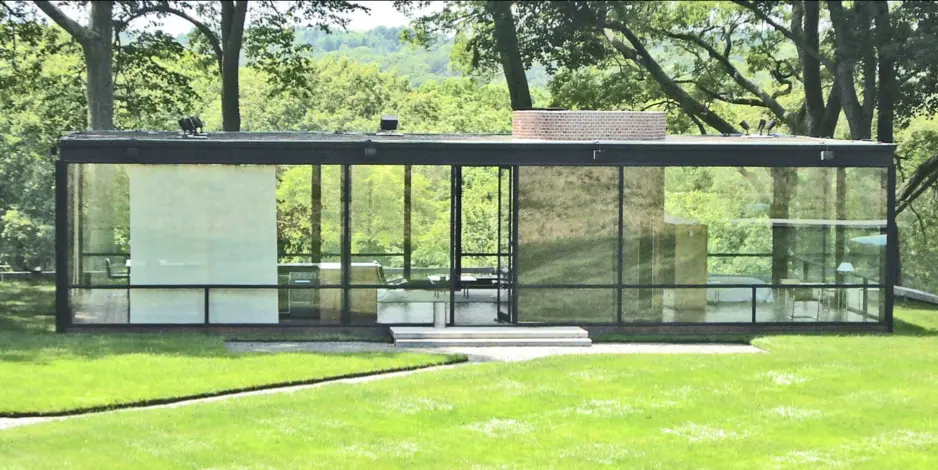
Eliot Noyes’ own home became one of the clearest examples of that idea.
“With these new materials and these new techniques,” Noyes said, “we can think of a house as being part of nature, not against it, but integral with it.”
The house opened itself to the surrounding woods through expansive glass and an arrangement of connected pavilions. Rather than standing apart from nature, the structure allowed its occupants to experience it — the sound of birds, the changing seasons, even the snow outside the windows.
Yet Noyes’ influence would extend far beyond residential architecture.
Through his work with IBM, he helped create one of the earliest examples of a comprehensive corporate design program. Working alongside IBM chairman Thomas Watson Jr., he helped unify everything from product design to graphics and advertising.
“He develops a program for IBM which touches on all of IBM’s face,” Fred Noyes said. “It is the graphics, it’s the way the advertisement works.”
Other companies soon followed, including Westinghouse, Mobil Oil and Cummins.
The underlying idea was that design could shape not only objects and buildings but organizations themselves.
Now Fred Noyes hopes to continue that legacy through the Eliot Noyes Center, an initiative intended to bring together thinkers from different fields to address modern challenges.
The goal, he said, is not to replicate the past.
“If you are looking at Eliot Noyes or Philip Johnson and saying, ‘wow, weren’t they terrific? We ought to be practicing the way they practice,’ the answer is no,” he said. “That was just right for their time.”
Instead, the aim is to carry forward the same spirit of experimentation that once turned a small Connecticut town into a laboratory for modern design.