By Peter Barhydt
The New Canaan Planning and Zoning Commission held an initial review March 9 of a proposal to build a 14-unit affordable housing development at 30 Parade Hill Road.
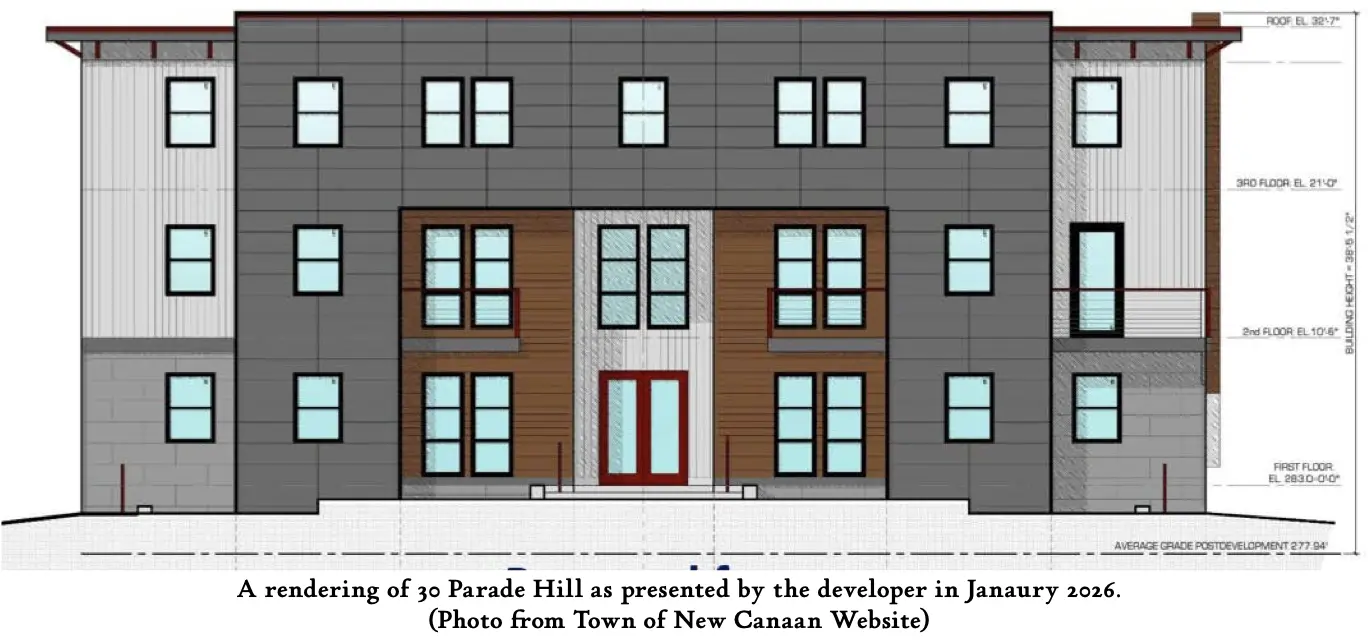
The application, filed by attorney Amy Souchuns of MacDermid Reynolds & Glissman on behalf of property owner GHF Parade Hill Road LLC, seeks site plan approval under Connecticut’s affordable housing statute, Section 8-30g. The proposal calls for a three-story residential building containing 10 two-bedroom units and four three-bedroom units.
The property, located in the B Residence and Half Acre zones, is approximately 0.37 acres, according to materials submitted to the commission.
Souchuns said the development would include 16 parking spaces and would be built by Garden Homes Fund in partnership with the Housing Collective, a nonprofit that works to place vulnerable residents into housing.
“Once completed, the intent here is to sell 30 Parade Hill below costs to an area housing nonprofit,” Souchuns told the commission.
She said the developer deliberately limited the scale of the project compared with what might otherwise be possible under state law.
“We have intentionally underbuilt this site,” Souchuns said, noting that the proposal is lower in height and coverage than some other affordable housing developments in New Canaan.
The project is being proposed under Connecticut’s 8-30g affordable housing statute, which allows developers to seek approval for qualifying housing even if it does not comply with local zoning regulations. However, the law still requires the commission to review issues related to health, safety and other statutory standards.
New Canaan currently has a state-approved affordable housing moratorium in place through August 2028, but some assisted housing proposals are exempt from that moratorium.
Souchuns said the applicant believes the project qualifies for an exemption because it includes assisted housing with fewer than 40 units.
The plan submitted to the commission includes two possible affordability structures. Under a default plan, five units would be reserved for voucher holders at 50% of area median income, six units would be restricted at 80% of area median income and three units would be market rate.
An alternate plan would increase the number of deed-restricted units, reserving five units at 50% of area median income, another five at the same level, and four units at 60% of area median income. The developer said the alternate plan would produce more state “housing unit equivalent” points for the town.
Commission members raised questions about the legal interpretation of the statute and asked the applicant to provide additional supporting materials.
Several commissioners also focused on how vouchers would be used in the project. David Rich, president and CEO of the Housing Collective, said the organization works across Fairfield County to match homeless individuals and families with housing and support services.
“Our job is to make sure that the system works,” Rich said. “We have the resources, we have the vouchers, we have the services. We simply lack the housing.”
Rich said the organization manages more than 1,000 housing vouchers throughout Fairfield County and works with local partners to place residents in available units.
Commissioners also raised questions about traffic safety and pedestrian conditions along Parade Hill Road.
Commissioner John Kriz said the road is narrow, has no sidewalks and already presents safety concerns.
“Public safety is sort of the number one thing I think about when I think about any kind of development,” Kriz said.
The applicant said the submission includes sight-line information but does not include a full traffic study.
“It’s 14 units in a site plan. We didn’t think it was necessary,” Souchuns said.
Chairman Daniel Radman said the commission would likely require one.
“I’d like to see a proper traffic study,” Radman said, adding that the analysis should include pedestrian traffic.
Design and site layout also drew discussion. Radman questioned the proposal’s layout, which places parking and a trash enclosure at the front of the property.
“Having all of the parking at the front of the property, having the trash enclosure at the front of the property, [is] not exactly a very attractive approach to a building,” Radman said.
Richard Freeman, president of Garden Homes, said the development team studied several layout options but found that moving parking behind the building would increase impervious coverage and conflict with fire access requirements.
Freeman said the project was conceived as a nonprofit effort intended to add housing without maximizing the site.
“This is a philanthropic project,” he said.
Commission members encouraged the developer to work with the town on design details and materials to better fit the surrounding neighborhood.
They also raised questions about landscaping, screening for the parking area and outdoor play space for families.
Freeman said two ground-floor units would be designed as “handicapped adaptable” units but confirmed the building would not include an elevator. He said avoiding an elevator is important to keeping construction and long-term maintenance costs lower.
After discussion, the commission voted to continue the application and hold a formal public hearing at its March 31 meeting.