Running a community newspaper in the current era requires a certain tolerance for contradiction.
Our practice has generally been to let the newspaper itself serve as the response to criticism. We rarely engage directly in disputes about the paper, especially from those who never even reach out to us about them. Yet it would be dishonest to suggest that persistent distortions and personal attacks go unnoticed by the people who produce it. Editors, reporters, photographers, and contributors are members of this community as well.
Every community newspaper learns, sooner or later, that sincere work is not appreciated at all by those with an agenda.
The Sentinel is criticized from many directions. Often not to us directly, but rather through the insidious muscles of social media, innuendo, and rumor. From one side come claims that the paper favors Democrats and dismisses conservative voices—too much coverage of environmental issues, some say. From another come accusations that the Sentinel promotes conservative viewpoints or advances the interests of the political right—and too much religion.
Rumors circulate with confidence: that the paper is owned by outside ideological groups, that it promotes a partisan agenda, that it harbors hostility toward one political faction or another.
In the internet age, speculation travels quickly and needs little in the way of truth.
The truth is far less dramatic—indeed, even a bit boring.
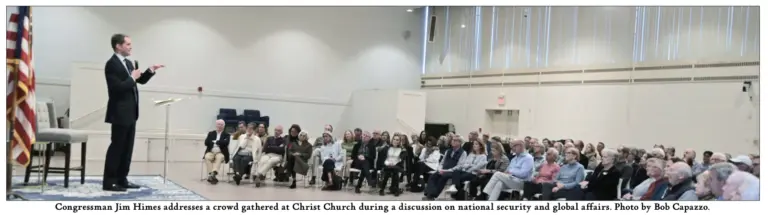
The Sentinel’s purpose is very simple: to serve the civic life of this community. As Congressman Jim Himes once joked during a Sentinel Award presentation, “We all know the Sentinel leans … into community.”
Most of what fills the newspaper is the ordinary but essential record of a town living its life. We rarely hear complaints about the obituaries, the community calendar, the worship pages, or the real estate columns. Politics, which occupies less space, receives disproportionate scrutiny and is often examined through a magnifying glass by those involved in it.
Of course, newspapers are produced by human beings working under deadlines. Errors occur. When they do, they should be corrected.
But there is a difference between acknowledging mistakes and accepting claims that bear little resemblance to the paper itself.
One curious feature of the criticism directed at the Sentinel is that much of it contradicts itself. All of the claims cannot simultaneously be true.
They do reveal something about the present moment. Increasingly, institutions are expected to serve the interests of particular factions. If they do not, they become targets.
A community newspaper must resist that expectation while still staying in print. It is not easy.
Many stories that fill these pages will never trend online. They report on students, volunteers, civic organizations, houses of worship, youth teams, and local initiatives. Yet these stories provide the shared civic record of the town.
The sharpest criticism often arises not from what appears in the paper but from what does not. Quite a lot of frustration stems from the belief that a specific viewpoint, individual, or cause deserved more coverage.
Across the country, local newspapers have closed as advertising migrates to digital platforms. Communities that lose their local paper often discover that something essential disappears with it: the common narrative of a place. In the absence of that shared record, blogs and online hostility often fill the space.
So we offer a straightforward request.
If readers encounter coverage they believe is inaccurate or unfair toward a particular individual or group, we ask them to contact us directly. Write a letter. Send an email. Come to the New Canaan coffee. Participate in the civic exchange that a newspaper exists to support.