By Sentinel Staff
The Project Development Subcommittee of New Canaan’s Affordable Housing Committee spent much of its March 11 meeting doing the slow, unspectacular work that often matters most in local government: testing ideas against geography, traffic, drainage, parking and public temperament.
The committee reviewed conceptual site plans for three town-owned properties — Richmond Hill, Locust Avenue and the Lumberyard lot — as it moves toward a public meeting and, possibly, a survey process intended to help shape a recommendation to elected officials.
Committee members said they are not yet asking the public to choose a final plan. Rather, they are trying to understand the strengths and liabilities of each site before bringing the options forward.
“I think that’s how we will present it to the public,” one committee member said. “Each of these site plans offers a series of trade-offs.”
Those trade-offs came into focus quickly.
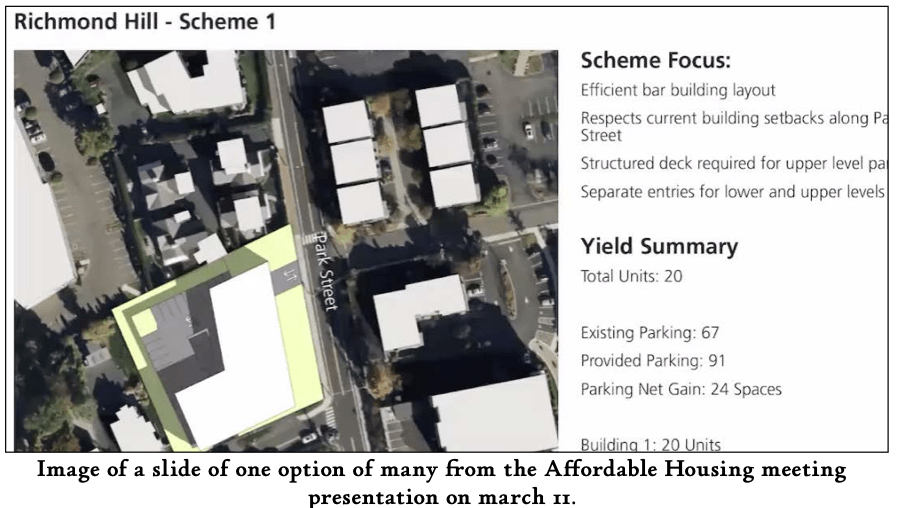
At Richmond Hill, discussion centered on two smaller concepts, one with a single apartment-style building and another with a townhouse-style design. Staff and committee members returned repeatedly to one theme: Richmond Hill may offer a more manageable first step, even if it does not produce as many affordable housing units as the larger sites.
Town Planner Sarah Carey said the townhouse-style option “could be a really attractive site for that type of development” if the town chose a project that would not by itself deliver a full state affordable housing moratorium. She also said the design appeared more compatible with nearby buildings.
Tiger Mann, the town’s public works director, went further, calling it “very elegant; it could be an elegant design for this location.”
Parking remained a live issue. Committee members noted the existing lot often appears underused in practice, though Jane Williams reported that parking manager Stacy Bass had said Richmond Hill still has an active waiting list for permits. Williams said Bass reported a wait list of 18 for Richmond Hill, and said new permits have been put on hold as more commuters return to offices.
There was also discussion of whether an adjacent property with unused subsurface parking capacity could someday help offset disruptions.
Drainage did not appear to alarm staff about Richmond Hill. Town Engineer Maria Coplit P.E. said engineering solutions were available and that the area is already “a substantially impervious lot.”
The Locust Avenue site drew a more mixed response. Its central location and higher unit counts make it attractive on paper, but staff raised sharper concerns about traffic, historic district impacts and the visual effect of a large structure in a sensitive downtown setting.
Carey said one Locust concept “also having some like public issues,” adding that the site is close to downtown, the historic district, Husted Lane apartments and newer Forest Street development. She warned that committee members should be candid if the project would exceed the density of other major local developments.
Traffic and parking circulation were a major focus. Coplit noted that earlier reviews had found that putting more cars onto Locust could stress fire department operations. She suggested one possible solution: using topography to split parking access between Locust and Heritage Hill, with separate levels feeding from each side.
That, she said, might improve efficiency because “ramps actually are what make parking garages and parking levels inefficient.”
The Lumberyard site inspired the broadest ambition and the greatest caution. Because of its size and proximity to the train station, it offers the clearest opportunity for transit-oriented development and the largest number of units. One concept discussed would yield 156 units; another, 163 units.
But the scale of the project, and the requirement to replace 354 existing parking spaces while also parking new residents, led to talk of garages with more than 500 spaces and costs that could exceed $100 million.
Committee members and staff seemed to admire the possibilities while doubting the politics.
“It’s pretty big garage, not going to lie,” one committee member said.
Carey suggested the town may be wiser to begin with a smaller parcel. “My gut is that one of the other two parcels would be a better, a smaller bite,” she said. “It would be a good way to kind of cut your teeth.”
Others worried that the Lumberyard lot, long the subject of competing visions in town, could again become a magnet for conflicting demands. Carey said the perception persists that the site has too many possible uses for any single one to prevail. Another participant warned that even a strong plan could face “death by a thousand cuts.”
By the end of the meeting, there was no consensus around a preferred site. But there was a subtle narrowing of mood.
Richmond Hill appeared to emerge as the most realistic near-term option. Locust remained plausible but difficult. Lumberyard, for all its promise, looked like the kind of grand project towns admire from a distance and struggle to bring to life.
The committee is scheduled to meet again March 25 to discuss its public process.