Can Fairfield County grow without becoming less livable?
By John Engel
Norwalk is growing faster than anywhere else in Fairfield County. Former office buildings are becoming apartments. Industrial waterfront is becoming public boardwalk. Manresa Island is planned as a 125-acre public park. Wall Street is adding affordable housing. South Norwalk is adding hotel and harbor activity. East Norwalk is adding train-oriented rentals. West Avenue is trying to lease more than 1,000 new apartments.
Norwalk is Fairfield County’s live experiment in housing, density, waterfront access, affordability, office conversion, and neighborhood identity. The question is whether growth will make Norwalk more livable, or simply more crowded and expensive.
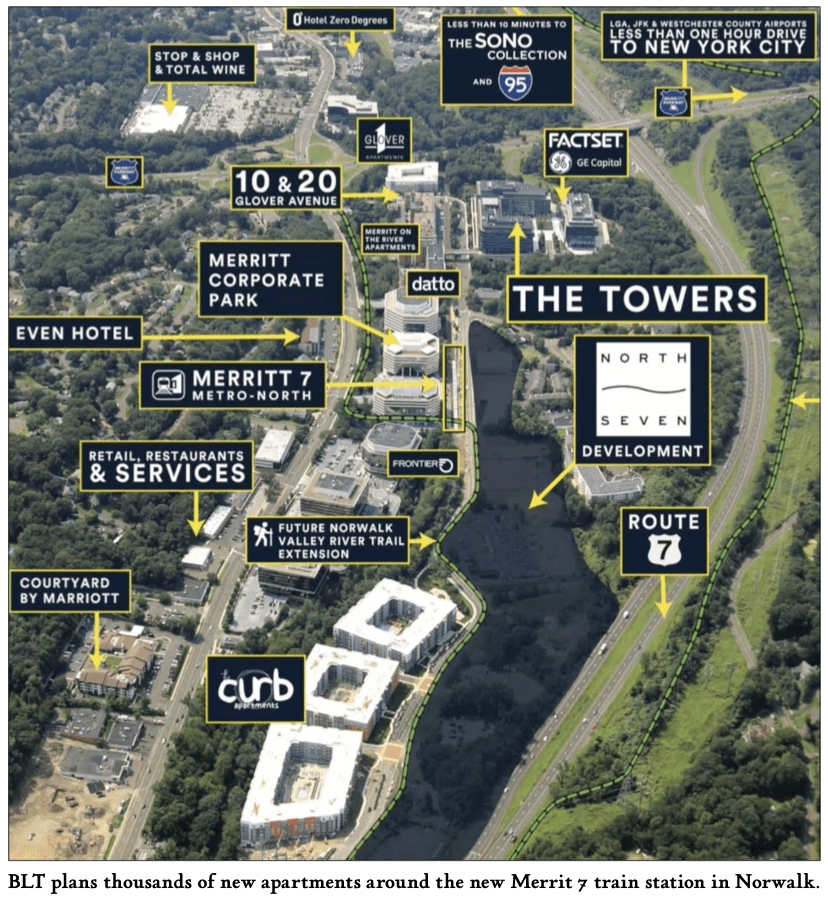
1. Merritt 7 is testing whether an office park can become a neighborhood.
Merritt 7 was built between 1980 and 2002 for a different work culture. Offices, parking garages, car access, corporate tenants, and weekday activity were the model. That model is changing.
In February, Norwalk approved the conversion of two former Merritt 7 office buildings into 300 apartments: 56 studios, 182 one-bedrooms, and 62 two-bedrooms, with 27 affordable units. The plan also reduces parking and turns parking areas into amenities, including a lawn, pool, barbecue area, dog park, gym, yoga studio, game room, and coworking space.
Therefore: Merritt 7 is the first train test. Can a suburban office park near a station become a mixed-use village, with housing, work, amenities, transit, and daily life in one place?
2. North Seven is testing the scale question.
Across the Merritt 7 station area, North Seven is planned as one of the most ambitious apartment concepts in lower Fairfield County: more than 1,200 apartments across seven buildings, plus retail, amenities, and public space.
Most Fairfield County towns would never absorb that much new multifamily housing in one location. Norwalk is being asked to try.
Therefore: North Seven is the second train test. Can a new apartment district next to a station absorb regional housing demand without overwhelming the roads, schools, tax base, and neighborhoods around it?
3. West Avenue is testing apartment absorption.
West Avenue may be the clearest evidence that Norwalk’s apartment boom is real. The former YMCA site at 370 West Avenue is now Scribe, a 200-unit luxury apartment building developed by RMS Companies, with rents reported from $2,600 to $4,880. Across the corridor, Toll Brothers’ Piper at 467 West Avenue adds 393 apartments, about 40 workforce units, street-level retail, and a large parking garage. The Waypointe at 515 West Avenue already added 464 units, and Quincy Lofts added another 69.
Together, those named West Avenue projects alone total more than 1,100 apartments.
Therefore: West Avenue is the lease-up test. Norwalk is trying to absorb hundreds of new rentals at the same time, at rents that show both demand and strain.
4. South Norwalk is testing mixed-use waterfront development.
South Norwalk already has the train station, Washington Street, the Maritime Aquarium, restaurants, nightlife, marinas, old commercial buildings, and Norwalk Harbor. What it has lacked is a more complete mixed-use waterfront model, with housing, hotel, restaurant use, office space, boat slips, green space, and public access working together.
At 108 Water Street, Spinnaker’s approved plan includes 59 apartments, a 130-room hotel, about 29,000 square feet of office space, restaurant and service uses, boat slips, green space, and a public boardwalk on a 2.72-acre harbor site.
Therefore: SoNo is the third train test. Can a train-served harbor district become a complete mixed-use waterfront neighborhood, with hotels, restaurants, offices, marinas, housing, public access, and street life working together?
5. Manresa Island could become Norwalk’s defining public asset.
Manresa may be the biggest swing factor in Norwalk.
The former power plant site is planned as Manresa Wilds, a 125-acre publicly accessible waterfront park. The first phase, called the Northern Forest, covers 28 acres and is expected to open in spring 2027. Plans include restored habitat, trails, educational spaces, gathering areas, parking, restrooms, and eventually, broader public access to a site that was closed off for generations.
Therefore: Manresa could change how people understand Norwalk’s coast. It benefits Harbor View, Village Creek, Wilson Point, Rowayton, South Norwalk, and the broader city brand.
6. East Norwalk is testing neighborhood-scale train development.
Ardea Pointe at Mill Pond, 77 units at 1 Cemetery Street, sits two blocks from the East Norwalk train station. The project includes 5 studios, 34 one-bedrooms, 23 two-bedrooms, 13 three-bedrooms, 2 four-bedrooms, 7 workforce units, ground-floor retail, and rents reported from $2,250 to $6,650 per month.
Therefore: East Norwalk is the fourth train test. Can smaller-scale development near a station add housing and value without overwhelming the neighborhood around it?
7. Wall Street is testing whether residents can revive a downtown.
Wall Street has had false starts, stalled projects, empty promises, and long memories. The new question is whether residential density can do what retail nostalgia could not.
The Wall Street Place redevelopment includes 105 affordable units at 61 Wall Street and another 50 units at 17 Isaacs Street. The broader project has been reported at about $125 million, with units aimed at households earning 30 percent to 80 percent of area median income.
Therefore: Wall Street’s future may depend on residents first. More people living downtown creates the customer base that area restaurants, shops, services, and street life need.
8. Main Avenue is testing whether approvals become projects.
Norwalk’s growth is also showing up along older commercial corridors. At 272-280 Main Avenue, the city approved a mixed-use plan in June 2024 with about 19,000 square feet of retail, 10 apartments, one workforce unit, a coffee shop, a restaurant, EV charging, and 196 parking spaces. Then the five-acre site was listed for sale for $15 million, with the approval already in place.
Therefore: Main Avenue is a different kind of test. It tests not only whether older retail corridors can evolve, but whether approved plans actually get built, or become more valuable land deals waiting for the next buyer.
9. Norwalk is testing whether supply can solve affordability.
Norwalk shows how hard affordability is to solve. More than 10% of its housing stock already qualifies as affordable under Connecticut law, and thousands of new apartments have been built or proposed. Yet rents remain high, with average rent around $2,536, two-bedrooms around $3,299, and three-bedrooms around $4,015. The vacancy rate is still only 3.2%, and nearly 14,000 households spend more than 30% of their income on housing.
Therefore: New housing may slow rent growth, but it does not automatically make a successful city affordable.
10. Norwalk is testing whether one city can hold many markets.
Rowayton, SoNo, East Norwalk, Silvermine, Cranbury, West Norwalk, Wilson Point, Harbor View, Wall Street, Merritt 7, West Avenue, Manresa, and Main Avenue do not behave like one market. Rowayton trades like a coastal village. SoNo trades around train access, restaurants, apartments, and harbor energy. East Norwalk is being pulled toward station-area development. West Avenue is testing apartment absorption. Silvermine and Cranbury are more suburban and single-family.
Therefore: Norwalk’s strength is range. It can absorb apartments near trains, along West Avenue, and on the waterfront while still offering coastal village life in Rowayton and single-family neighborhoods in Silvermine, Cranbury, and West Norwalk.
Five questions Norwalk will answer:
Can the train stations create different kinds of growth? Merritt 7 tests office-park reinvention. North Seven tests new apartment density next to a station. SoNo tests train-served waterfront redevelopment. East Norwalk tests smaller-scale station-area development.
Can West Avenue lease all this new supply? Scribe, Piper, Waypointe, and Quincy Lofts represent more than 1,100 apartments in one corridor. If they lease smoothly, it confirms deep demand. If concessions rise and vacancy persists, it shows the limit of the luxury rental market.
Can waterfront redevelopment create public value? Water Street and Manresa matter because they include boardwalk, parkland, trails, harbor access, habitat restoration, and public use.
Can affordability survive success? Norwalk has added affordable units and exceeded the state threshold, yet thousands of households still spend more than 30% of their income on housing.
Can Norwalk remain several markets inside one city? It has to. Norwalk’s strength is variety. The risk is that growth flattens that variety into one expensive market.
Norwalk is unique because it is doing several difficult things at once. It is adding apartments, converting offices, rebuilding waterfront, creating public access, supporting affordable housing, absorbing train-area density, reworking older commercial corridors, and still trying to protect neighborhoods with very different identities.
Therefore, Norwalk is Fairfield County’s test case. The outcome will tell us whether growth can make a city more livable, or whether it simply makes a city more expensive.
John Engel is a broker with The Engel Team at Douglas Elliman, covering Connecticut. He believes Norwalk matters more to New Canaan than almost any other neighboring town. We shop there. We eat there. We go to the water there. And if these developers are right, many of us may eventually move there, either because New Canaan has become too expensive, or because we no longer need the schools and want more convenience. That is why the Norwalk question should matter to every New Canaanite.