By John Kriz
Editor’s Note: This article is based on interviews with New Canaan’s Fire Chief Albert Bassett and Fire Marshal Paul Payne, and focuses on fire extinguishers for the home.
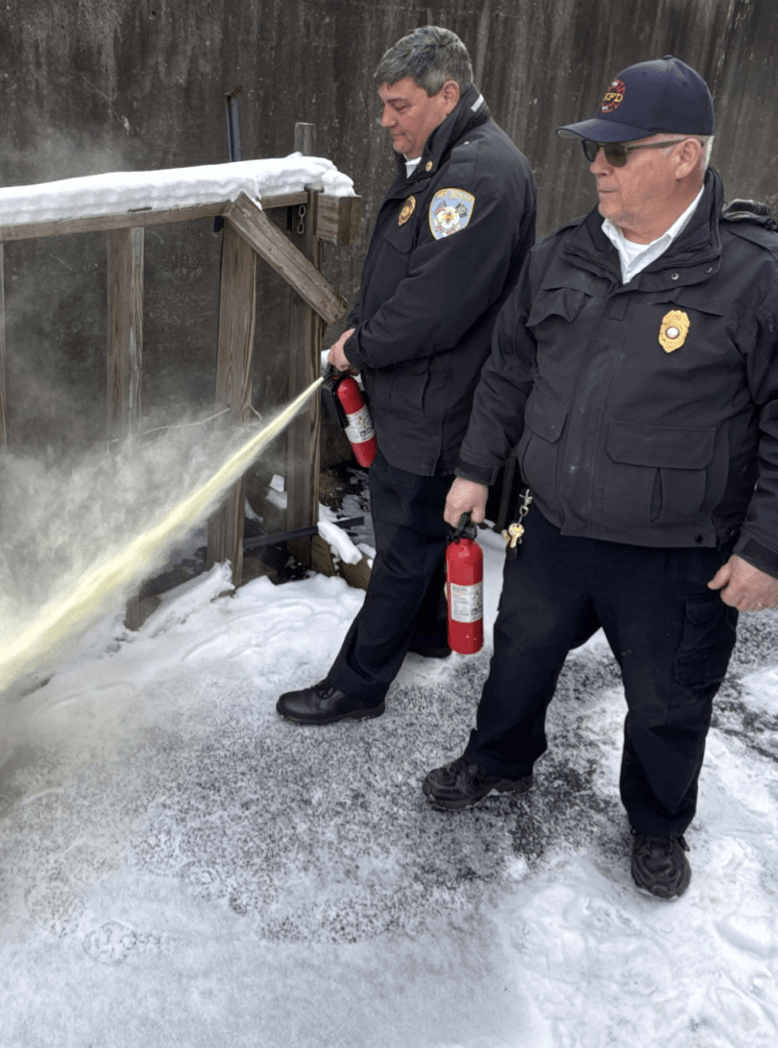
proper use of a typical fire extinguisher for the home.
What are the types of fires and fire extinguishers?
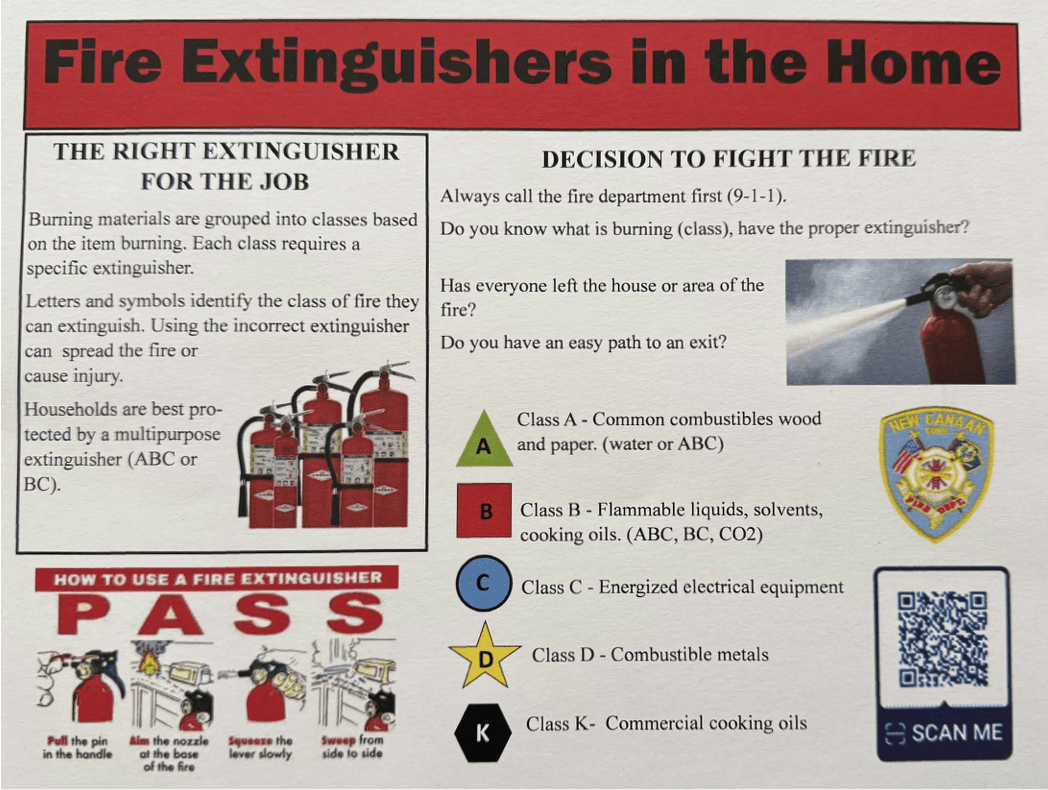
Typical home fires are ‘A, B or C fires’: ‘A’ for combustibles like wood, paper or fabric; ‘B’ for cooking oils and grease – kitchen fires of these items are the most common household fires – and ‘C’ for electric, such as an outlet or something plugged into it.
The best fire extinguisher for the home is a so-called A,B,C multi-purpose extinguisher, which can tackle these typical home fires. You find them at most hardware stores.
The fire extinguishers you often see on TV with a big funnel at the end that emits a huge white cloud are called carbon dioxide extinguishers, and they only are effective against class B and C fires. They work by cutting off the oxygen feeding the fire. They tend to be used by firefighters or in commercial settings such as a commercial kitchen, with their big hot oil fryers.
What’s in an A,B,C multi-purpose extinguisher?
It’s a powder of baking soda and some other chemicals that coat whatever is burning and smother it.
How big an extinguisher does one need for a typical home?
A so-called one pound extinguisher should suffice. This means a pound of stuff in the extinguisher to smother the fire.
And how many do I need?
Probably two or three.
Where should I put them?
Definitely one in the kitchen, preferably hung on a wall near a door to the outside. Why? If you end up needing a fire extinguisher, you want easy, quick access (do not keep it in a cupboard!), and you want it near an escape route if it comes to that. Think of it this way: there’s a small fire in the kitchen. You first call 911, then rush for the extinguisher. By the time you get there, the fire is much bigger. At that point the best choice is likely to just leave, and get everyone else out of the house, too. Plus most home fires are in the kitchen, and time counts. You should also consider putting one in the basement, and maybe in the garage or workshop.
If there is a fire what should I do first?
Call 911. One you’ve done that, and you think the fire is not so big or fast moving that you need to promptly skedaddle, get the extinguisher and use it.
How long until the extinguisher empties when in use?
For a one pound extinguisher, about 30 seconds.
Thirty seconds?! Is that enough?
Yes, probably. Most fires will be extinguished after 2-3 seconds of use by an extinguisher. Note that extinguishers are best suited for so-called ‘incipient fires,’ meaning ones that just started. If the fire has really spread and engulfed nearby items, get out!
OK, I am holding the extinguisher. How do I use it?
Think PASS: Pull the safety lock; it’s usually a ring, pin or plastic wire. Aim the nozzle at the base of the fire. Squeeze the trigger. Sweep from side to side.
Is the extinguisher heavy? Does it ‘kick’ when used?
A one pound extinguisher is not very heavy, with no ‘kick’. However, you might want to have one hand on the handle and trigger, and another on the bottom, to help steady and aim it.
How close to the fire should I get?
It depends on how comfortable you are given the circumstances. An extinguisher can shoot 20 feet. You want to be as close as you can. Try starting from a bit of distance, and then move closer. But note this: If you’re at all uncomfortable, just get everyone out of the house and wait for the cavalry to come. (You did call 911, right?)
OK, the fire is out. So all clear?
No! You did call 911, right? There is a thing called ‘flashback’, when the still hot, but not burning, oil or paper reignites. Let the firefighters check things out and ensure all is safe.
OK, I used my extinguisher. Is it still good?
No. While there might still be powder inside, it will be depleted, and the internal pressure has been weakened. It’s really a single-use item. Take it to the transfer station and put it in metal recycling. And buy a new one.
What about using good old water?
Water can work well with wood and paper fires, and especially fires in couches and mattresses because the water will soak in and reach the interior of the item. Never use water on a grease or electrical fire. The burning grease will float, and perhaps spill, making things worse. And water on an electrical fire can cause electrocution. Use the ABC extinguisher on those. And call 911!
I’ve had a fire extinguisher for a few years. Is it still OK?
Probably. The date of manufacture is usually inscribed on the bottom or side of the cylinder. Assume 10-12 years is a useful life. Also check the dial and ensure the arrow measuring pressure in the cylinder is in the green zone. Also, at least once a year take the extinguisher and gently shake it for a minute or two until you feel the powder inside moving. Why? The powder will settle over time, and it needs to be loose for maximum effectiveness.
I am still unsure how to safely and effectively use a fire extinguisher. Does the fire department hold classes?
Yes! The fire department welcomes civic and community organizations, and groups of neighbors, to arrange hands-on fire extinguisher training with firefighters. Just contact Chief Albert Bassett at 203.594.3140 or at albert.bassett@newcanaanct.gov
I want to protect my family. Does the town provide fire safety inspections for my home?
Yes! Fire Marshal Paul Payne performs these at no cost to homeowners. In 2025 he conducted about 100 such inspections, making suggestions on fire safety issues from chimney cleaning, to safe cooking methods to fire extinguishers. Just contact him at 203.594.3030 or at paul.payne@newcanaanct.gov
Stay Safe, New Canaan