By John Engel
I just met a man from Nebraska in the lobby who said, “What is the Glass House?” After my brief explanation he asked, “So, why is this important?”
I’ve written about some of New Canaan’s midcentury modern houses in this column, the Leuthold and Round Houses, and architects Laszlo Papp and Landis Gores. But the man from Nebraska is right: It’s time to start at the beginning and answer the fundamental question, “What is Modernism, and why should we care?”
And why now? Because the New Canaan Playhouse is about to premiere Modernism, Inc., The Eliot Noyes Design Story on Sunday, March 1, and the Eliot Noyes Center is about to open. This is a big week for Modernism in New Canaan.

So, what is Modernism?
For most of human history, architecture meant one simple thing: walls holding up a roof.
Mud brick in Mesopotamia. Timber framing in Medieval Europe. Colonial saltboxes in New England. The walls were thick because they had to be. They carried the weight. Windows were small because cutting too much out of a wall weakened the structure.
Even when steel arrived in the late 19th century and skyscrapers began to rise, most houses were still built the old way. The walls did the work.
Modernism changed that.
Once steel and reinforced concrete columns could carry the structural load, the walls were relieved of duty. They could thin out. They could open up. And finally, they could disappear.
That structural shift — the freedom from load-bearing walls and the move to a skeletal frame — coincided with other key developments. Newly available materials like glass and concrete, changes in labor building skills, and, importantly, a major shift in social organization all came together in this town. That makes New Canaan a special place for understanding the evolution in architectural thinking that marked the beginning of modern architecture.
In 1926, Le Corbusier gave the movement a vocabulary, outlining what he called the Five Points of Modern Architecture. The essence was simple: Lift the structure off the ground on columns, free the interior from load-bearing walls, free the façade from structural limits, stretch windows horizontally to bring in light, and reclaim the roof as usable space.
In other words, once structure was separated from walls, architecture became flexible. Space could flow. Light could enter. The exterior no longer dictated the interior.
In 1926, Le Corbusier gave the movement a vocabulary, outlining what he called the Five Points of Modern Architecture. The essence was simple: Lift the structure off the ground on columns, free the interior from load-bearing walls, free the façade from structural limits, stretch windows horizontally to bring in light, and reclaim the roof as usable space.
In other words, once structure was separated from walls, architecture became flexible. Space could flow. Light could enter. The exterior no longer dictated the interior.
That idea — separating structure from enclosure — changed everything.
And you can see it in the Glass House. Steel columns carry the weight. The walls are glass. The plan is open. The roof is flat. Nothing is pretending to be something it isn’t.
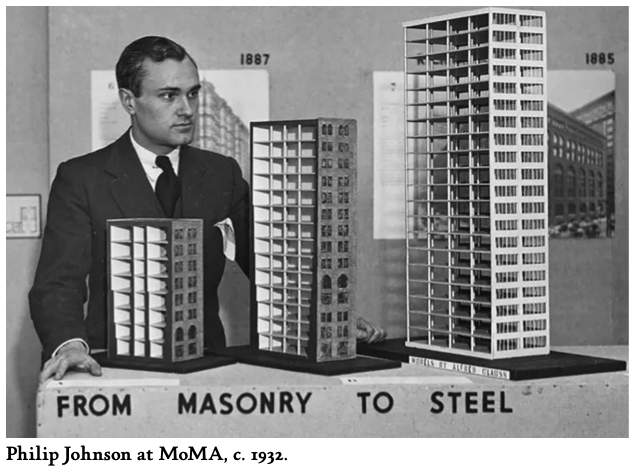
That leads us to New Canaan in 1946. Philip Johnson had served as curator of architecture and design at the Museum of Modern Art from 1932 to 1936, introducing America to the new European style. In 1946, he returned to MoMA as the Director of Architecture and Design, and that year, he bought the land on Ponus Ridge in New Canaan that would become the site of his famous Glass House.
Johnson’s greatest contribution to the Midcentury Modern movement might not be as an architect but as a promoter and catalyst of the movement. In New York, he curated major exhibitions: Modern Architecture: International Exhibition (1932); Machine Art (1934); Mies Van der Rohe (1947); From Le Corbusier to Niemeyer (1949); and Painting and Sculpture in Architecture (1949). In addition, to exhibitions educating the public to this new, European style of architecture, he designed MoMA’s East Wing (1951), Sculpture Garden (1953), Garden Wing (1964), and the East Wing Addition.
As for New Canaan, Eliot Noyes was the first to arrive and became the catalyst for modern building here. He started his search in Westport and rented there briefly before settling in New Canaan, persuading his friends and colleagues Philip Johnson and Marcel Breuer to join him.
Marcel Breuer is significant because he and Walter Gropius were rather famous Bauhaus architects who had fled Germany before the war. Gropius was personally recruited by the Harvard dean to head the architecture school there and replace the Beaux Arts style with modernism. In 1937, they began teaching a generation of students — Philip Johnson, Eliot Noyes, John Johansen, and Landis Gores among them. All eventually move to New Canaan, who, along with Breuer, became known as the Harvard Five.
Breuer moved to New York in 1946 and New Canaan in 1947 because he found it difficult to raise his young son in New York City and because he wanted to be close to his student, Eliot Noyes, who had recently built a house in town. Johnson purchased five acres on Ponus for his own house in 1946, and by 1947, Breuer had done the same on Sunset Hill.
Landis Gores co-designed The Glass House with Johnson, drafting 27 different versions while they worked side by side from 1945-1951. Noyes supervised Breuer’s house construction while Breuer was working in South America. Johansen was the rebel of the group, designing the Bridge House (1957) and the Upside Down House (1950).
Those houses were not isolated experiments. The ideas tested here would echo in office towers, corporate campuses, and homes across the country.
But the influence of these architects and their ideas spread way beyond houses and skyscrapers, and I suspect that is the main point of the film.
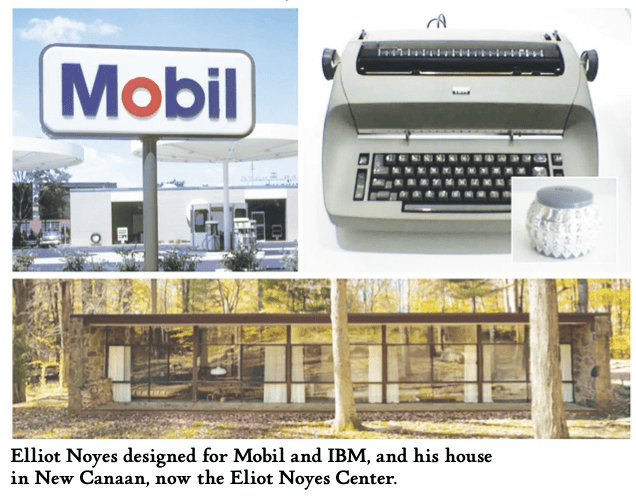
For Eliot Noyes, influence in architecture was not enough. Industrial design became a secondary focus for him. Even further, he worked with top management to help reorganize the structure of businesses themselves. His work for Mobil Oil and IBM transformed how companies thought about design.
Every gas station in America with a modern canopy over the pumps traces back to Noyes’s designs for Mobil Oil — an early example was implemented here in New Canaan. Typewriters, once complicated mechanical tools, became simpler and more elegant in Noyes’s IBM Selectric of 1961, now on display at the New Canaan Museum and Historical Society.
As Noyes said, “Good design is good business,” a phrase picked up by Thomas Watson Jr., IBM’s CEO.
It wasn’t a slogan. It reflected a shift in thinking: Design was not decoration added at the end. It was fundamental to the product, the building, even the process. Every visible element contributed to a unified whole.
That principle — that form and function are inseparable — is now so normal we barely notice it. Apple didn’t invent it. IBM didn’t invent it. The roots run straight through Noyes, through MoMA, through the Bauhaus, and through New Canaan.
So, when someone asks, “Why is the Glass House important?” the answer isn’t because it’s made of glass.
It’s important because it represents a moment when architecture stopped pretending. Structure became visible. Space became flexible. Light became intentional. The house became a frame for living instead of a decorated box.
And that thinking didn’t stop in 1951.
Look at Grace Farms. The River Building — that long, quiet ribbon of glass and steel designed by SANAA — floats over the landscape in a way that would have made Philip Johnson smile. Structure is minimal. Walls dissolve. The building bends with the land instead of dominating it — ’50s ideas that have moved forward into the 21st century.
Grace Farms is a wonderful example of how Modernism isn’t a style frozen in time. It’s an ongoing conversation about light, structure, landscape, and restraint. The fact that one of the most significant contemporary buildings in America sits here, in the same town as the Glass House, is not an accident. It’s continuity.
That’s why this week matters. A film about Eliot Noyes. A design center opening. A renewed look at what happened here, starting in 1946.
Before we dismiss a flat roof or a glass wall as “just midcentury,” it’s worth remembering its origins: A group of architects came to a small Connecticut town and experimented with a new way of building. The ideas they tested didn’t stay here. They spread — into offices, into products, into campuses, into the open floor plans buyers now expect.
That’s why this week feels significant: not because we’re celebrating old houses, but because we’re being reminded that something real began here.
Note that as of this writing, the 6 p.m. show is sold out, and they’ve added a 6:30 show. Tickets are available at the playhouse website: playhouse.cinemalab.com/home.
John Engel is a broker with The Engel Team at Douglas Elliman, and his interest in modern design is not academic. His grandfather, Eugene Casey, learned industrial design working for Walter Dorwin Teague and Raymond Loewy in Manhattan before moving his firm, King-Casey, to Pine Street in New Canaan. There, he designed the green American Express card and the Merrill Lynch bull. John grew up around conversations about branding, structure, and strategic design. On Sunday, he will be in the audience when Fred Noyes introduces the film about his father. He understands what that moment feels like.