By Peter Barhydt
A gathering of about 200 designers, educators and community members in New Canaan recently celebrated the legacy of influential architect and industrial designer Eliot Noyes, while looking ahead to how his ideas about design and creativity can shape future generations.
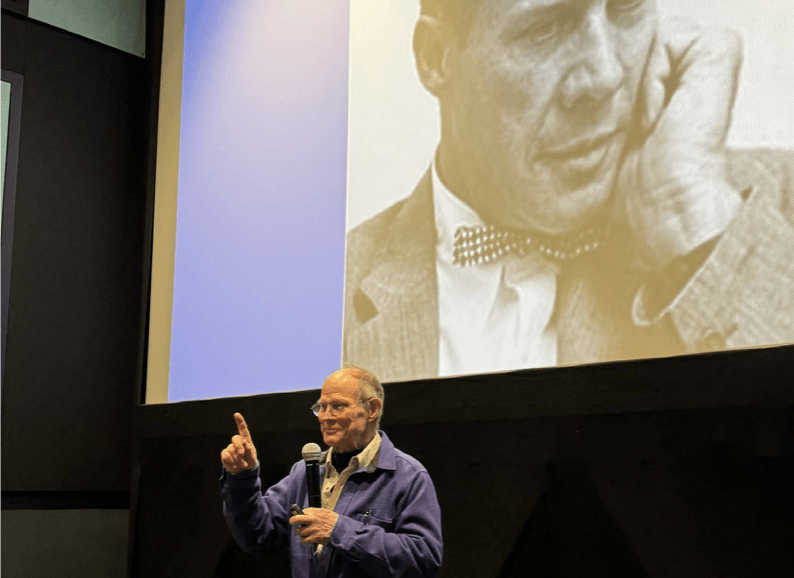
The event, held downtown at The Playhouse, featured a screening of “Modernism, Inc.” about Noyes followed by a wide-ranging discussion led by his son, architect Fred Noyes, along with colleagues and family members. The conversation touched on the origins of the film, the cultural moment that produced the group of modernist architects known as the ‘Harvard Five,’ and the role New Canaan played in fostering one of the most significant design communities of the mid-20th century.
Fred Noyes opened the evening by announcing that the Eliot Noyes Center www.eliotnoyescenter.org is now actively developing programs to connect students and designers with New Canaan’s architectural heritage.
“We’re looking to establish connections with students and institutions who want to engage with the richness that’s here in New Canaan,” Noyes said.
He introduced two students involved in early outreach efforts: June Lee, a Harvard senior studying urban design, and Lucas Lou, an industrial design student at the Rhode Island School of Design (RISD). Lee has been working with the center over the past year and recently brought a group from the Harvard Architectural Undergraduate Society to New Canaan to explore the town’s modernist landmarks.
Noyes said similar collaborations are being explored with RISD, the Pratt Institute and other universities. The goal is to encourage informal exchanges among students and the town’s design community, and to help younger generations see design as a broad way of thinking.
“Design is a way of looking at the world,” Noyes said. “You design when you get dressed in the morning, when you plan a dinner party, when you decide how things relate to each other.”
The film itself grew out of a long-standing belief among colleagues that Noyes’ father deserved a documentary. The project was ultimately produced by filmmaker Jason Cohn, known for a documentary about Charles and Ray Eames, another pair of influential modernist designers.
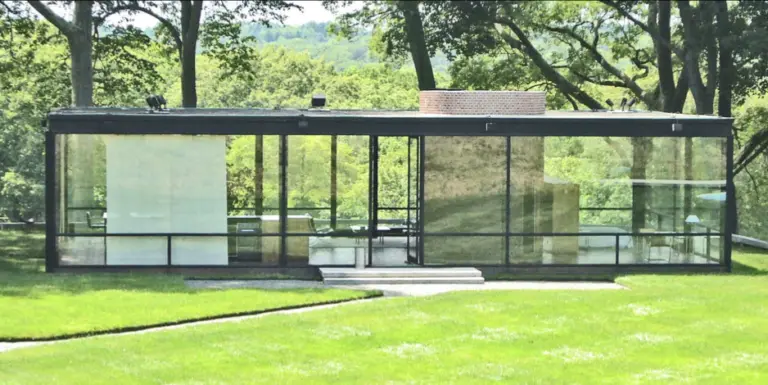
During the discussion, audience members asked what it was like growing up in New Canaan during the formative years of the Harvard Five — the group of architects including Philip Johnson, Marcel Breuer, John Johansen, Landis Gores and Eliot Noyes who helped define American Modernism. (Eliot Noyes lived in New Canaan with his family for many years and built an iconic house here.)
Fred Noyes said that when he was a child in New Canaan, the architects who would later become internationally known were simply neighbors building careers and raising families.
“They weren’t famous,” he said. “They were just out of school trying to figure out how to make a living.”
The period following World War II proved fertile ground for experimentation, he explained. New materials such as steel, glass and concrete were becoming widely available, while social and economic changes were reshaping how homes were designed.
“You didn’t have the servant class anymore. Housewives were in the kitchen. Labor was different. Materials were different. Economics were different,” Noyes said. “It was almost inevitable that there would be invention.”
His sister, Meredith Noyes Bruce, reflected on how the family environment shaped their sensibilities. Though she pursued a career in nursing rather than design, she said both parents instilled a deep awareness of aesthetics and relationships between objects.
“Every single thing you looked at, you had an opinion about its appearance, its shape, its color, its size and how it fit with everything else,” she said. “It becomes second nature.”
Speakers also discussed the broader cultural atmosphere that allowed New Canaan to become a hub for Modernist architecture. With proximity to New York City and a small population at the time, the town attracted designers, writers and thinkers who influenced each other’s work.
“There are moments in history where things come together,” Noyes said. “Florence had Michelangelo and Leonardo. Amsterdam had Rembrandt. In a smaller way, something like that happened here in New Canaan.”
But he emphasized that the town should not treat its architectural history as a museum piece.
“There’s no reason New Canaan has to be frozen in time,” he said. “Ideas have to keep moving forward.”
The evening also highlighted Eliot Noyes’ impact beyond architecture. His work as a design consultant to companies such as IBM helped shape the concept of corporate design and identity.
John Iwata, former chief brand officer at IBM, said Noyes’ writings in the company archives helped inspire a renewed investment in design decades later.
“He talked about the character of the company,” Iwata said. “It wasn’t about marketing or advertising. It was about something deeper.”
Others emphasized the importance of education and creative thinking in carrying those ideas forward. Industrial designer Gordon Bruce, who worked with Eliot Noyes early in his career, described applying similar principles when helping develop design education programs in Japan and at Samsung.
“Design is about relationships,” Bruce said. “It’s about understanding how things connect and making the highest quality judgments about those relationships.”
Organizers said the newly active Eliot Noyes Center hopes to continue hosting programs and partnerships that encourage that kind of thinking — both in New Canaan and beyond.
“Education is key,” Bruce said. “The goal is to give people the opportunity to expand their creativity and learn how design can shape every part of life.”