By Bob Giaquinto
The atmosphere was thick with the weight of global instability as Neal Wolin, the chief executive of the Brunswick Group and a veteran of the Treasury Department, took the stage to navigate a world that seemed to be tilting off its axis.
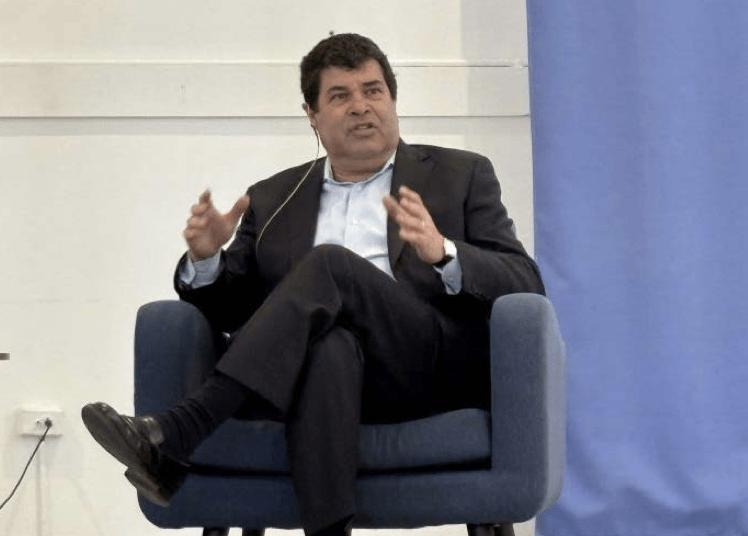
Wolin did not offer the comfort of simple answers. Instead, he presented a landscape defined by what he called an extraordinary moment in history. Wolin, who served as the deputy secretary of the Treasury under President Barack Obama and held key roles in the National Security Council, brought the perspective of a man who had seen the inner workings of power during the 2008 financial crisis. He argued that while the headlines were dominated by a sudden war in Iran and the ongoing Russian invasion of Ukraine, the most troubling issue was something more domestic and insidious: the fraying of democratic norms in the United States.
Wolin explained that the inability of the American political system to function—paralyzed by polarization and a lack of trust in basic institutions—made it nearly impossible to solve any other problem effectively. He noted that this institutional decay was not just a matter of “coarse” political speech but a fundamental “hollowing out” of the government that affected everything from healthcare to basic research.
The conversation quickly turned to the “gorilla in the room”—the escalating hostilities with Iran. Wolin observed that while a policy of strength was justifiable, the current administration’s objectives remained a moving target. He noted that the president and his top advisers, including the defense secretary and secretary of state, had at various times suggested goals ranging from destroying Iran’s missile and nuclear capabilities to outright regime change. Wolin was skeptical of the latter, reminding the audience that such ambitions often lead to long, unsustainable entanglements. He pointed to the immediate economic fallout, specifically the volatility in energy markets and the spike in gasoline prices, which he suggested would eventually force the president to declare a victory short of his original rhetoric.
Wolin’s background as a national security lawyer informed his critique of how the war was being conducted. He spoke at length about the 1974 War Powers Resolution, a post-Vietnam era statute designed to check executive overreach. He argued that the current administration was operating under a “maximal understanding of executive power,” bypassing Congress even when the situation was not a direct reaction to aggression against the United States. This trend, he warned, was part of a broader shift toward a “unitary executive” theory, an idea building for many years and currently being tested in the federal courts and the Supreme Court. Wolin emphasized that the founders intended for three co-equal branches of government to act as a system of checks and balances, a structure that distinguishes American democracy from the parliamentary systems common in Europe.
Turning to the global stage, Wolin described a world of “frayed nerves” among traditional allies. Having traveled extensively to Europe and Asia in his role at the Brunswick Group, a firm that advises global companies on geopolitical risk, he reported that countries like Australia, Germany, and the United Kingdom were beginning to “hedge” their strategies. They no longer view the United States as the steadfast partner it once was. He criticized the “America First” style of diplomacy, suggesting that “poking our finger in the eye” of the prime minister of Spain or the chancellor of Germany was counterproductive to long-term American interests.
On the subject of China, Wolin proposed a framework of “managed rivalry.” He acknowledged that while the United States must compete in technology—specifically in artificial intelligence, quantum computing, and semiconductors—it must also maintain cooperative lines with Xi Jinping, the general secretary of the Chinese Communist Party, on global threats like climate change and nuclear proliferation. He noted that Xi Jinping’s serious rhetoric regarding Taiwan must be taken at face value, even as the U.S. remains “overstretched” in other theaters.
The session concluded with a warning about the American economy. Wolin noted that the federal debt had crossed into the “rarefied air” of 100 percent of the gross domestic product. He warned that while the dollar’s status as the global reserve currency provides a cushion, the political system’s inability to address the deficit prophylactically would eventually lead to a crisis. As Neal Wolin hurried off to catch a flight, he left the room with the impression of a man who understands the fragility of the world and fears that the tools once used to steady it are being discarded.
The Retired Men’s Association’s (RMA) next presentation, “Shipwrecks and U-Boats: Amazing New England Coastal Sea Stories” by Eric Wiberg, is scheduled for 11 AM on Wednesday, March 25, 2026. RMA presentations are held at Christ Church in Greenwich.
In this compelling presentation historian Eric Wiberg relates the story of two German submarines dispatched to evade a blockade and obtain valuable war materiel from the United States in 1916—when the U.S. was still officially neutral in the European conflict. One was highly successful, and the other not. The British and its allies had imposed a strict blockade in the Atlantic and around ports of the Central Powers. The privately-funded German cargo submarines Deutschland and Bremen were designed to evade this blockade. On its first voyage to America the Deutschland carried a mixed cargo valued at $17.5 million to Baltimore, while on the second she reached New London with $.25 billion worth of gems, securities, and medicines, returning to Germany with at least six-and-a-half tons of silver bullion. It was then converted to a warship by the Imperial German Navy, sank forty-two Allied ships and cut telegraph cables at St. John’s and Nantucket. The Bremen was not so lucky. En route to Norfolk in 1916 with funds to start a submarine-building program in the U.S., she is believed to have been sunk by the Royal Navy off the Shetland Islands. These are but two stories of seaborne warfare during World War I.
Eric Wiberg is a sea captain and maritime historian, the author of over 45 non-fiction books largely on World War II. He has over 40 years’ experience in maritime, aviation, and military history, and has worked with the national archives of Bahamas, Bermuda, USA, Germany, Norway, Australia, and many others. A former resident of Connecticut, he now lives and writes in Boston.
To stream the presentation by Eric Wiberg at 11 AM on Wednesday, March 25, click on https://bit.ly/30IBj21. This presentation will also be available on local public access TV channels, Verizon FIOS channel 24 and Optimum channel 79.
Note: The views expressed in these presentations are those of the speakers. They are not intended to represent the views of the paper or RMA or its members.