By Elizabeth Barhydt
John Kriz brought a small wooden box with paper tubes to a gathering at Staying Put, www.stayingputnc.org a not-for-profit which supports independent living by seniors in town. Within minutes, he was explaining the fate of pumpkins, the chemistry of landfills, and why a honeybee might travel three miles for lunch.
It was not a typical presentation, though it covered familiar territory: trash, recycling and the arithmetic of what happens after something is thrown away.
Kriz, a board member of local sustainability not-for-profit Planet New Canaan www.planetnewcanaan.org, described a volunteer-driven organization focused on reducing waste across town. “The focus is on reducing waste broadly,” he said, outlining projects that range from composting subsidies to seasonal collections.
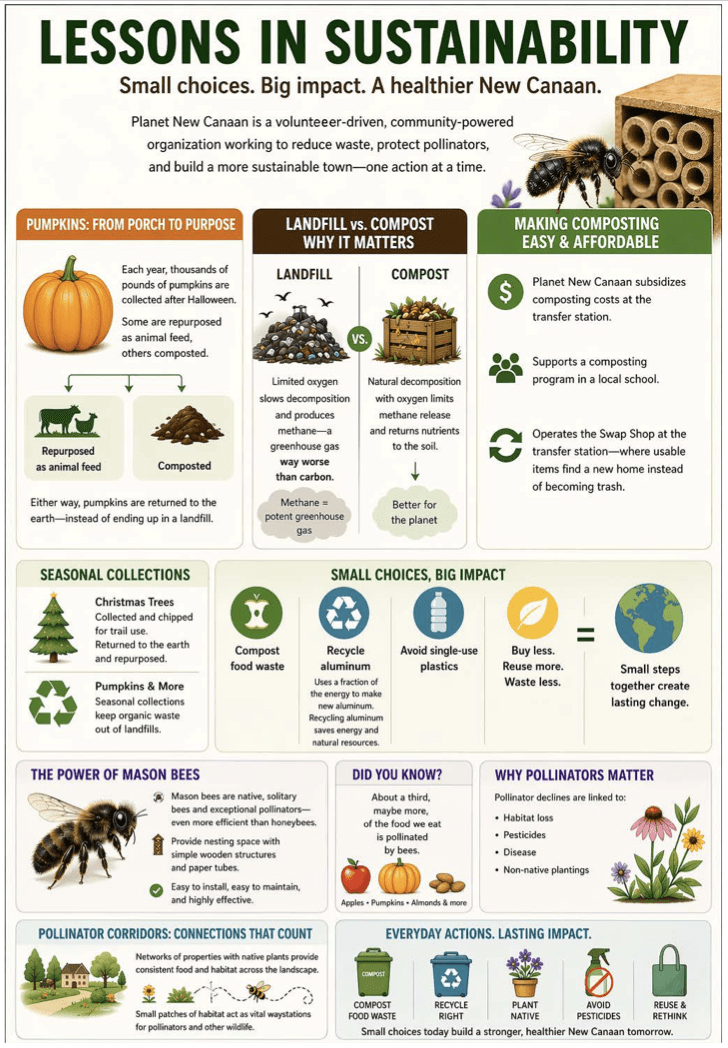
One initiative begins just after Hallowe’en, when discarded pumpkins accumulate across town. “Last year I think it was 15,000 pounds of pumpkins,” that were collected, Kriz said.
Some are repurposed as animal feed, others composted. Left alone, he noted, they would likely end up buried in a landfill.
That distinction is important. Modern landfills, he explained, operate with limited oxygen, slowing decomposition and producing methane, a greenhouse gas he described as “way worse than carbon.”
Organic waste, when buried, does not break down efficiently. Composting, by contrast, allows natural decomposition while limiting methane release.
To encourage that shift, Planet New Canaan subsidizes composting costs at the transfer station. “The difference between dumping it and composting it is paid for by Planet New Canaan,” Kriz said, describing a system designed to remove financial barriers for the town and encourage composting.
The organization also supports a composting program in a local school, and operates the Swap Shop at the transfer station, where residents can bring still-useful, but no longer needed, items for others to reuse, rather than discard them.
Christmas trees, once seasonal decorations, are collected and chipped for trail use. “Returned to the earth,” Kriz said, describing a process that reduces waste while improving trail conditions.
Much of the work is incremental. Kriz emphasized that small changes—separating and composting food waste, recycling aluminum, avoiding single-use plastics—can have cumulative impact. Aluminum recycling, he noted, requires a fraction of the energy used to produce new material. “You really, really, really want to recycle aluminum,” he said.
The conversation shifted from waste to pollination, and the wooden box on the table became relevant. Inside were paper tubes designed as breeding chambers for mason bees, a native species distinct from the more familiar honeybee.
“Mason bees are native bees and mason bees are really good at pollination, way better than honeybees,” Kriz said.
Unlike honeybees, which live in large colonies, mason bees are solitary and travel shorter distances. Providing nesting space—simple wooden structures with replaceable tubes in which eggs are laid and young bees grow — can support local populations.
“Build it and they will come,” Kriz said.
The appeal of the system lies in its simplicity. A homeowner can install a small structure, replace the tubes annually, and leave the rest to the bees. Kriz described it as a low-effort way to contribute to local ecosystems.
The broader concern is not theoretical. Pollinators play a central role in food production. “About a third, maybe more, is pollinated by bees,” he said, referencing crops such as apples, pumpkins and almonds.
Declines in pollinator populations have been linked to habitat loss, pesticide use and disease. Kriz pointed to common landscaping practices—chemical sprays, non-native plantings—as contributing factors. Native plants, he said, offer more reliable food and habitat for local species.
He also described the concept of pollinator corridors: networks of properties that provide consistent resources across a landscape. Without them, insects and birds face gaps that limit survival. “They don’t want to fly somewhere and have to say… ‘Hey, I can’t find a gas station,’” he said.
The analogy, delivered with a measure of humor, underscored a practical point. Small patches of habitat, even in residential settings, can serve as vital pollinator waystations.
By the end of the session, the discussion had returned to ordinary routines: separating waste, planting native species, reconsidering what is discarded. The solutions described were not large-scale infrastructure projects but adjustments to daily habits.
Planet New Canaan, Kriz noted, operates without a formal office. Its work depends on volunteers and community participation. “It’s all volunteer driven,” he said.
The approach is cumulative rather than immediate. A compost bin here, a bee house there, a decision to recycle rather than discard. None is transformative on its own.
Together, however, they form a system that, like the bees Kriz described, depends on many small actions carried out consistently over time.