By John Kriz
What happens after you flush?
Whether you’re on the town’s sewer line or have a septic system, it all ends up at New Canaan’s Waste Water Treatment Plant.
Situated on the Fivemile River by the Transfer Station, the plant was built in the 1960s, with a major upgrade in 1999. Prior to that there were sand filters on the site. According to plant superintendent Nick Colabella, the waste water “went on a big open field full of sand, and the water would sink through and the paper and debris would stay on the top.” That debris would later be scraped off and burned in the incinerators that used to operate at the Transfer Station.
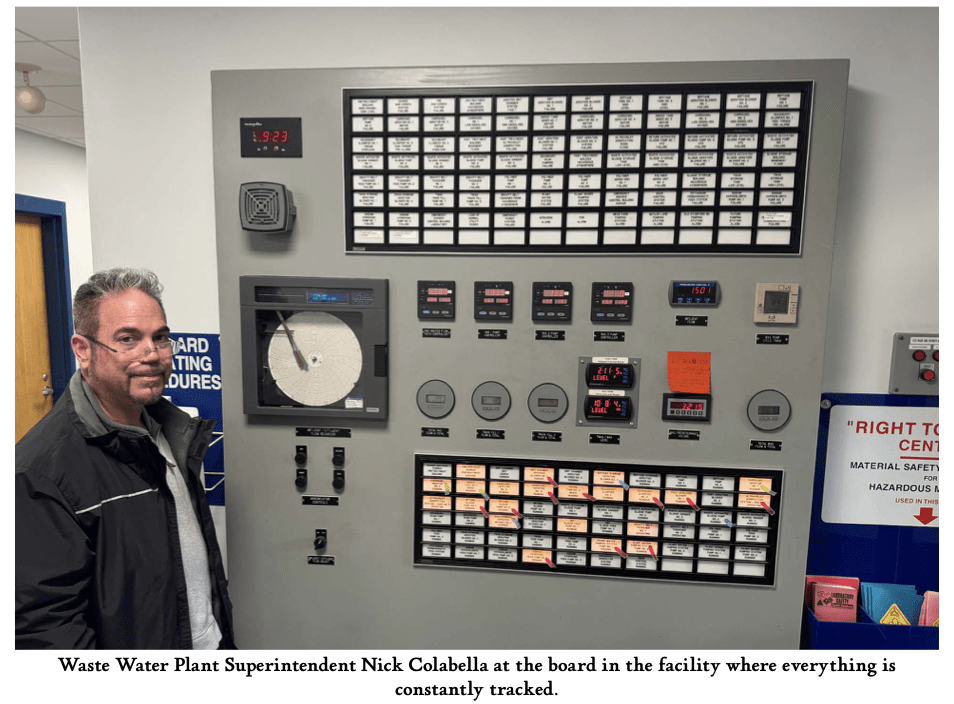
Today it’s all different, with a modern facility capable of processing several hundred thousand gallons of waste water a day – every day.
Why is this important? Because waste water never stops. Toilets, dishwashers, sinks, washing machines, tubs, showers all pour into the system 24/7/365. And all that influent needs to be processed, the water cleansed, and the solids disposed of.
(Those with septic systems periodically have their tanks pumped out, and the ‘honey wagon’ dumps the contents at the plant for processing.)
Sewer Types
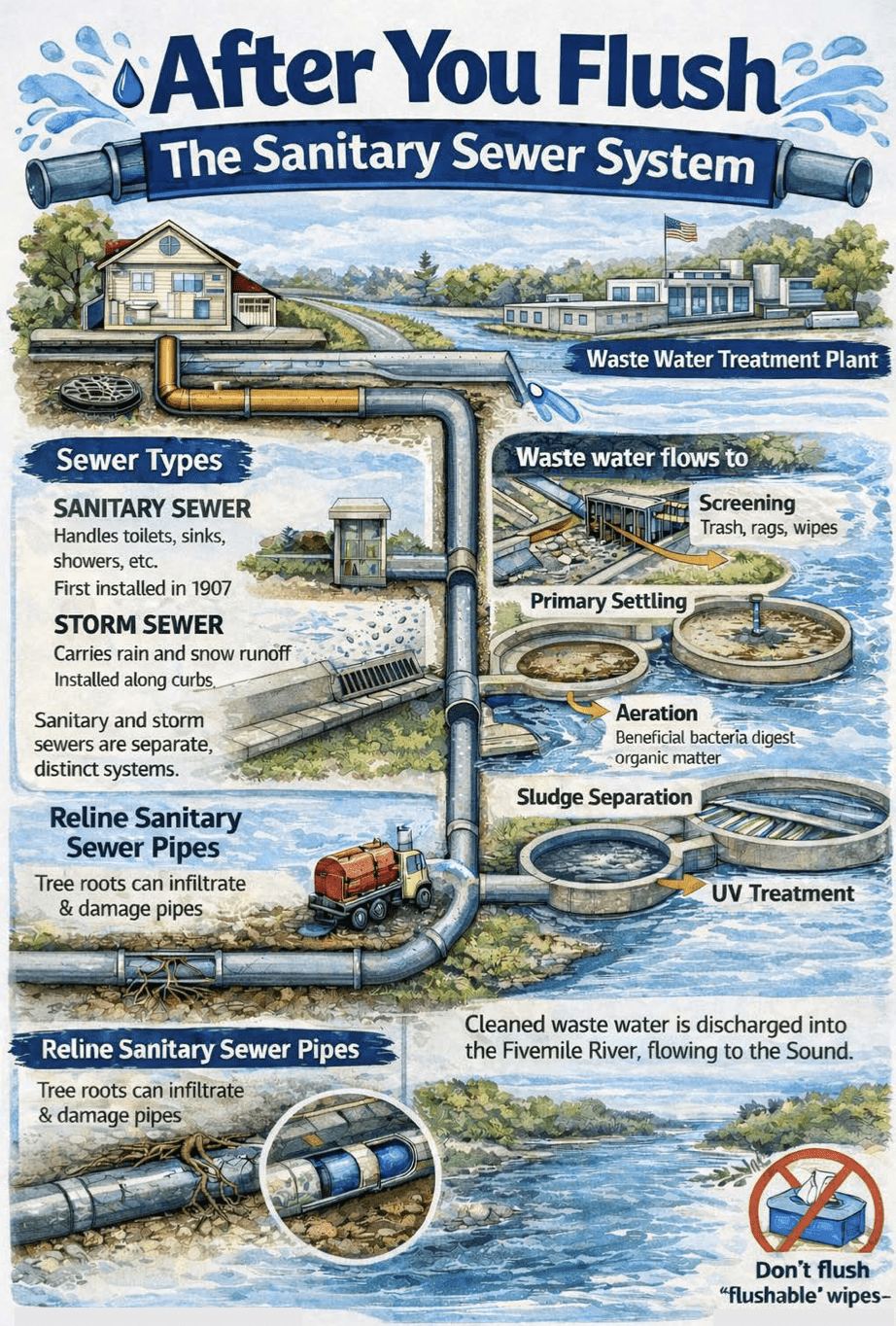
According to town engineer Maria Coplit P.E., New Canaan has two types of sewer: 1) Sanitary Sewer (which is where things go when you flush, the first pipes having been installed in 1907) and 2) Storm Sewer, which handles run-off from rain and snowmelt. In total, there are 900+ manholes in the sanitary sewer system, and 30+ miles of pipes, this system covering only the more central sections of New Canaan.
New Canaan has both systems, and they are distinct systems. In some older cities, the two are tied together, which creates volume challenges for processing the water – assuming it gets processed.
You generally find storm sewer openings along the curbs in streets, whereas sanitary sewers tend to run under the center of streets, with houses and businesses (‘laterals’ in sewer-speak) tapping into those sewer lines.
The water from storm sewers flows into streams, ponds and wetlands, much of it eventually reaching Long Island Sound. Water in storm sewers is not treated, even though it does contain some pollutants, such as animal feces, fertilizers, pesticides, and dripped oils from vehicles.
The idea, says Ms. Coplit, whose office is responsible for storm water management, is to try to mimic natural, pre-development conditions. Rain still fell and snow still melted hundreds of years ago, and went somewhere: ponds, streams, swales and wetlands. New Canaan has six watersheds, the Fivemile River being the most important. Though much earth has been moved around in New Canaan since then, the town’s stormwater management system still utilizes all those endpoints (plus some more modern tools) to absorb or manage runoff, with the goal that properties should be designed so as to absorb water on site, and avoid the storm sewer system.
Intense Storms
One of the challenges the town faces in managing water runoff is more intense storms, with the volume of water sometimes infiltrating the sanitary sewer system. This creates problems.
Faced with this challenge, a few years ago the town began an analysis of the best ways to manage it.
One tool is replacing sanitary sewer system perforated manhole covers (of which there are many) with ones without perforations to help keep all that heavy rain runoff from infiltrating the sanitary system. This challenge is exacerbated when the storm sewer gets overwhelmed, and there is ‘ponding’ in streets.
Ms. Coplit notes that some venting is needed in the sanitary sewer system, with methane being one of the gases the sanitary sewer system produces. However, that venting is concentrated at high points in the system, where gasses accumulate, so perforated manhole covers will still be found there.
Not all manholes are part of the sanitary sewer system. Some are part of the stormwater sewer system and some are for utilities, such as electricity.
Relining Sanitary Sewer Pipes
The joints connecting lengths of sanitary sewer pipe can attract tree roots, which slowly infiltrate the pipes, causing cracks, leakage, groundwater infiltration and obstructions – obstructions that get exacerbated by sticks, paper and those ‘flushable wipes’ that get caught by the roots.
“The sanitary system is food for trees,” notes Tiger Mann, Director of Public Works.
Furthermore, it’s much more likely that tree roots will be a problem for homeowners because the town’s pipes run under streets, far from trees, observes Ms. Coplit. The sewer pipe from a house to the street coupling is the homeowner’s responsibility, and those pipes tend to be near, if not under, trees.
Homeowners might consider periodic inspections, and cleaning, of their sewer connections to reduce the possibility of clogs. Once a clog takes hold, it tends to get worse and worse. No one wants toilet back-ups.
For the town, a solution to roots, age and heavy storms is to reline the sewer pipes.
“The relining gives better integrity to the interior of the pipe,” notes Ms. Coplit, extending its lifetime. Any roots that found their way in get eliminated. Fluid flows more easily, which helps prevent solids from settling and causing obstructions, and the relining strengthens the pipe and seals those root-attracting joints.
But even with relined pipes, ‘flushable’ wipes and other debris can still get caught in manhole shoulders and pump stations, impairing system efficiency and boosting costs to clean the debris out. Best not to flush them. The same goes for feminine products.
Water Types
Think potable (drinkable) water, grey water and black water.
Potable water is straightforward enough. It’s either naturally clean – such as much water from wells or reservoirs — or has been sanitized. Grey water is waste water from, say, a shower. It can be used for washing a car or flushing a toilet. Black water is what comes from a flushed toilet, and it needs to be processed. Some green buildings have grey water systems that route water from showers and roofs into toilet flushing and other uses to reduce water waste and pressure on waste water treatment plants.
Water from sump pumps should not flow into the sanitary or storm sewer systems. Ms. Coplit recommends flows be directed to landscaped areas. Water from swimming pools can be discharged into the storm sewer at the end of the season, provided that chlorine levels are below a specific minimum.
 WPCA
WPCA
The Water Pollution Control Authority (WPCA) is the town body that, per its website, “may establish and revise rules and regulations as allowed by §7-247 of the Connecticut General Statutes, including without limitation rules and regulations for the supervision, management, control, operation and use of sewerage systems in the Town of New Canaan.”
The town’s Board of Finance has been designated as the WPCA. In effect, the two are comprised of the same people, but they have different powers depending on whether they are seated as the Board of Finance or the WPCA. The WPCA also sets sewer use fees for those houses and businesses connected to the sanitary sewer, as well as septic dump fees.
The fees received are kept in a distinct fund, and used to finance the sanitary sewer system and waste water treatment plant to make them self-sustaining.
Processing Waste Water
The Waste Water Treatment Plant’s intake is from a big pipe that runs under Main Street – the final collector. Most of the sanitary (and storm) sewer system is gravity-driven, though there are three pump stations for the sanitary sewer. Why gravity? It’s proven technology, works 24/7/365 and is free.
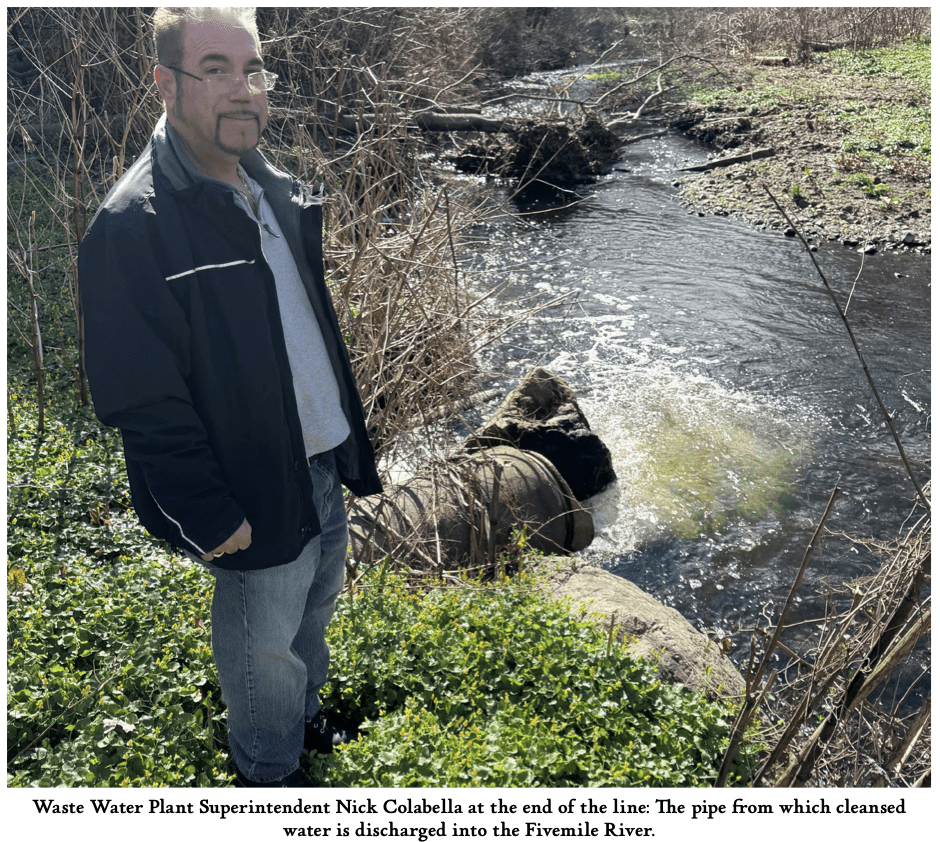
It takes about 16-20 days for the plant to process influent, with the treated water flowing into the Fivemile River. Its source is near the New York State line, and it empties into Long Island Sound in Rowayton.
As noted in New Canaan’s Plan of Conservation & Development, “Fivemile River is the only impaired waterbody within the Town. The Department of Energy and Environmental Protection (DEEP) first classified the Fivemile River as impaired in 2010, and it remains so today due to its inability to support aquatic life and recreational uses. According to DEEP, the water quality impairment is most likely due to stormwater runoff and nonpoint source pollution sources, such as farms, golf courses, and residential yards (fertilizers).”
Processing influent takes longer in the winter because the microscopic bugs that naturally flock to the influent and help breakdown and eat the organic matter and chemicals are less active when it’s cold. In addition, very high temperatures reduce dissolved oxygen in the waste water, which also impairs the bugs.
Testing of water discharged into the Fivemile River is continuous. “We have to test for these things every day: Nitrogen, ammonia, phosphorus, zinc — they’re all tested on a daily basis,” says Mr. Colabella. Any violation of state or federal standards results in a fine, with the fines continuing until the problem has been fixed. He further notes that “we’ve never been fined by the state.” Some fines can run to $25,000/day, and even include jail time. In addition, the plant has received several awards from the Environmental Protection Agency over the years.
Mr. Colabella also remarks that, “four times a year we do toxicity testing where we test the metals and basically everything in the waste water.” The plant has its own on-site lab.
A waste water treatment plant’s health record affects the likelihood of obtaining state or federal grants for new equipment and upgrades. Says Ms. Coplit, “we’re proud of our clean record, and want to maintain our clean record in order to be able to make ourselves available” for funding opportunities.
The plant’s operating permit from the state lasts only five years, and the current permit expires in June. The renewal application has been submitted, and awaits state approval. The renewal could result in new mandates regarding mitigation of additional elements in the water, or tighter standards for mitigation of elements currently required.
All plant workers must be trained and certified to work there. Mr. Colabella has the highest level of certification.
As well, all of the plant’s systems have back-ups. It’s a bit like NASA: Failure is not an option.
Once the influent enters the plant, the first step is to screen out things like sticks, rocks and hair, which are mixed with municipal waste and shipped out. This leaves small particles, waterborne chemicals such as soap residue, and human waste in the influent.
A chemical is added to the influent to control its pH so that it maintains a proper acidic/alkaline level.
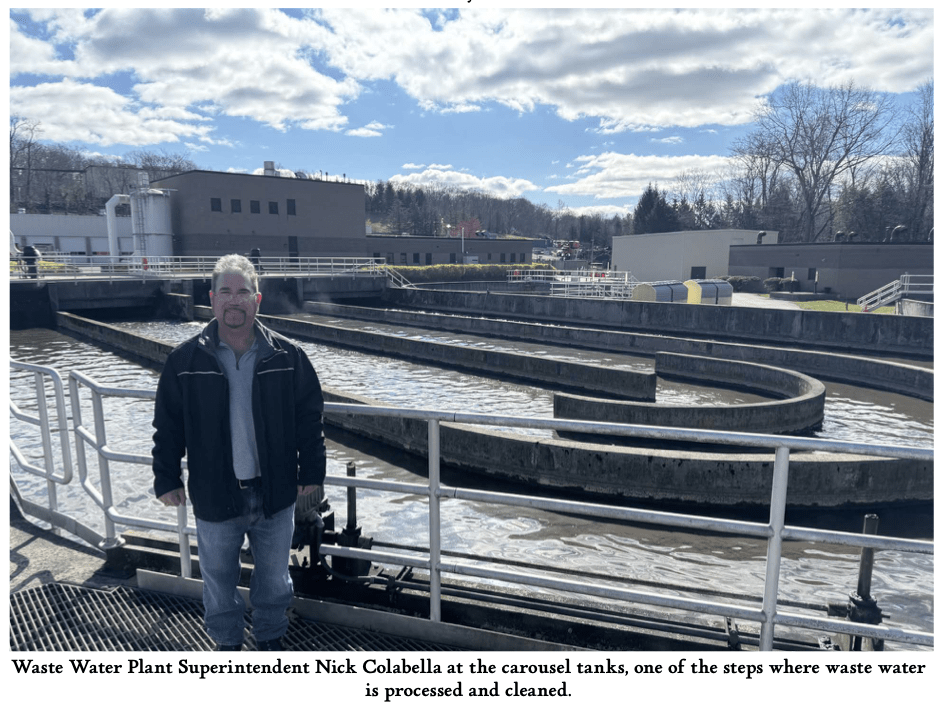
In the next step the influent flows into carousel tanks – shaped like a winding river – which aerate the liquid “like an egg beater,” says Mr. Colabella. This helps keep the bugs alive and active. Round and round the influent flows, letting the bugs do their thing: consuming and breaking down the organic matter. This process maintains a proper oxygen level in the influent, and helps convert ammonia in the influent to nitrogen.
The influent then goes into an air-free chamber, where the bugs consume the oxygen in the influent, converting it to nitrogen gas, which is vented into the atmosphere. Ammonia, which is generated by the organic waste, is also converted into nitrogen gas here, and vented. Another chemical is added to take the phosphorus out. (Ammonia in water kills fish. Nitrogen and phosphorus create algae blooms. When the algae dies it sucks the oxygen out of the water, killing fish.)
The influent then goes into round clarifier tanks that are gently stirred. Each clarifier tank is really two tanks, with a smaller, round one in the center, the coagulated solid matter – sludge – falls to the bottom and is pumped out, thickened, separated and shipped out for processing into such things as Milorganite fertilizer. With the constant addition of more influent, the clearer water on top spills over the edge of the smaller, central tank into the bigger tank in which it sits, and the process repeats, with the even clearer water, in turn, spilling over the edge of the larger tank. It is then transferred to the last step.
That last step is ultra-violet (UV) treatment as a final polishing. The clear, cleansed water is then discharged into the Fivemile River.
“That [UV treatment] is done to such a high level because of the Fivemile, because we are the receiving waters so that we don’t impact any of the ecosystems that are immediately downstream of us, or furthermore into the Sound,” says Ms. Coplit. “So at that point, while I’m not going to put a cup out there and drink it, it is safe for the environment. It’s safe for the ecosystem.” Mr. Mann says, “we don’t consider [processed water from the water treatment plant discharged into the Fivemile River] potable, but it’s beyond grey.”
The UV system, while fully functional, is 20+ years old, and is in process of being replaced and modernized.
And that’s it!
Concludes Mr. Mann, “I think it’s a good thing that nobody knows — in essence that everyone just kind of flushes the toilet and it goes away and no one hears about it. It almost means that we’re doing our job.”
What Can’t Be Removed
Despite best efforts, some things in waste water cannot be removed, given current technology. What are they?
One such example is PFAS (Per- and polyfluoroalkyl substances) – so-called ‘Forever Chemicals.’ According to the EPA:
• PFAS are widely used, long lasting chemicals, components of which break down very slowly over time.
• Because of their widespread use and their persistence in the environment, many PFAS are found in the blood of people and animals all over the world and are present at low levels in a variety of food products and in the environment.
• Scientific studies have shown that exposure to some PFAS in the environment may be linked to harmful health effects in humans and animals.
But PFAS are not the only waste water health challenge. Pharmaceuticals – excreted by humans, or pills flushed down a toilet or put into the trash and then landfills, later leaching into ground water – are an EPA concern, too.
The EPA says that “while POTWs [publicly owned treatment works] may remove some pharmaceuticals incidentally, many pass through and enter the environment because POTWs are not designed to remove pharmaceuticals. While some POTWs may have implemented advanced treatment technologies, even these technologies are not specifically designed to remove pharmaceuticals.”
In early April Health & Human Services Secretary Kennedy issued a draft rule to include pharmaceuticals, PFAS, microplastics and several other items on its Contaminant Candidate List, which “drives research, funding, and future decisions on regulating emerging threats in public water systems.”
Mr. Colabella says that “I’ve reached out to a few different plants and nobody is testing for pharmaceuticals at the moment, but it can always be an up and coming thing. They’re changing limits all the time.” Mr. Mann adds, “there are certain things that we cannot remove,” citing pharmaceuticals and PFAS. Ms. Coplit comments that, “if there is some technology in the future that comes out that can help remove some of these forever chemicals, it can’t be at a zero. We’re never going to be at a zero, but so what is the acceptable threshold? And that will have to be guidance that’s given to us.”
Safety Tips
• Don’t put ‘flushable’ wipes or feminine products down the toilet. They can clog sewer pipes, including leach fields in septic systems. And pipes include the sewer pipe from your house to the main sewer line. Maintaining that is the homeowner’s responsibility, and repairing or replacing it is an expensive hassle. As well, two words you never want to hear in the same sentence are ‘Septic Problem.’ Be sure to use toilet paper marked ‘Septic Safe’ if you have a septic system.
• Do not dispose of pharmaceuticals down the toilet, or put them in the trash, as they can cause environmental damage. As noted, pharmaceuticals are difficult, if not impossible, to remove from waste water given current technology, and pharmaceuticals in landfills eventually leach into ground water. There is a free, no questions asked, 24/7/365 drug disposal box at the police station.
• Do not dump waste into storm sewers. That water is not treated, and goes into streams, wetlands and Long Island Sound.
• Take caution on the fertilizers, pesticides, herbicides and fungicides you use on your property, because they will run off and enter water systems.
• If you live near a storm sewer, be a good citizen and keep it clear of debris. Clogged intakes result in flooding.
• Most all of the influent at the treatment plant is water. So running your water needlessly – wasting water – not only costs you, but puts more pressure on the plant. Conserve. Don’t assume the aquifer feeding your well is infinite.