By John Engel
When my wife and I bought our first house on South Avenue, we paid $230,000 for a small antique on a quarter-acre lot. Behind the detached one-car garage was a patch of overgrown scrub: weeds, brush, vines, volunteer trees, the kind of neglected little corner every first-time homeowner inherits and quietly hopes no one notices.
My father-in-law from North Carolina noticed.
He did the math in his head and said, “That mess back there cost you more than $10,000. You need to clean it up.”
He was right. That is the instinct of every homeowner, every farmer, every developer, every zoning board, and every real estate person I know. We look at land and ask what it is doing. If it looks like it is doing nothing, we call it waste. Then we reach for the mower, the chainsaw, the site plan, or the zoning rewrite.
Much of the time, we are right.
Neglect is not character. Rot is not history. A collapsing building is not automatically charming because it is old. Every town has places that need attention, money, paint, drainage, landscaping, and imagination. I am not against cleaning things up. Quite the opposite. A lot of my work is helping people see what a property could become once the mess is removed.
But the older I get, the more suspicious I become of the phrase.
Because sometimes the thing we call “scruffy” is not useless. Sometimes it is just useful in a way that does not photograph well.
I thought about this recently when I picked up a dock float from Gary Wetmore at his boatyard on Water Street in South Norwalk. Gary is 67. He was a lobsterman before that business declined and pushed him out about 25 years ago. He reinvented himself building and repairing docks, the kind of practical marine work that waterfront communities absolutely depend on and rarely celebrate. Today, he works with his son. He is still an owner-operator, still fixing the things that hold the waterfront together.
Now Gary has to leave.
The Water Street property is making way for Spinnaker Real Estate Partners’ approved redevelopment at 108 Water Street: 59 apartments, a 130-room hotel, restaurant, office space, parking, boat slips, and a public boardwalk along Norwalk Harbor.
There is a lot to like in that sentence. More housing. More public access to the water. A restaurant. A boardwalk. A more polished edge to the harbor. This is not a cartoon-villain development story. South Norwalk is changing, and much of that change has been good.
But still, something useful is being pushed out.
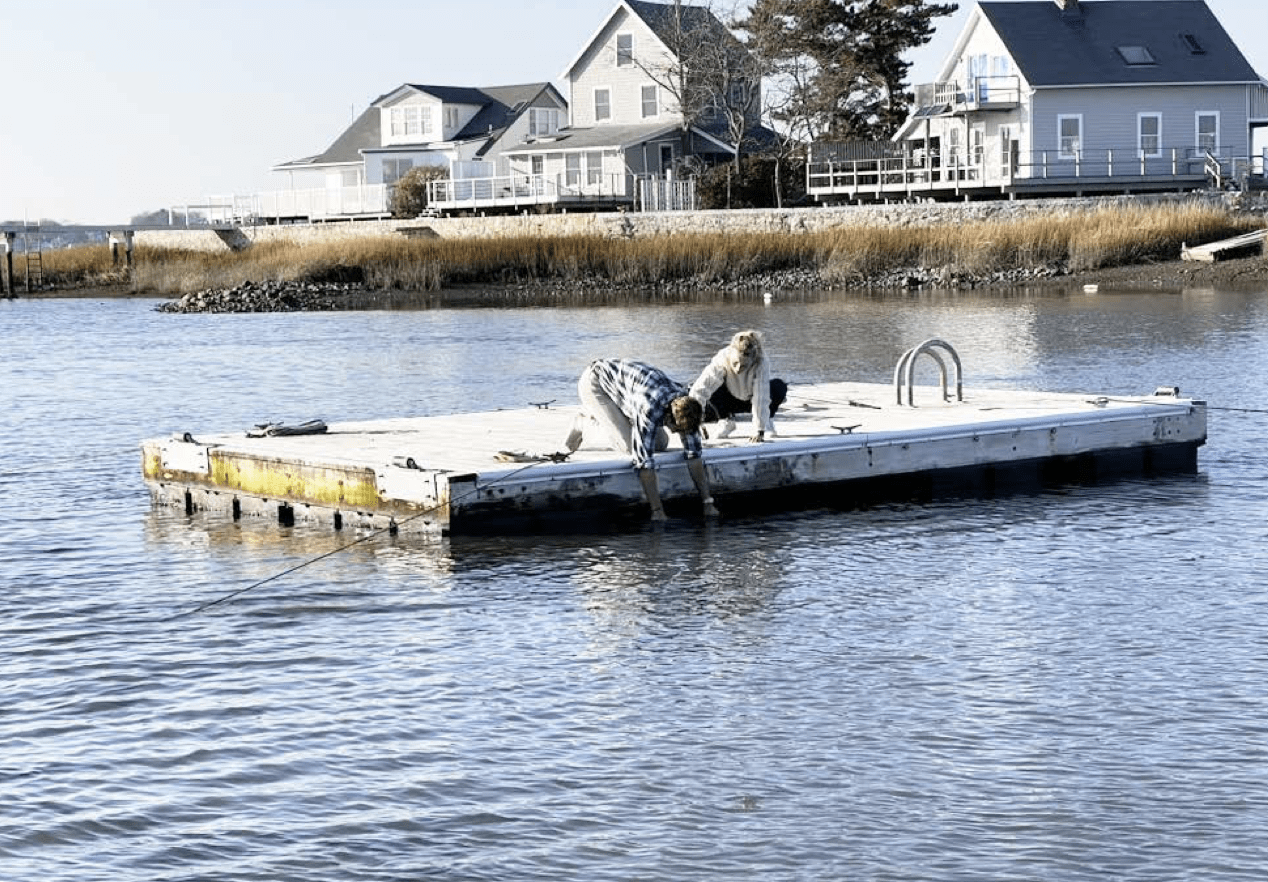
Gary is looking for space upriver, where the yachts will not go. That line says almost everything. The working waterfront is retreating so the recreational waterfront can enjoy the view.
The irony is hard to miss. The waterfront has become too valuable for the people who maintain the waterfront.
A dock is not romantic until you are sitting on one at sunset. A piling is not interesting until shipworms and gribbles start chewing through it at the waterline. A marine repair yard is not charming next to a hotel rendering. But if no one is left nearby who knows how to repair the docks, replace the floats, drive the pilings, and keep the harbor functioning, then the beautiful new waterfront becomes a stage set without a backstage.
That same tension exists in New Canaan, even without the harbor.
Cross and Vitti Streets have always been the less polished side of town, which is another way of saying they are useful. They are where the body shop lives, where the deli lives, where the limousine business lives, where practical businesses like shoe repair and surveying make a town work. Santo and Lynda are not abstractions in a zoning document. Lynda runs the limousine business. Santo is the unofficial mayor of Cross and Vitti, crossing the street 50 times a day to check on his businesses. They are reminders that every functioning town depends on the practical businesses that keep daily life moving.
People are both afraid and excited about what may come next on that side of town. That is understandable. Change brings value. It also brings loss. New Canaan is reviewing its commercial zoning, and the broader trend is obvious: light industrial uses, repair shops, service businesses, and the practical concerns that keep town life moving are under pressure everywhere. Shoe repair gives way to something cleaner. Car repair gives way to something quieter. Lawn mower repair disappears because the land under it is worth more than the work being done on it.
Again, not all of that is bad. Some places really do need a facelift.
That is why Pine Street matters. Fred Afragola and Tom Burger are restoring two more old brick industrial buildings there, not pretending they never existed. That is a different kind of cleaning up. It respects the bones. It improves the place without erasing its memory. It says the past may need paint, windows, investment, and a new use, but it was not a mistake.
That distinction matters.
There is cleaning up that restores and cleaning up that evicts.
In real estate, we are trained to talk about “highest and best use.” It is a useful concept, but a dangerous one if applied without humility. From a spreadsheet, the answer is often obvious. From the ground, it is more complicated. What looks inefficient may be doing work no one has bothered to measure.
I have been wrong about this since childhood.
When I was about 12, I used to trace my finger along the Gold Coast and stop at Bridgeport. I could not understand it. Here was the last underpriced waterfront in Connecticut. Sooner or later, I announced to my mother, Bridgeport had to turn around.
My mother, who knew more than I did, said that even though I was only 12 and had plenty of time to wait, I might still find myself waiting a few more generations.
She was right. I’m still waiting. Land does not obey our logic just because we can see it on a map.
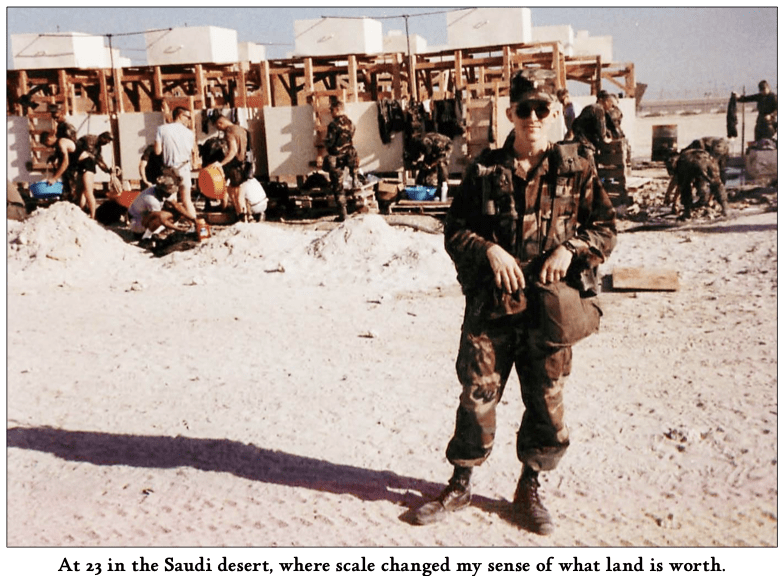
At 23, I spent six months living in a small tent in the Saudi Arabian desert, 400 miles from the Persian Gulf. We drove inland on the Tapline Road, one lane in each direction, straight across an emptiness so large it made the American desert feel almost intimate. Five hundred thousand troops were sent to the Saudi border and told, in effect, to drive a few hundred miles, turn into the raw desert, spread out, and wait.
The desert swallowed us. Five hundred thousand troops could spread across that landscape and still disappear into it.
You could look in every direction and see nothing but flat sand. Units were spaced so far apart they could not see one another. After that, Fairfield County’s habit of assigning destiny to every quarter-acre lot begins to look a little provincial.
That does not mean land here is not scarce. It is. Scarcity is real. Zoning matters. Housing matters. Public access matters. Restoration matters. So does economic growth.
But perspective matters, too.
Years later, when I was choosing a college, my mother gave me another piece of advice. “You need to get out of this area,” she told me. “The whole world is not like this area. It’s on a different scale, with different values, moving at a different pace. Go get some perspective.”
She was right about that, too.
Around here, we are very good at seeing value. We see the quarter-acre. The waterfront parcel. The underused industrial street. The old brick building. The scruffy corner behind the garage. We see what could be cleaned up.
The harder discipline is seeing what is already there.
Before we clean up a place, we should ask what purpose it already serves.
John Engel is a broker with The Engel Team at Douglas Elliman and is still trying to tell the difference between cleaning something up and understanding what it was doing there in the first place.