Last week, under the leadership of First Selectman Dionna Carlson, the town of New Canaan submitted an elaborate 300-page application for a Certificate of Affordable Housing Completion/Moratorium to Seila Mosquera-Bruno at the Connecticut Department of Housing (DOH). This submission is a significant step in New Canaan’s strategy to comply with the challenges of Connecticut’s 8-30g affordable housing statute.
The application aims to secure a moratorium, a critical element in Connecticut’s housing policy, which would offer New Canaan temporary relief from 8-30g’s requirements. This statute necessitates the development of affordable housing in towns with less than 10% affordable housing stock and allows developers to override local zoning laws to provide low- and moderate-income housing.
A public hearing, integral to the application process, was held on January 24. First Selectman Carlson remarked on the necessity of the hearing, triggered by a resident obtaining 25 community signatures concerning the application. During the hearing, Town Planner Sarah Carey reviewed New Canaan’s journey since the first moratorium and the changes since the 2022 application for a second moratorium. The hearing, attended by few residents, also included questions from the Planning and Development Committee.
The application presently under consideration includes only housing units certified for occupancy after New Canaan’s last moratorium was granted by the DOH. Town Attorney Nick Bamonte, representing Bercham Moses, P.C., outlined the next stages of the moratorium process, expressing confidence in the application’s compliance with the DOH’s current legal interpretation.
Having submitted the finalized application with public feedback from the hearing, New Canaan awaits the DOH’s response. The department has approximately 1-2 weeks to acknowledge receipt of a complete application, followed by a 90-day period to make a decision on the moratorium request, a waiting period that has now commenced following last week’s submission.
New Canaan’s initial attempt at securing its second moratorium in October 2022 was rejected by the DOH, based on a new interpretation disqualifying units built prior to the last moratorium. This decision contradicted previous understandings and was a departure from the approval of similar applications from other towns.
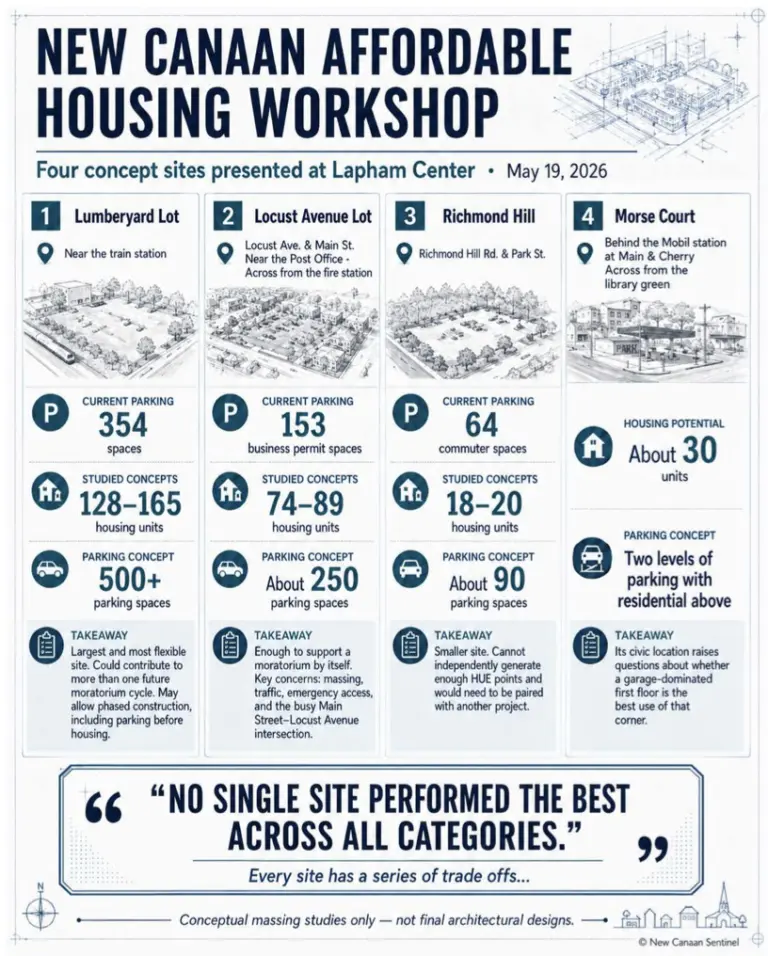
The town is currently in litigation with the state over this revised interpretation, hoping for a legal resolution that would allow “front loaded” affordable units and their HUE points, not counted in previous moratoria, to be considered in future applications. Bamonte mentioned that a decision on the moratorium is anticipated before the litigation concludes, with final briefs due by May 17 and oral arguments expected about a month later. Should New Canaan prevail in court and “front loaded” units become eligible for subsequent applications, the town would need only an estimated 20-25 additional HUE points to apply for a third moratorium.
This new interpretation by the DOH may lead to a more cautious approach in developing affordable housing, as towns might build only to the extent necessary for achieving the next moratorium, potentially leading to less strategic use of land resources. New Canaan, having already submitted its moratorium application, now waits for the DOH’s decision, expected by the end of April after the ongoing 90-day review period.
The town’s persistent effort for a moratorium underscores its commitment to meeting state housing standards, albeit facing challenges, especially in calculating Housing Unit Equivalency (HUE) points, crucial for moratorium eligibility. These points, determined by a formula considering the type of housing units and their affordability, have been central to New Canaan’s application. However, the town’s prior application faced a setback due to the DOH’s policy change on the utilization of HUE points from earlier projects.
The inconsistency in the state’s policy and its implications for affordable housing development have been highlighted by Scott Hobbs, Chairman of the town’s Housing Authority. He emphasized the complex impact of the 8-30g rule on New Canaan’s housing efforts and the challenges it presents in addressing diverse housing needs. Hobbs argued that the one-size-fits-all nature of the 8-30g rule might not be appropriate for every municipality, including New Canaan, and restricts the town’s ability to make independent housing decisions. His comments reflect the intricate and urgent housing issues in New Canaan, as the town navigates the constraints of the 8-30g rule while striving to maintain its distinct character.
Purpose of the Moratorium
The moratorium is intended to give towns a break from the stringent requirements of the 8-30g statute. It acknowledges that a town has made significant progress towards increasing its affordable housing stock and provides a period during which the town is not subject to the usual 8-30g rules that allow developers to override local zoning laws.
Criteria for Qualification
To qualify for a moratorium, a town must demonstrate that it has added a sufficient number of affordable housing units. This is measured in Housing Unit Equivalency (HUE) points. The required number of HUE points is typically 2% of the total housing units in the municipality or 75 points, whichever is greater. The points are calculated based on a formula that considers factors like the type of housing units and their level of affordability.
Duration of the Moratorium
Once granted, the moratorium typically lasts for four years. During this period, the town is exempt from the provisions of the 8-30g statute, meaning that developers cannot override local zoning regulations based on the statute’s criteria. Some towns that have achieved a second moratorium can extend this period for an additional five years.
Expectations During the Moratorium
Even though a town is exempt from the 8-30g rules during the moratorium, it is expected to continue developing affordable housing strategies.
Impact on Local Zoning Control
The moratorium restores greater control to the town over its local zoning decisions. Without the pressure of 8-30g, towns have more say in the approval or denial of housing developments, allowing them to plan and execute housing projects in alignment with their specific needs and goals.
Application and Public Involvement
Applying for a moratorium involves a detailed process, including public notice and hearings. The application must be thoroughly documented and demonstrate compliance with the 8-30g criteria for affordable housing development.
Statewide Issue
According to a 11/9/23 DOH report on the state website, only 12 towns in CT have ever received a moratorium and six of those have been granted more than one moratorium. Currently, only South Windsor and Brookfield have an active moratorium in place.