New Canaan parents were urged to talk with their children earlier and more directly about online safety during a Rowan Center-led panel that warned children are encountering explicit images, sextortion, pornography, social-media pressure, gaming risks and AI companions at younger ages.
The May 11 discussion, “Raising Kids in a Digital World,” was held at New Canaan Library’s Bartlett Auditorium and focused on digital safety, ethical technology and the growing impact of artificial intelligence on children and families. The event was presented in partnership with the New Canaan Community Foundation, New Canaan CARES, the New Canaan Police Department and New Canaan Public Schools.
The program also connected to Mental Health Awareness Month. According to the Substance Abuse and Mental Health Services Administration, Mental Health Awareness Month is recognized every May to increase awareness of the role mental health plays in overall health and well-being.
Cody Baird, chief operating officer at the Rowan Center, opened the discussion by saying the event was intended to give parents practical information before harm occurs.
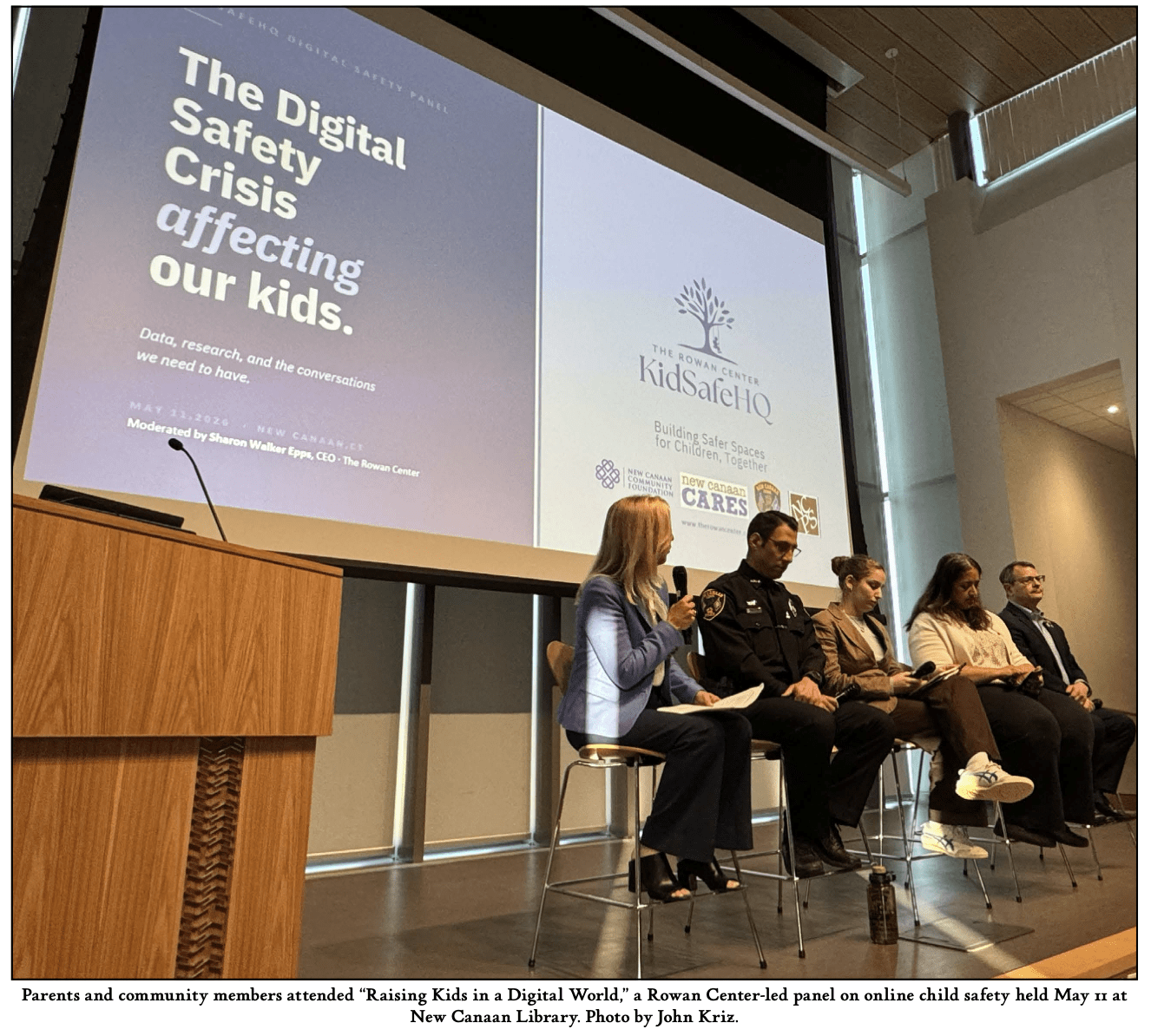
“The data is unambiguous and it’s urgent,” Baird said. “This is not something we can ignore and these are not abstract statistics. This is affecting children in this community and all of our communities.”
The Rowan Center also introduced KidSafeHQ [https://therowancenter.org/kidsafehq/], a digital platform for parents and caregivers. According to Rowan Center, KidSafeHQ provides expert tools to help parents prevent online exploitation, grooming and sexual abuse.
The panel’s central message was that technology is now part of childhood and adolescence, including in communities with strong schools, active parents and local resources.
Officer Matt Blank, a New Canaan police officer and school resource officer at Saxe Middle School, said the district’s phone-free policy has changed the school-day environment. Students are talking more in person, he said, but parents should not mistake school rules for complete protection.
“There is no bubble,” Blank said. “There’s no one way to protect your kids. It’s kind of everywhere all at one time.”
Dahlia Edidin Locke, policy and education manager at World Without Exploitation, said image-based sexual abuse and sextortion have become major risks for students. She described image-based sexual abuse as the weaponization of sexually explicit images to cause harm, including the use of real images, child sexual abuse material and AI-generated deepfakes.
Locke said sextortion can affect boys and girls differently. Girls may be pressured by peers or partners for more explicit images, she said, while boys are often targeted in financial sextortion schemes by people posing as girls online.
Locke also warned parents about pornography, saying children may first encounter explicit material through algorithms, pop-ups, pirated streaming sites, gaming chats and social media.
“They’re not your friend,” Locke said of pornography sites, according to the transcript. “They were never meant to be sex ed. They’re meant to be a business and to produce profit.”
Dr. Marc Potenza, the Steven M. Southwick Professor of Psychiatry and professor in the Child Study Center and of Neuroscience at Yale School of Medicine, urged parents to look beyond total screen time. Warning signs may include irritability, declining school performance, impaired social functioning, reduced control over use and an increasing priority placed on digital activity at the expense of other parts of life.
“Oftentimes it is difficult to see direct signs of problems with usage of social media,” Potenza said.
Potenza said digital activity can become concerning when it crowds out other activities, causes impairment in school or social life, or continues despite adverse consequences. He said young people also need help learning how to manage uncomfortable emotions without turning immediately to digital devices.
Vaishnavi J, founder and principal of VYS, a child-safety product advisory firm, said children and teenagers do not always experience online harm in the ways adults expect. Adults may focus on violent language in gaming chats, she said, while young people may be more hurt by exclusion from a group activity or online social circle.
She said AI companions present a newer challenge because children and teens may use them for social, romantic or emotional role-playing. She said many young people are curious about AI tools but also skeptical of them.
Vaishnavi said teens she has worked with were interested in tools such as an AI tutor, but more uncomfortable with the idea of an AI friend or romantic partner. She said some young people worry that AI tools may collect personal information and then use it in ways that increase emotional dependence.
Panelists said parental controls have limits because platforms change, settings vary by product, and children often find ways around barriers. They urged parents to combine settings with ongoing conversation.
“I never like to outsource any one thing to anyone else if it’s my child,” Blank said, according to the transcript.
New Canaan school officials at the event said the district teaches digital citizenship and digital learning from the younger grades through 12th gradet. Melinda Meyer, director of innovation and technology for New Canaan Public Schools, said the district has digital citizenship and digital learning programs that continue through high school. Susan Bliss of New Canaan Public Schools said the district has a health curriculum that addresses healthy relationships, boundaries and digital citizenship.
The event ended with comments from two sponsoring organizations.
Colleen Prostor, executive director of New Canaan CARES, said her organization was pleased to partner with the Rowan Center, New Canaan Police Department, New Canaan Public Schools and the New Canaan Community Foundation.
“We were so happy to partner with the Rowan Center, New Canaan Police Department, New Canaan Public Schools, and the New Canaan Community Foundation to bring this important conversation to our community,” Prostor said. “We are also happy that we are able to record it and share that recording with the greater New Canaan audience and look forward to further conversations on digital safety for our children in the future.”
Lauren Patterson, president and CEO of the New Canaan Community Foundation, said KidSafeHQ can help parents and children find information and guidance as technology continues to change.
“This resource that the Rowan Center and partners have developed is an invaluable resource for parents and for kids to interact with, to learn from, to help find information and guide them,” Patterson said.
Patterson said the panel addressed “a complex and ever-changing landscape,” and said community members had shown interest in learning how to navigate the issues.
Parents seeking more information can use KidSafeHQ, the Rowan Center’s online resource for guidance on online safety, sextortion, grooming, AI-related harms and related concerns. Families needing direct support can contact the Rowan Center’s 24/7 crisis helpline at (203) 329-2929, while anyone facing an immediate mental-health crisis can call or text 988. The National Center for Missing & Exploited Children also operates Take It Down, a service designed to help remove or stop the online sharing of sexually explicit images or videos involving minors.
KidSafeHQ: https://therowancenter.org/kidsafehq/